
Marylebone Theatre, London NW1 – until 7 June 2026
Reviewed by Phil Brown
4****
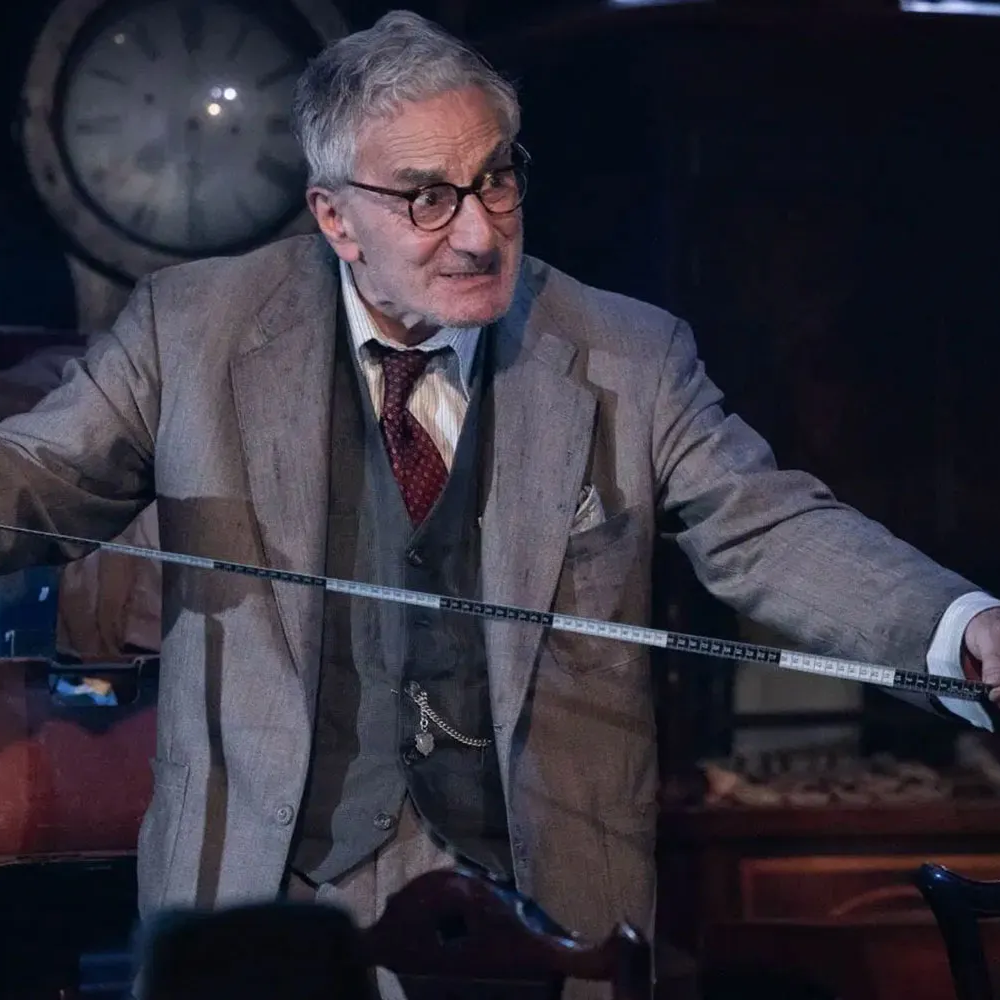
The Price is one of the great Arthur Miller’s mid career plays – originally started in the early 50s but not fully honed and completed until much later, premiering eventually in 1968 at Broadway’s Morosco Theatre, earning nominations for 2 Tony awards. It was his most successful play since 1949’s Death of a Salesman and this powerful and hugely impressive production shows why.
As befits a work so long in gestation, it positively gleams like a polished gemstone – the culmination of Miller’s preoccupation with the 1930’s depression and the far reaching impacts on US families and family members. It’s a masterpiece of composition – complex, multi-layered, acutely observed, rich in nuance and detail, immaculately constructed, paced with precision, and ferociously analytical of family dynamics. Miller’s command of authentic dialogue is sublime and the four actors bring it superbly to life over the course of 2+ hours of stellar performance. Everything about this production ( director – Jonathan Munby) is superb.
The action revolves around the Franz family – Victor (Elliot Cowan), his wife Esther (Faye Castelow), and Victor’s estranged and elusive older brother Walter (John Hopkins), and takes place in the cluttered New York attic, to which the family’s late patriarch retrenched having lost everything in the Wall Street crash of 1929, never working again.
The family is due to gather there and agree on the disposal of the attic contents some time after the father’s death. To which end, Gregory Solomon (Henry Goodman), an antiques dealer, is invited to quote (the price) for house clearance. It’s a meeting that will bring Victor and Walter together for the first time in 16 years and will naturally trigger a lot of memories.
In a play of two distinct halves, what begins as a relatively straightforward and amusing negotiation between Victor and Gregory in Act 1, inevitably fuels the latent resentment and simmering tensions which erupt between the brothers in Act 2. The true import of the play’s title becomes crystal clear – The Price is really about the price paid for their choices in life. And as the dialogue cleverly unpeels layer upon layer of concealed information, you realise that both brothers have paid dearly for their life choices despite superficial appearances.
Act 1 sees a world weary Victor the first to arrive in the attic crammed with a lifetime’s residue of furnishings and accessories including a full size harp. It’s a suitably atmospheric and beautifully constructed set (designer – Jon Bausor), very much symbolic of the psychological baggage the two brothers are carrying. Esther arrives next, full of frustration, indignant and desperate to be done with the sale so she and Victor can start to live, whilst Victor continues to dither about retirement from the police force. This risk aversion may well explain the course of his life. The sale of the house contents should give them some freedom to start living. Then 89 years old Russian New York Jew, Gregory Solomon wheezes up the staircase to inspect the “foyniture”. What follows is sheer delight as Gregory’s engaging chutzpah and homespun wisdom initially exasperates and then stimulates Victor to reveal more about himself. This wonderfully acted passage could almost be used for sales training in expectation setting, overcoming objections and closing deals. Gregory has some wonderful lines – “anything Spanish Jacobean, you’ll quicker sell a case of tuberculosis”. Just as Victor gets Gregory to name his price, Act 1 ends on a nice cliff hanger with the arrival of brother Walter.
Act 2 sees Victor and Walter finally face off after years of estrangement, resentment and misunderstanding. Victor feels left in the lurch and denied an education supporting a father shattered by the great depression, with older brother Walter unprepared to sacrifice a high flying career in medicine to help out. Walter’s somewhat bright, breezy and insouciant appearance in the middle of finalising the contents sale is initially polite and cordial until more probing questions arise. Victor seems unsure he can trust some of Walter’s glib revelations or that Walter’s self centred attitude has changed. Things start to unravel when Walter offers Victor a job opportunity and suggests engineering the house clearance deal to yield more cash for Victor who reacts fiercely – “it sounds like I have to be saved”. In his mind, acceptance would undermine the life he has led and signal forgiveness of his brother. Tempers become ever more frayed as more comes to light until Victor admits it was his choice to support his father but according to his code of familial loyalty, he refuses to absolve Walter’s guilt in not doing so.
Such deep and thought provoking content will chime with many audiences of the modern era. Matching the excellence of the writing, are the performances of the cast – each breathtaking for their respective, contrasting characters. Take a bow Helena Palmer (casting director) who has assembled a wonderful cast.
Henry Goodman’s wily furniture dealer Gregory Solomon is the most obvious star turn. It is perfectly pitched with immense charm, dry humour and brilliant comic timing. Far from being the mercenary Victor suspects, he projects perspective and humanity into the relationship, and tempers the raw intensity of the scenes in which he appears. (Sadly too few in Act 2).
Opposite him, and the central character on stage for the full stamina-sapping 2+ hours, Elliot Cowan plays the role of dutiful son Victor masterfully, portraying a proud and decent man barely concealing the martyrdom he feels even after pounding the beat for 28 years. In a totally convincing characterisation he keeps a festering bitterness and resentment mostly in check until the final exchanges in the showdown with Walter when he explodes thunderously.
John Hopkins playing Walter looks the part of an American success story and has the appropriate confident demeanour. He conveys the glib, ambitious and ruthless older brother who glosses over key events in his life as if they meant nothing with persuasive ease. The brittle sibling rivalry played out between Cowan and Hopkins is palpable and the emotional exchanges could be some of the most painfully authentic one is likely to see on stage.
Finally, Faye Castelow is the consummate disappointed but ultimately loyal wife, who seems to have turned to drink to cope with the frustrations of Victor’s occupation, lack of money and paralysis over decisions. Along with Gregory she provides some welcome variety in the intense second act.
This brilliant production of The Price is some of the most accomplished theatre to be had in 2026 and will not disappoint. I also loved the programme which contains background information on Arthur Miller and a price inflation conversion chart for the sums of money quoted in the course of the play. Seems like Gregory Solomon’s offer was probably a good deal.
Overall, this show offers sensational entertainment whatever the price…