
Darlington Hippodrome – until Saturday 10 October 2026
5*****
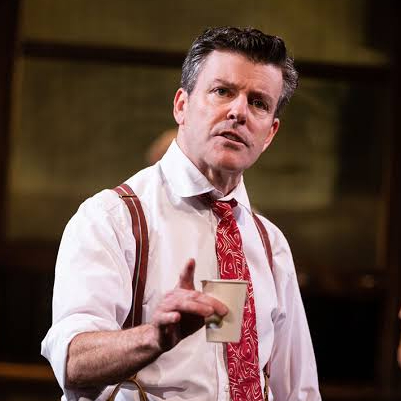
On the hottest day of the year, twelve men find themselves locked in a stifling jury room after hearing three days of testimony in the trial of a sixteen-year-old boy accused of murdering his father. The evidence appears overwhelming: a troubled relationship, eyewitness testimony, and a background that encourages easy assumptions. A guilty verdict seems inevitable.
As the judge reminds the jury that a conviction will carry the death penalty, the men retire to deliberate. A quick vote should settle matters – one juror is already thinking about the evening’s baseball game. Yet the first ballot reveals a single dissenter. Juror Number 8 (Gray O’Brien) is not convinced, and because the verdict must be unanimous, he begins the painstaking process of examining every piece of evidence and every assumption that has led his fellow jurors to their conclusions.
What follows is one of the most compelling and thought-provoking dramas ever written. Reginald Rose’s script is a masterclass in tension, logic and character development, exposing prejudice, personal bias and the dangers of rushing to judgement. Piece by piece, certainty begins to unravel as reasonable doubt emerges from the most unexpected places.
Michael Pavelka’s superb set design perfectly captures the claustrophobic atmosphere of the jury room, making the audience feel every degree of the oppressive heat and mounting pressure. The masterful use of a slow revolve ensures that every juror has their moment in the spotlight, subtly shifting perspectives and allowing the audience to scrutinise each character as alliances form and fracture. The period costumes convincingly evoke 1950s America, while Christopher Haydon’s assured direction expertly balances moments of explosive confrontation with quieter scenes of reflection. Particularly effective in the second half is the rhythmic thud of the fan, which resonates like a heartbeat beneath the action or the relentless ticking of a clock counting down towards a verdict. This understated but powerful sound motif heightens the tension, reinforcing the sense that time is running out for both the accused boy and the men tasked with deciding his fate. The tension never dissipates, maintaining an almost unbearable sense of anticipation throughout.
This is an ensemble piece in the truest sense, and every cast member delivers a finely judged performance. At its heart is Juror 8, whose remarkable restraint, intelligence and quiet authority make him the lone voice prepared to challenge the consensus. His measured reasoning provides the moral centre of the play, but what makes 12 Angry Men so compelling is the way each juror is forced to confront their own prejudices and assumptions.
Particularly striking is the heavily implied but never explicitly stated suggestion that the accused boy is not white, exposing the ugly racism simmering beneath the surface of the jury room. Tristan Gemmill is chilling as Juror 10, whose certainty of guilt appears rooted less in evidence than in prejudice, culminating in one of the production’s most uncomfortable and powerful moments. Bill Ward gives a formidable performance as the volatile Juror 3, whose personal anger and stubbornness are skilfully baited by Juror 8 until he is finally forced to confront the flaws in his reasoning. Ben Nealon brings a fascinating uncertainty to Juror 12, whose repeated shifts between guilty and not guilty reflect the ease with which opinions can be influenced, while Ricky Norwood’s Juror 7 initially appears more concerned with getting to a baseball game than delivering justice. Yet even he gradually comes to appreciate the enormous responsibility resting on the jurors’ shoulders.
As the discussion unfolds, the dawning realisation that there is reasonable doubt becomes almost tangible. The performances feel authentic and deeply human, ensuring every change of heart carries genuine dramatic weight. By the final vote, the audience has witnessed not only a jury deliberation but a profound examination of conscience, responsibility and the courage required to stand against the crowd.
Despite being set over seventy years ago, Twelve Angry Men remains strikingly relevant. Its exploration of justice, bias and the responsibility that comes with judging others feels every bit as urgent today as when it was first written. The dialogue is dense and demanding, but Rose’s script is so tightly constructed that every word matters, drawing the audience ever deeper into the debate.
Intelligent, gripping and superbly acted, this production of Twelve Angry Men is a riveting piece of theatre that commands attention from beginning to end. A timeless classic brought vividly to life, it leaves audiences questioning not only the verdict on stage but their own assumptions and prejudices. Quite simply, this is five-star theatre.