
Birmingham Hippodrome – until 18th April 2026
Reviewed by Emma Millward
5*****
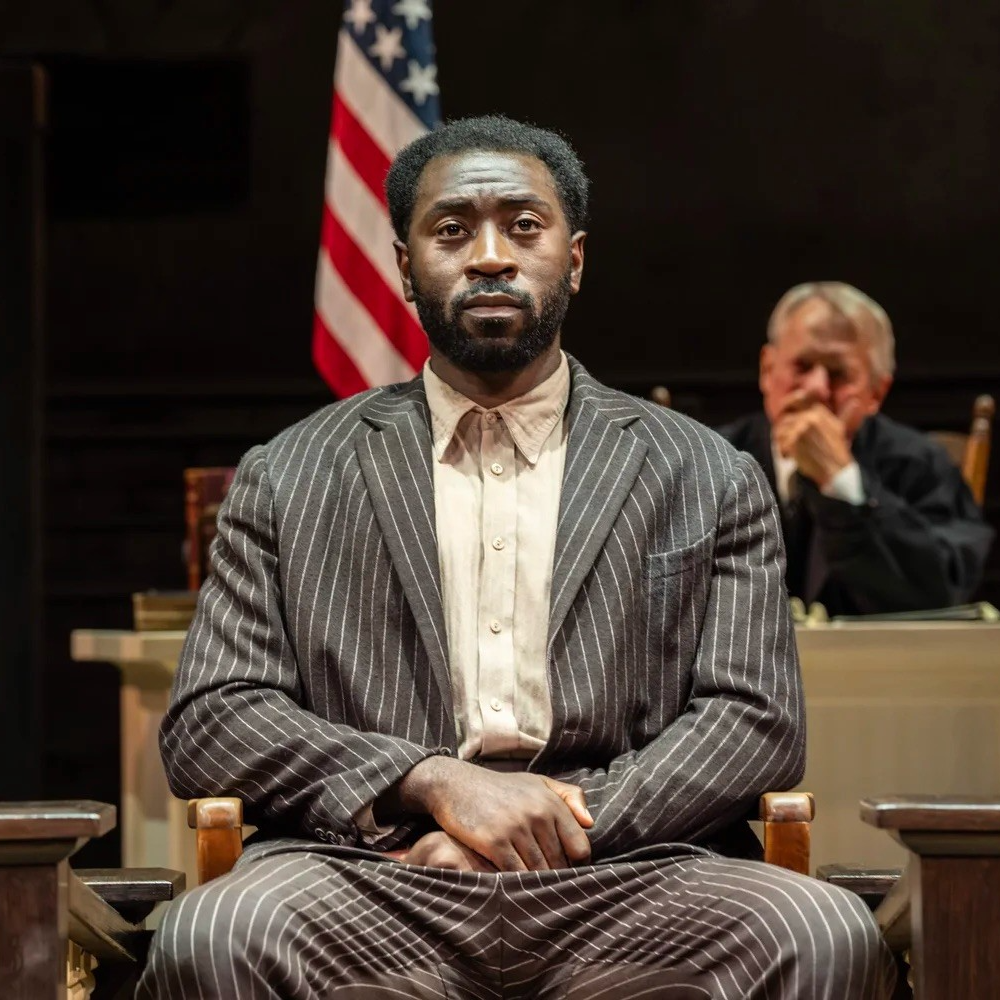
Harper Lee’s To Kill A Mockingbird began a brief run at Birmingham Hippodrome last night. Lee’s classic 1960 novel has been adapted before, as a play and a movie, but in this version, writer Aaron Sorkin has added a fresh perspective to certain elements of the storyline, shifting the focus onto more of the characters than previous adaptations. Sorkin’s dialogue is fast, witty and extremely hard-hitting. This is a production that doesn’t shy away from the era’s racial prejudice and language. The story takes place in 1930s Alabama, where a black disabled man, Tom Robinson (Aaron Shosanya), is falsely accused of raping a white woman, Mayella Ewell (Evie Hargreaves). He is defended by Atticus Finch (Patrick O’Kane), a white lawyer determined to fight social injustice.
The story is told through the eyes of Finch’s children, Scout (Anna Munden) and Jem (Gabriel Scott), and their inquisitive friend Dill (Dylan Malyn). They act as narrators who carry the story forward, with their comedic bickering adding brief moments of light in contrast to the darker themes throughout. All three often almost steal the show, especially Dylan Malyn as he veers between wide-eyed optimism and complete despair.
The storytelling adopts a non-linear structure, beginning unusually at the end of the story with Scout revealing the fate of Bob Ewell (Oscar Pearce), who is said to have ‘fallen on his knife’.. The trial of Tom Robinson and the courtroom scenes provide some of the most unflinching and shocking moments of the play. The racist outbursts of Bob and Mayella Ewell are delivered with such venom that they audibly shocked the audience. Stephen Boxer as Judge Taylor brings occasional humour to the scenes as he tries to maintain order in his courtroom. Aaron Shosanya gives a heartbreaking performance during these scenes, as Tom Robinson is determined to tell the truth while Prosecutor Horace Gilmer (Richard Dempsey) relentlessly questions him.
At nearly three hours long (including interval), this is a long play, but Bartlett Sher’s tight direction ensures every minute is used wisely. Miriam Buether’s cleverly constructed set design swiftly alternates between the Finch family’s porch, Boo Radley’s house and the Maycomb courtroom, with the cast themselves moving parts of the set. Jennifer Tipton’s atmospheric lighting and Scott Lehrer’s haunting sound combine to add varying levels of tension and calm throughout the show.
To single out one cast member would be impossible in a production with such a strong ensemble. Beyond the principal roles, my eyes were often drawn to the ensemble seated around the court room scenes. Some never spoke in the play, but their emotions were clearly etched on their faces. Harry Attwell gave a touching performance as the mostly silent Boo Radley towards the end of the play. Patrick O’Kane undeniably captures the audience’s attention as the seemingly unflappable Atticus. Andrea Davy gives an outstanding performance as maid Calpurnia. The final scenes between Atticus and Calpurnia are powerful, as she demands to know why a one-armed man was shot seventeen times. Her raw, unrestrained cry when she believed she was alone on the porch will stay with me for days to come.
To Kill A Mockingbird is undoubtedly a difficult watch, but it is also a powerful, thought-provoking, and deeply moving piece of theatre.