
Swan Theatre, Royal Shakespeare Theatre, Stratford-Upon-Avon – until 30th May 2026
Reviewed by Amarjeet Singh
5*****
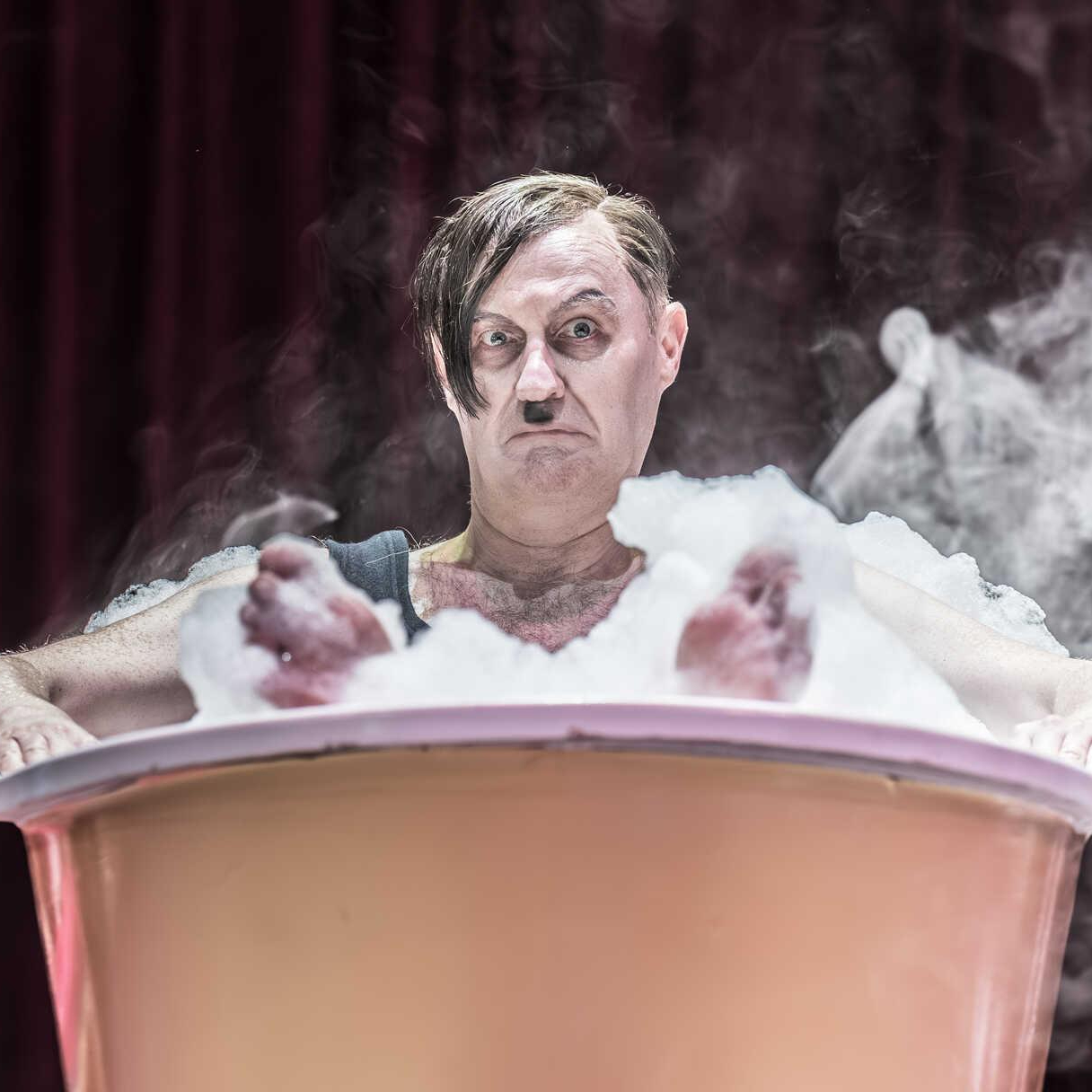
The Resistible Rise of Arturo Ui is Bertolt Brecht’s 1941 satire on the rise of Hitler. Using the bizarre idea of Ui taking control of the cauliflower market and forcing traders into a protection racket, it frighteningly echoes historical Nazi tactics. The production plays out as a comic nightmare, each scene reflecting a real moment in Hitler’s rise and exposing how power builds through fear, opportunism and inaction. The parallels with current events feel uncanny. It is a lesson from history that now feels like everyday news. The play speaks to us as we watch these events unfold, reminding us that this rise is ‘resistible’ and we must not lose hope. Director Seán Linnen charts these societal shifts with skill and clarity. The early scenes lean into absurdity, vegetables become weapons and the gangsters’ verge on caricature. The humour disarms. Gradually, safety disappears. People vanish, calls for help go unanswered, laughter fades and applause stop. By the end, the cauliflower racket no longer feels absurd, and the message beneath becomes clear.
Mark Gatiss is nothing short of genius, completely inhabiting the role of Ui from his first entrance to his final, chilling domination. He begins as a gaunt figure, pitiful and faintly ridiculous. What follows is an insidious, gripping rise to power. Watching him command the stage feels like a masterclass in acting, mesmerising, precise and quietly sinister. Perfectly timed hair stroking, menacing smiles that reveal tombstone-like teeth, and a measured tone allows his outbursts to land with full force. His prowling presence grows more unsettling scene by scene, tightening its grip until what emerges is not a simple imitation of Hitler, but something far more disturbing. Ui represents a multitude of fascist dictators, past and present.
The ensemble is formidable. Mawaan Rizwan is magnetic, exuding intense and troubling mannerisms. His menacing physicality recalls Alex DeLarge from A Clockwork Orange. With awkward, acrobatic movement, wide eyes and a maniacal laugh, made even more unsettling by his expert comic timing and fondness for hats. Christopher Godwin brings weight to Dogsborough, a once powerful man undone by greed and weakness. His performance as the acting coach, particularly in the “Friends, Romans and Countrymen” duet, is chilling. With full-length revolving mirrors and the evolution of the goose step, we watch aghast as he enables Ui to grow into his Machiavellian mould. Mahesh Parmar plays multiple roles with precision, fully embracing both a child and various adult characters with aplomb. Kadiff Kirwan commands attention with a strong, assured presence as Roma, bringing a measure of humanity to the wrongdoers. L J Parkinson remains creepily controlled and dangerous as Givola, playing off Rizwan with striking comic horror. Rebekah Hinds shines as Dockdaisy and others, her voice work, alongside Parmar’s, is a delight. Janie Dee grounds the production, particularly as Betty Dullfeet, whose resignation to the regime lands heavily. Amanda Wilkin is harrowing in her scene as the ‘Woman’, leaving the audience stunned into silence.
Georgia Lowe’s design elevates the play. The set shifts constantly, bold and chaotic, with minimal pieces that are moved and repurposed, adding to the instability of events. There are moments when it is hard to know where to look, things changing at speed, with actors moving rapidly around the theatre. The effect is disorientating. Costumes and make-up trace the shift from disorder to chaotic control with vivid clarity. A large box slides forwards and backwards during transitions, absorbing and releasing new scenes and set as if earlier events never happened, rewriting history.
The live band sits atop this box structure, reinforcing the central role of music. Placebo’s score, performed under musical director Richie Hart, adds energy and immediacy while giving the violence a dangerous pull. Jennifer Jackson’s choreography brings a malevolent, undulating quality to the movement. Moments of violence transform into stylised sequences, shootings bloom into flowers and short bursts of dance give the regime an unsettling appeal, adding to the ‘pull’. The audience is never allowed to remain passive. Performers move through the theatre, speak directly to us and mingle during the interval, drawing us all into action and making us complicit in what unfolds. Robbie Butler’s lighting extends this, illuminating the audience and sharpening the mood of each scene.
This RSC production of The Resistible Rise of Arturo Ui is a theatrical tour de force. It’s exceptional, accomplished and formidable in performance, production and staging. Intense and innovative, it ends with an epilogue that lands like a sucker punch. When Gatiss steps out of character to deliver it, the words carry undeniable force and the warning is clear. The conditions that allow Ui to rise are still present. The rise is not resistible, and we need to act now, before it’s too late.