
Cambridge Arts Theatre, Cambridge – Tuesday 21st July 2026
Reviewed by Steph Lott
5*****
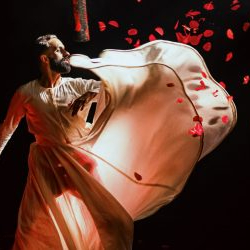
Some shows you appreciate. This one you feel somewhere deep inside.
Aakash Odedra’s Songs of the Bulbul, which made its Cambridge debut this week as the final stop of the company’s UK tour, is breathtaking, unusual, and genuinely extraordinary — the kind of performance that goes beyond dance into something closer to ritual. It lasts just 55 minutes, and not a second is wasted.
It begins with astonishing restraint: single rays of light falling onto an empty stage, light bleeding through gauze. Nothing more is needed. From this quiet opening, Odedra draws us into the ancient Sufi myth of the bulbul — a songbird caught and caged, who sings more sweetly as death nears, until one final, piercing song at the moment of release.
What makes Odedra such a rare artist is his economy of movement. He conjures the bird not through grand gesture but through the smallest details — a curl of the fingers, a flicker of the feet, a tilt of the head — each one utterly precise, utterly alive. When the bird is trapped, that precision turns to panic: the frantic beating of wings against an invisible cage, a creature yearning for freedom and light, which becomes almost unbearable to watch. It’s tragedy distilled into gesture.
Though it’s a solo piece, it never feels like the work of one person alone — it’s clearly a collaboration between many gifted artists working just out of sight. Rani Khanam’s choreography and Rushil Ranjan’s Kathak-and Sufi-rooted music feel inseparable from one another. And in the quieter sections, where the music falls away almost entirely, the silence is so complete you can feel the whole audience holding their breath. Fabiana Piccioli’s otherworldly lighting and Emanuele Salamanca’s spare, clever set design do the rest — together they build a dreamlike world around Odedra, one that feels both ancient and timeless.
The final sequence is the crescendo of the piece. As the bulbul is blinded, Odedra stumbles forward, cloth over his eyes, cradling small lamps of light. Light shimmers through gauze once more, echoing the opening — a sense of coming full circle, captivity and death folding back into the same luminous stillness the piece began with. It’s a devastating and beautiful way to close, and the audience clearly felt it: Odedra received a full, well-deserved standing ovation.
This is not a show only for those who already love dance. It speaks to something more universal — grief, longing, the cost of captivity, the strange sweetness of an ending. See it if you get the chance. You won’t just watch it. You’ll carry it with you.