Leeds Playhouse – until 23 May 2026
Reviewed by Sal Marino
3***
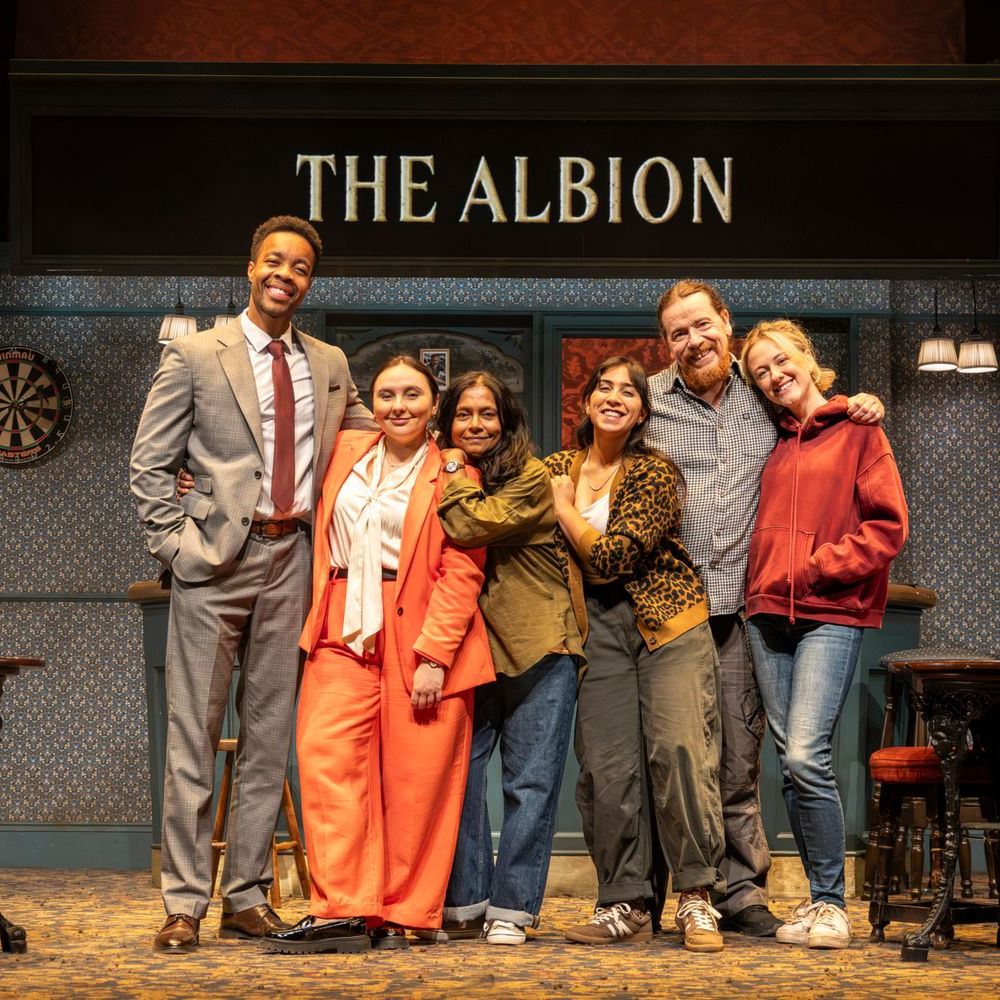
Barney Norris’s Our Public House, currently playing at the Leeds Playhouse, arrives with an ambitious premise: a community so politically disillusioned that nobody votes anymore. Set almost entirely inside a local pub, the play examines apathy, class, representation and the widening gulf between politicians and the people they claim to speak for. Directed and created by Josephine Burton, with music by Jonathan Walton, it blends traditional drama with song-led storytelling, allowing characters to voice their frustrations, memories and hopes in lyrical interludes.
The opening scenes struggle a little. The mother and daughter exchanges don’t feel authentic and so their characters initially feel hard to connect with. Too often, the script leans heavily on swearing, as though volume and profanity alone can create convincing working-class voices. Instead, it occasionally has the opposite effect, feeling exaggerated, with some performances veering dangerously close to caricature. However, once warmed up and with the entrance of some other characters, the play begins to open up and unfold some interesting ideas and concepts.
Yet Our Public House noticeably picks up the energy with the arrival of Mary Parker, an aspiring MP played superbly by Gabriella Leon, and her aide Tom, portrayed with understated realism by Kit Esuruoso. Both actors bring a grounded naturalism that the production desperately needs. Esuruoso captures the uneasy balance between political ambition and sincerity, while Leon gives Mary a quiet humanity that feels entirely authentic. Their scenes together inject the play with tension, nuance and emotional credibility.
The music is similarly uneven but often effective. Some lyrics land with real poignancy, giving voice to frustrations about political abandonment and social stagnation whereas others feel simplistic and overly earnest. Still, when the songs work, they deepen the emotional landscape and allow glimpses into the characters’ inner lives that the dialogue alone sometimes struggles to reach.
One particularly missed opportunity is the play’s relationship with its setting. Given its focus on community identity and political neglect, tailoring elements of the production to the city in which it is staged could create a far stronger connection with audiences. Referencing recognisable Leeds locations, events or cultural touchstones would ground the story in a more tangible reality and reinforce the idea that these frustrations belong to real places and real people.
Despite its issues, Our Public House does succeed in provoking thought. Beneath it all lies an unsettling question: what happens when people lose faith entirely in the democratic process? The play’s central idea — that perhaps people might collectively reject all available political options rather than continue electing “just another one of the same” — lingers long after the curtain falls. It may not always get there gracefully, but it does leave its audience reflecting on anger, representation and whether democracy still feels meaningful to those most often promised everything and given very little.