The Lyceum Theatre, Sheffield – until 23 May 2026
Reviewed by Lauren Fordham
3***
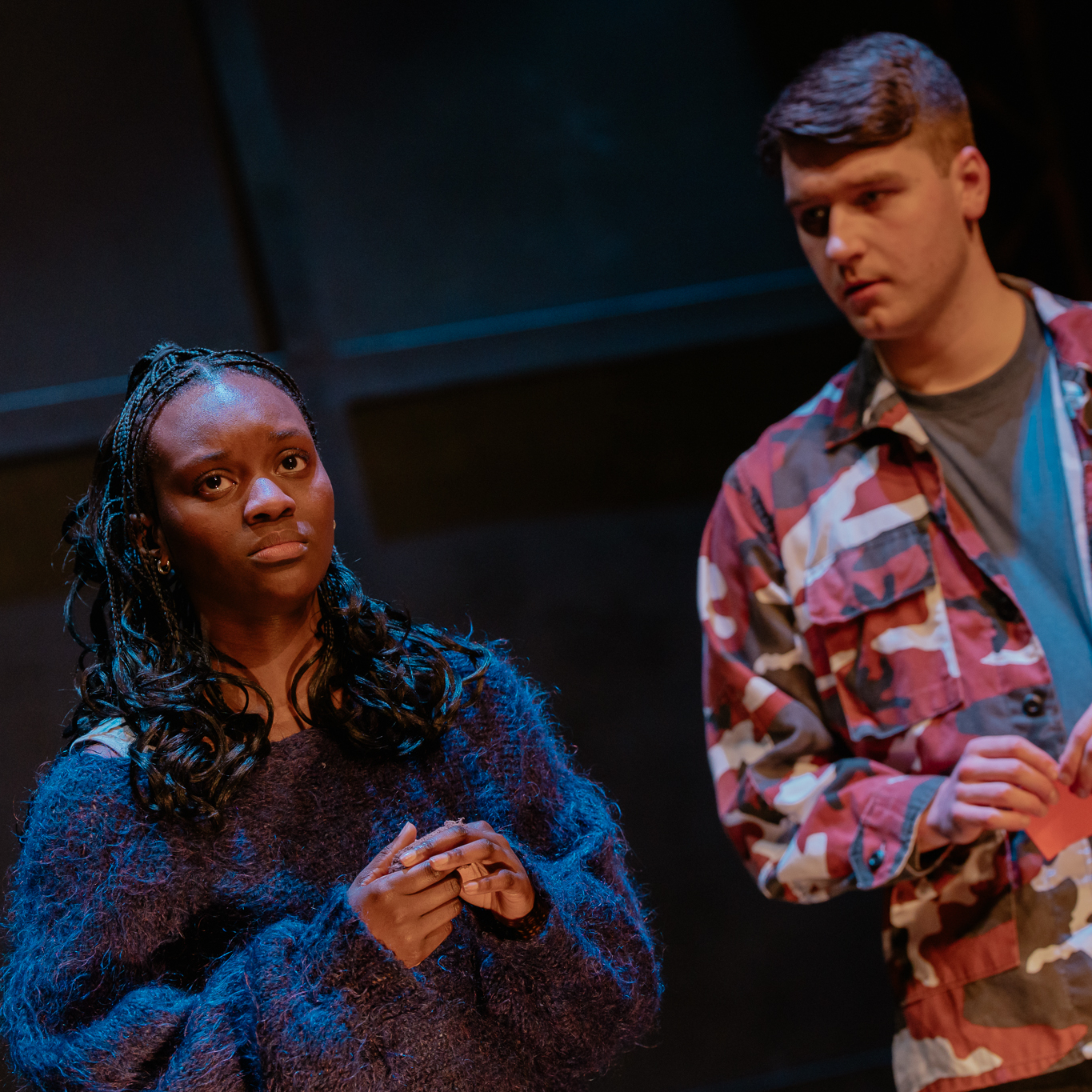
‘Noughts and Crosses’ is a play written by Sabrina Mahfouz, adapted from the series of novels by Malorie Blackman. It is set in an alternate universe where so-called Crosses, people with dark skin, who are members of the ruling class, are institutionally racist towards, oppress and discriminate against people with lighter skin, who are known as Noughts. Persephone Hadley (Sephy), daughter of prominent Cross politician Kamal Hadley, becomes friends and falls in love with Nought boy, Callum McGregor. They grow up together because his mother, Meggie works as Sephy’s mother, Jasmine’s maid, however they experience increasing conflict both within their relationship and without due to the societal divisions that exist between Noughts and Crosses.
One clear strength of this show is in its lighting design by Ben Cowens. The neon red noughts and crosses symbol that is the first powerful image the audience sees, isn’t set apart like the game otherwise known as tic tac toe, but blended together, as if they have become one, perhaps a metaphor for Callum and Sephy’s relationship and how, despite her father’s efforts, they will always be connected.
Set designer Simon Kenny takes a simple but very symbolically powerful approach to representing the conflicts of the show through the colour schemes he chooses. The set itself is sparse and therefore versatile, with screens showing anything from the red brick of the McGregors’ home to the invisible screen between Meggie and Ryan McGregor when the latter is arrested. Kenny is also responsible for the stark but effective choices of costume – both Callum and Sephy’s school uniform and Ryan McGregor’s prison jumpsuit are bright orange, perhaps indicating that none of them can hide from the spotlight or from justice, whatever that looks like.
Cowens should also be praised for the highly evocative neon red lighting and flashes of darkness that feature heavily, symbolising anger and danger, violence and bloodshed. This dovetails perfectly with Si Cole’s video design showing TVs with scarlet news tickers proclaiming Breaking News after the Liberation Militia, the rebel movement that Callum’s brother, Jude and father Ryan are part of, bombs the Dundale Shopping Centre.
The physicality of the actors is also evocative, particularly in the first scenes when a playful young Sephy (Brianna Douglas) is leapfrogging over Callum (Lewis Tidy) subtly representing the power differential between them from the very start.
Douglas commands the stage as Sephy, whether she’s standing up for Callum when he joins their school, to be met with protesting children à la Ruby Bridges, or, when she cannot change Callum’s family’s fate, cynically getting drunk on her mother’s alcohol. It is easier to be sympathetic to Tidy’s Callum, as he grieves for his sister Lynette, driven to suicide by an attack on her and her Cross boyfriend by fellow noughts, upending her worldview and alienating her from the rest of her family.
Daniel Copeland, who plays Ryan, has a dignified and determined demeanour as he walks to the scaffold after being convicted of the Dundale Centre murders, a memorable moment of high drama. You have to feel sorry for the multiply-bereaved Meggie too, whose agony is played out palpably by Emma Keele.
But the weakness of the show is in Sabrina Mahfouz’s adaptation. While compressing a whole series of novels is an unenviable task, the ageing and changing outlook of Sephy, in particular, after she goes off to boarding school and studies Cross oppression, feels too sudden and unbelievable, as though, like Scrooge, she has been visited by ghosts overnight. The length of the novels lets Sephy grow in a more natural and nuanced way than this play allows.
This is a visually gripping, powerful show on a surface level, but if you want to see these characters in depth and with appropriate space given to their complex narratives, definitely read the books.