Joseph Rowntree Theatre, York – 14th February 2026
Reviewed by Lauren Fordham
5*****
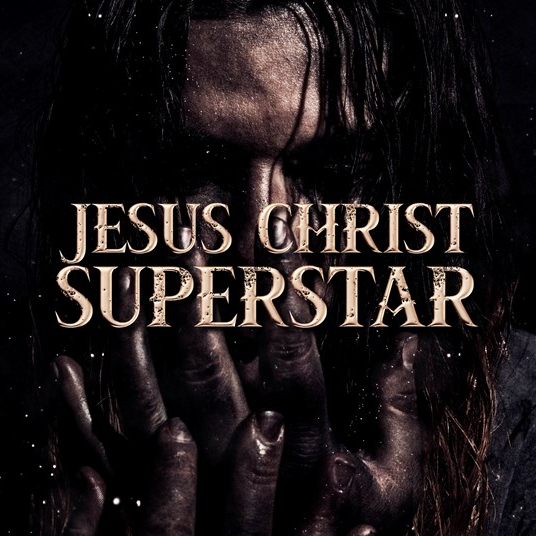
Jesus Christ Superstar is a rock opera conceived in 1970 by famed musician Andrew Lloyd Webber and lyricist Tim Rice. It dramatises the rise of Christ in Jerusalem, his relationship with Mary Magdalene, Judas’ betrayal and events leading up to Christ’s crucifixion.
In its promotional material Dan Crawfurd-Porter’s production promised a darker version of ‘Superstar’ than ever seen before, and this is visually very evident in both costume, and makeup choices by Chloe Morgan-Fennings, Jasmine Barnard and the multi-talented Gi Vasey (who was Production Designer and also plays Annas.) The High Priests of Israel, led by Caiaphas (Joseph Hayes) wear thick black eyeliner against chalk white faces, reminiscent of many heavy metal bands, and they also wear black robes, recalling to me the scenes of Death Eaters in the Harry Potter franchise plotting his murder.
Judas also wears black robes from the opening moments ot the show, foreshadowing (were the ending not already known to the audience) the betrayal of Jesus (Iain Harvey.)
An atmosphere of tension, fear, threat and violence is expertly executed by Lighting Designer Daniel Grey’s use of red and black flashes and spotlights to effectively evoke feelings of agony and symbolic bloodshed, particularly when Christ is being whipped.
Between Grey’s lighting and Production Designer Gi Vasey’s set of simple wooden pallets moved by the cast at various points to form an inverted cross, there is a wonderful synergy that dovetails perfectly with Rice’s lyric ‘like his father carving wood…tables, chairs and oaken chest would have suited Jesus best.’
I also liked the fact that Pilate’s Dream took place with Josh Woodgate standing on the symbolic inverted cross, embodying the same ‘haunted, hunted look’ that he dreamt of Jesus wearing, making Pilate seem actually just as vulnerable as Jesus and as guilty as Judas, accentuating the effect of the line ‘leaving me the blame.’
Iain Harvey’s Jesus physicality evoked Alfie Boe and a pious Jean Valjean and his falsetto rivals that of Ted Neeley. I could definitely see him heading the cast of Les Miserables in the not-too-distant future.
Rianna Pearce’s Mary Magdalene is more maternal than meretricious, addressing the Apostles as well as Jesus in ‘Everything’s Alright’, but I enjoyed this interpretation as it made her have more of a relationship with the Apostles as well as Jesus, which made Could We Start Again Please a particular highlight for me, over the popular yet still deftly delivered I Don’t Know How To Love Him.
I also want to pay tribute to Mickey Moran’s mesmerising, queer David Bowie-esque Herod, whose performance was once again enhanced by Daniel Grey’s lighting choices, this time in the form of a flashing disco ball effect.
The way the lighting design could have been improved further is if in the scenes where Judas and the High Priests are wearing black, if a follow spot could have been placed on the soloists, because I found it very difficult to follow who was singing at times. I also found some of the dialogue difficult to hear. I wish regional theatre productions could fund captioned performances.
But for me, the absolute superstar of this show (please forgive the pun) was Kelly Ann Bolland as Judas. Dan Crawfurd-Porter’s decision to gender flip this role was absolutely inspired and Bolland ran with it, making her criticism of Mary Magdalene particularly cutting as an attack by a woman on another woman, her Judas showed no mercy or sisterhood. In my mind Crawfurd-Porter’s bravery echoed Sheffield Crucible Theatre’s decision to cast Joanna Ampil in the role of the Engineer in their 2023 production of Miss Saigon, and Crawfurd-Porter’s decision and Bolland’s complex portrayal was just as powerful and thought-provoking.
Bolland also had a captivating hateful rivalry with Gi Vasey who played Annas, coupled with Annas’ makeup it put me in mind of Bellatrix Lestrange and Narcissa Malfoy if you’ll grant the continued analogy. Her white blonde hair accentuated her gothic makeup and she definitely could have passed for a Malfoy. I also loved the symmetry in Dan Crawfurd-Porter’s decision to have Judas commit suicide by drinking poison rather than hanging himself, to mirror Jesus’ ‘Gethsemane’ lyric: take this cup away from me, I don’t want to taste its poison.’
Bolland’s defiant, acrobatic and powerful vocal was impressive and impactful and could easily earn her a role in a show like We Will Rock You in the future. Her acting skills also impressed me as she cut a Lady-Macbeth-like figure during Damned For All Time, trying frenetically to physically wash off the ‘blood money’ she has accepted.
But there are some moments, especially in theatre, when music speaks louder than words, and the simple power of that is demonstrated beautifully in the instrumental version of Gethsemane that is played after Jesus is crucified, just before the curtain falls. Credit goes to the wonderful live musicians: Matthew Peter Clare on keyboard, Katie Maloney on the enormously effective, plaintive Reed, paired with Elizabeth Dixon on horn, James Lolley on trumpet and Lauren Jones on cello.
After seeing this wonderful, innovative show, I am definitely a new disciple of Inspired by Theatre and eagerly look forward to reading their next chapter.