Tower Theatre, Stoke Newington N16 – until 13 June 2026
Reviewed by Phil Brown
4****
Perusing James Graham’s impressive body of work as a playwright, reveals he often writes about real life events that appear to mark or signal paradigm shifts. Events with noticeable societal diffusion but which seem ever more significant with the passage of time. It seems he is currently having a moment – not only gracing our screens with the TV adaptation of his own stage play Dear England (about Gareth Southgate and England football) but also the Tower Theatre stage with his rigorously researched and wonderfully written play Ink about the relaunch of a struggling left wing broadsheet, ‘The Sun’, in 1969.
Ink was first premiered at the Almeida in 2017 before transferring to the West End. The Tower Theatre Company deserves praise for making an inspired choice to revive Ink which ranks alongside such classic newspaper dramas as The Front Page and The Post as gripping insights into press practice and behaviour. Not only does it take us back to the days of newshounds and expletive laden, smoke filled news rooms in Fleet Street, it’s a cracking underdog story as well as a searching examination of class, ambition, establishment disruption and media power.
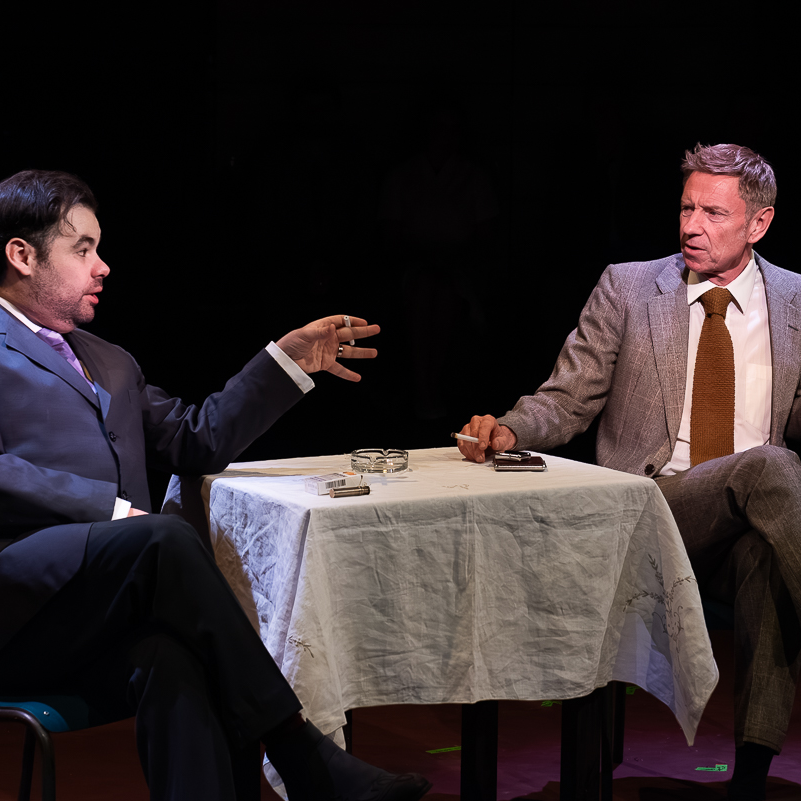
And the Tower Theatre players have produced a very fine production indeed, carried along by two excellent leads – Christopher Lloyd James, more Yorkshire than some hybrid of Michael Parkinson and Geoffrey Boycott, as the no nonsense Editor Larry Lamb, and Zane Fleming as the ruthlessly determined but very young Rupert Murdoch who by this time was already the owner of the ‘News of the World’. They spark superbly off each other.
The powerful opening scene sees Lamb and Murdoch at dinner discussing what makes a good story. Lamb expounds on the 5 Ws – who, what, where, when, and why. But over time, he’s changed his mind about the importance of why – once that question has been answered, the story is over. The most important question is what next? And the need to know what happens next is what makes the story of Ink such a gripping one.
Of course, Murdoch has invited Lamb to Rules Restaurant to pitch the editor’s job just before finalising the purchase of the Sun from the Mirror. “The Sun? “Bollocks. It’s a stuck up broadsheet that’s never once made profit”. But Murdoch knows exactly which buttons to press and they agree to a fearless mission – “to shine a light in every corner no matter what…”
Act 1 takes us from venture initiation to the initial launch at which the Sun achieves a circulation close to 1 million – well in excess of the previous level. It covers a lot of ground in terms of story content but only a few weeks of real time. Like Murdoch, Lamb, previously overlooked as editor of the Mirror, has his own point to prove and despite being under funded and under resourced sets about recruiting and shaping ‘The Sun’ team mark 2 with phenomenal energy.
Christopher Lloyd James is utterly convincing as the driven and inspiring kick-ass editor, cajoling the old school new team out of their comfort zone into taking risks such as the hilarious moment they decide to use italics on the front page as well as the initially stilted brainstorming session that turns into a flood of ideas forming the basis of the paper’s new values – win, free, love. There are clashes with the unions and a nice scene on hot metal newspaper production. Lamb has taken something old and turned it into something quite new. Or as Murdoch says – taken something borrowed and turned it into something blue. The scene ends with Murdoch challenging Lamb to beat the Mirror in one year whilst Hugh Cudlipp (Steve Grist) of ‘The Mirror’ bewails the danger signs flashing for his paper.
Act 2 covers the rest of the year as ‘The Sun’ accelerates past ‘The Mail’ whilst being sneered at by the media establishment and the rest of Fleet Street, but Murdoch is unmoved – “who needs friends when you have readers”.
There are two absolutely side splitting moments early on when Murdoch questions the wisdom of Knickers Week but agrees to TV advertising and Harry Apps playing the actor Christopher Timothy gains a deserved ovation for sprinting through the tightly scripted advert, word perfectly and quite brilliantly in 30 seconds flat.
Things turn darker when Muriel (wife of Sir Alick McKay a close colleague of Murdoch and deputy chairman of News Limited in the UK) is mistaken for Murdoch’s wife Anna and kidnapped. Larry Lamb recognises this is the biggest story so far in the paper’s history and chooses to lead on the story, propelling circulation past 1.8 million. This story ends in the murder of Muriel McKay and questions are inevitably asked about paper’s role in the tragedy. The final controversy addressed at some length is the decision to go topless on Page Three.
There is much to admire about this hugely enjoyable and imaginatively directed production (director – Jess Staufenberg). The writing is exceptional and the performance ain’t far short. The leads are fabulously suited to their exhausting roles and are well supported by the rest of the cast who also have their moments. Sets are economical but marvellously effective (Jennie Foot) and the frequent, brilliantly choreographed scenery changes by the cast are a work of art in their own right (Angharad Ormond). Use of lighting (Samuel Littley) and projection (James Christensen) is good, and I particularly love the way scenes are punctuated with iconic 60s music.
I hope this well paced production is as much fun to be part of as it is a treat to watch – you get a real sense of how liberating the 60s and early 70s experience was – a world of possibilities with anything and everything up for grabs.
This show commandeers your attention from the get-go and does not relinquish it until the very end when (spoiler alert), ‘The Sun” sinks Hugh Cudlipp and ‘The Mirror’. That’s entertainment…