Leeds Playhouse – until 26 September 2026(on tour until February 2027)
Reviewed by Dawn Smallwood
4****
Charles Dickens’ A Tale of Two Cities, produced by Marlowe Theatre, embarks on a nationwide tour and with a visit to the Leeds Playhouse. It is adapted for the stage by Terence Rattigan and John Gielgud and under the direction of Michael Fentiman. The novel is set in both London and Paris during the late 18th Century and at the backdrop of the French Revolution and the Reign of Terror.
The main focus in this production is on two characters; Sydney Carton (Samuel Collings), an English lawyer, and Charles Darney (Ed Slayer), hails from French Aristocracy and is an English émigré. Both characters fall in love with Lucie Manette (Jordan Loughran) also an émigré and whose father, Dr Manette (François Testory) was imprisoned in France and is released to join her in England.
The events, particularly the revolution, unveil and how the characters are fatefully bound to the noted themes raised; love, redemption, sacrifice, scrutiny, secrecy and surveillance from the experiences of the Revolution and The Reign of Terror. The concluding part is when Carton has to decide a self-sacrificing and significant fate.
The production is put together well with dark and fluent choreographic and compact staging. The lighting, mainly strobe, projections including text ones, and soundscapes work so well with the nature of the story and its fateful themes. Excellent portrayals from all the cast, particularly Collings as Carton and Slayer as Darney.
It’s an enjoyable production and offers one an opportunity to A Tale of Two Cities, a popular novel and learn more about the characters’ lives during the historical events that shaped both Paris and London forever. The production sums up at the beginning that their lives and events bring out the best of times and also the worst ones. It can be resonated to today with countries that are affected by revolutions and its varying regimes and how its citizens are faced with those related themes and how these impacts and change their lives.
Hampstead Theatre Downstairs, London – until 24 October 2026
Reviewed by Celia Armand Smith
4****
The Urmetazoan, a new play by Alex Rugman centres on sisters Alice and Abigail who have been estranged for seven years. Alice (Dorothea Myer-Bennett) is a brilliant, Nobel Prize winning scientist preparing to leave Earth permanently on a one-way mission to Mars, and Abigail (Meghan Treadway) is just living a comparatively ordinary life as best she can. The sisters reunite at Alice’s home in Florida just weeks before she leaves forever, giving them days to fix their broken relationship and reconnect over shared memories, resentments and ultimately grief.
The Hampstead Theatre Downstairs lends itself perfectly to intimate dramas, and Anna Ledwich’s direction creates an atmosphere where you can deeply feel every intake of breath and quiet moment of reflection on stage. The play is 1.5 hours with no interval, and for the first hour we learn about Alice and Abigail’s relationship; light hearted sisterly banter and the recalling of a shared past is punctuated with still and haunting tableaux that show the true impact of this momentous event. A third character, WIll (Ben Allen), is introduced as Alice’s former partner. His role in the play does not seem all that necessary other than creating a bit of tension between Alice and Abigail, as ultimately the relationship between the sisters is much more interesting. As the launch approaches, big questions of life, death, the universe, and purpose bubble to the surface and force the sisters to finally address their actual feelings and beliefs about what is happening at home, on Earth and beyond.
Myer-Bennett and Treadway are so natural in their exceptional performances you could mistake them for actual sisters. They dance around each other with a bonded familiarity, bouncing the dialogue back and forth with ease. The design by Tomás Palmer is simple showing the strange simplicity of packing up a life lived on earth in a house occupied for years but is somehow temporary as Alice had known for 10 years that she would be leaving. Jonathan Chan’s lighting adds a real life context to the set. There are car head lights that shine through the blinds, quiet moments of reflection in dark rooms, and the fiery reds of rocket blasters.
Rugman’s debut is an intelligent (if at times wandering) and thought provoking play. The themes of family, existence, and living grief are smartly and subtly addressed, and the science is never heavy. The relevance of the subject matter is unavoidable and you certainly leave with some big existential questions, the future, and how we can shape our relationships around it.
26 years after its West End premiere, The Lion King is still playing to packed houses. Julie Taymor’s brilliant adaptation of the classic Disney film never quite hits the emotional highs and lows of the cartoon but is a glorious theatrical spectacle that still delights.
Taymor’s design team, from Richard Hudson’s scenery, Michael Curry’s puppets, Donald Holder’s lighting and Steve Canyon Kennedy’s sound created a magnificent atmosphere for the performers to excel in and have added no gimmicks as theatre technology has developed, trusting in their original concept that now feels comfortingly traditional while still managing to take the audience’s breath away at certain points. The entrance of the animals through the audience is as exciting as ever, while the ensemble twirling as the grasses of the savanna is enchantingly calming between the more dramatic events. Elton John and Tim Rice’s classic songs from the film are mostly in act 1, but the additional numbers in the musical are atmospheric and great fun.
The story of Simba (Posi Morakinyo) being manipulated by his evil uncle Scar (George Asprey) into self-exile after the death of Mufasa (Shaun Escoffery), living a hedonistic life with comic pals Timon (Stuart Neal) and Pumbaa (Pierre Van Heerden) before returning to defeat Scar and take his place as rightful king is told in admittedly clunky bare bones between musical numbers – with Timon and Pumbaa’s jokes never quite landing with the younger audience unless they involve bodily functions – but Roger Allers and Irene Mecchi’s book retains the important details. The cast are full of energy, with Thenjiwe Nofemele delighting as the mischievous but wise Rafiki, Gary Jordan wonderfully officious as the hapless Zazu and Sadia McEwen, Michael Jeremiah and Mark Tatham stealing scenes as Scar’s hyena henchmen.
A wonderful show for all the family, The Lion King still rules over the West End.
Sightlines can be a worry when taking children to the theatre, but by using https://seatplan.com/london/news/best-seats-lion-king-london/ you can check the view from each seat when you book. (Also a useful tool for the vertically challenged like me!)
The Questors Theatre, Ealing – until 3rd October 2026
Reviewed by Mike Linane
3***
Noises Off is a 1982 farce by the English playwright Michael Frayn who conceived the idea in 1970 while watching from the wings a performance of The Two of Us, a farce that he had written for Lynn Redgrave. He said, ‘It was funnier from behind than in front, and I thought that one day I must write a farce from behind.’ The prototype, a short-lived one-act play called Exits, was written and performed in 1977. At the request of his associate, Michael Codron, Frayn expanded this into what would become Noises Off.
It takes its title from the theatrical stage direction indicating sounds coming from offstage.
Noises Off is a play within a play. It tells the story of a theatrical company preparing to take a not very good comedy called Nothing On off on a three-month tour of provincial theatres. It’s the sort of tour that was so prevalent at the time the play was written. A somewhat poor comedy performed by a cast of actors who are either past their best, never quite made the big time or those that need to sleep with someone involved with the production to earn their place on the tour.
The tour is being financed by ageing actress Dotty Otley who hopes to make enough money from it to enable her to buy a nice little house to retire to. She is also starring in it as hopeless housekeeper Mrs Clackett who is looking after a delightful 16th-century posset mill modernised by the current owners and available to let while they are abroad.
Nothing On is the type of farce in which young women run about in their underwear, men drop their trousers, and many doors continually bang open and shut.
The play begins with the final technical rehearsal of Nothing On before it opens to the public the next evening. The cast have had only two weeks to rehearse and it is nowhere near ready to be seen by anyone let alone a ticket buying audience but jaded director Lloyd Dallas is determined that the show must go on the road as all he wants to do is to move on to his next more interesting project of a production of Richard III.
Poor Dotty cannot remember her lines or when she is supposed to come on or go off and whether she is supposed to have a plate of sardines or a newspaper with her at any given time. Add to this that one of the cast has a serious drink problem and several of the cast are having affairs with each other unknown to the rest of them are we have a recipe for disaster which is what follows.
Act Two shows the same first act of Nothing On one month later but from behind the scenes. We see everything from the backstage perspective and a lot of this is played out in silence as we see the cast go on and come off stage at a riotous pace as the play is being performed in Weston-Super-Mare. Matters have deteriorated between the cast. Some of the affairs have become public knowledge causing jealousy amongst the fellow thespians, a drink problem has become seriously worse and the stage management team of Tim and Poppy have their work cut out just keeping the show going whilst all around them the cast are running amok with some deliberately trying to sabotage other actors performances.
Act Three plays out on the final week of the tour at Stockton-on-Tees and we are back in the front of the set again. By now the cast (and the production) are on their last legs literally. If anything can go wrong, it surely will and does. Despite the best efforts of some of the more professional members of the troupe the play that is performed no longer makes any sense at all and the entire ensemble just cannot wait for the final curtain to fall.
When it was first performed Noises Off was described as being ‘the funniest play ever written’. I’m not sure it can still call itself that as the Mischief Theatre Company have since come along and taken Frayn’s baton and run with it, but it is certainly still one of the top five farces.
It is not an easy play to perform. There is an old theatrical saying: ‘Dying is easy. Comedy is hard’ and Noises Off proves the point. What looks like complete chaos must be incredibly precise and the cast of Despina Sellar, Pip Nixon, Amy Green, James Burgess, Nine Flitman, Mark Redrup, Willo Johnson, Jamie Gould and Maddy Westaway have clearly all worked very hard to make this production work as well and as funny as it is. Congratulations should also go to director Pam Redrup for her work in pulling this all together and set designed Alex Marker for a very impressive set that literally comes apart before our very eyes (spoiler: stay in your seat between acts 2 and 3!)
If you remember the days of the Brian Rix Whitehall farces or love Mischief Theatre’s The Play That Goes Wrong and Comedy About Spies then this is the play for you or even if you just enjoy a night out when you are guaranteed to belly laugh at the antics performed before you then you really shouldn’t miss out on this wonderfully silly production. I guarantee you won’t be disappointed.
Chichester Festival Theatre – until 17th October 2026
Reviewed by Lorna Hancock
5*****
While most of us are familiar in some way with William Shakespeare’s original play A Midsummer Night’s Dream, this new production co-directed by Justin Audibert and Hannah Joss has transposed this magical comedy to 1994, and the riotous rave scene in the local area. When you first hear of it, this pairing may sound completely bonkers (and it is at times) but I found it was actually airing on genius, the forest felt like a place where all normal rules were suspended, which perfectly and very cleverly captured the spirit of the original play. The production also showed that, despite being written hundreds of years ago, Shakespeare’s themes of love, jealousy, rebellion and confusion still feel incredibly relevant in a modern world.
I’m always excited to see a show at Chichester Festival Theatre as their use of stage and set is consistently so innovative, and this show did not disappoint. Their use of rave dancers and clever lighting really made us feel we were deep in the forest amidst the action. The costumes (Ryan Dawson Laight) also added to the visual storytelling and symbolically frayed and gathered grime to mirror the unfolding drama.
The whole cast was incredibly strong and delivered the sometimes difficult text absolutely flawlessly with boundless energy. I must mention Munya Chawawa (Bottom), Freya Parks (Helena) and Eve Ponsonby (Titania) with their characterisation, facial expressions and the way the moved adding humour and really bringing their characters and the stage to life.
I really wasn’t sure what to expect from this modern take, however, the combination of Shakespeare’s language and the unmistakable atmosphere of the 90’s worked surprisingly well. Something that really impressed me, was that my 13 year old absolutely loved the show, despite never having studied the play or knowing the story beforehand. It made Shakespeare feel really accessible and genuinely entertaining.
Overall, a very engaging, imaginative and wonderfully chaotic production that proves Shakespeare can still surprise us.
HOME Theatre Manchester – until Saturday 26 September 2026
Reviewed by Sofia Robottom
4****
Mrs Dalloway explores the complexities of each character through its free indirect discourse which producer Jen Heyes and solo performer/co-writer Kit Green beautifully encapsulated in this interpretation of Virginia Woolf’s Modernist text. Through this engaging performance, the audience were encouraged to embrace the timelessness of this piece of literature as its social commentary exceeds its context and touches upon current anxieties and the complexities of the human experience. The indistinct shifting perspectives that Virginia Woolf is renowned for in her writing were conveyed brilliantly by Kit Green who wonderfully embodies all fifteen characters, both on stage and on screen. The blurring of boundaries that the novel exhibits are mirrored through the seamless transitions between each character and the audio and visual effects such as the translucent screen and the ticking of the clock, raise the prominent themes of time, memory and identity.
This emotionally charged production delivers a poignant message through its exploration of these fifteen characters. Taking place over the course of a single summer’s day in the early 1920s, we see Clarissa Dalloway engulfed in her own party preparations, while in a parallel storyline Septimus Smith suffers, riddled with the horrors of his time served in the war. His psychological turmoil is depicted in pre-recorded performances projected on screen, capturing his tragic decline in fragments of film and the two plotlines are tied together through the recurring motif of plunging.
Kit Green breaks character at various points cutting into the narrative to relieve some of the tension with short interruptions, engaging with the audience and providing personal reflections. With these pauses we are guided through a complicated piece of literature with its intense topics and are encouraged to reflect on how the plays commentary is relevant today, before we are asked to take the next plunge.
The songs performed by Kit Green in these brief intervals are both pensive and captivating, and at times interactive. They express thoughts on the text and honour Woolf’s artistic influence as well as bring in comedic relief. The theme that pervades Kit Green’s delightful engagement with the audience is the party that Clarissa Dalloway is preparing for, playing on the idea that we are all here for a party.
Having read the novel prior to the play, one might imagine that this would be a difficult plot to deliver, however it was tackled brilliantly. I believe that even without reading the text this performance is accessible and allows this story to be grasped in all its complexity. This production is a theatrical transformation of Woolf’s intricate and perplexing narrative into a modern, topical adaptation with an amusing twist. Its alluring visual effects and its perfect balance of timely wit with an earnest approach to the difficult topics explored, make this performance fascinating.
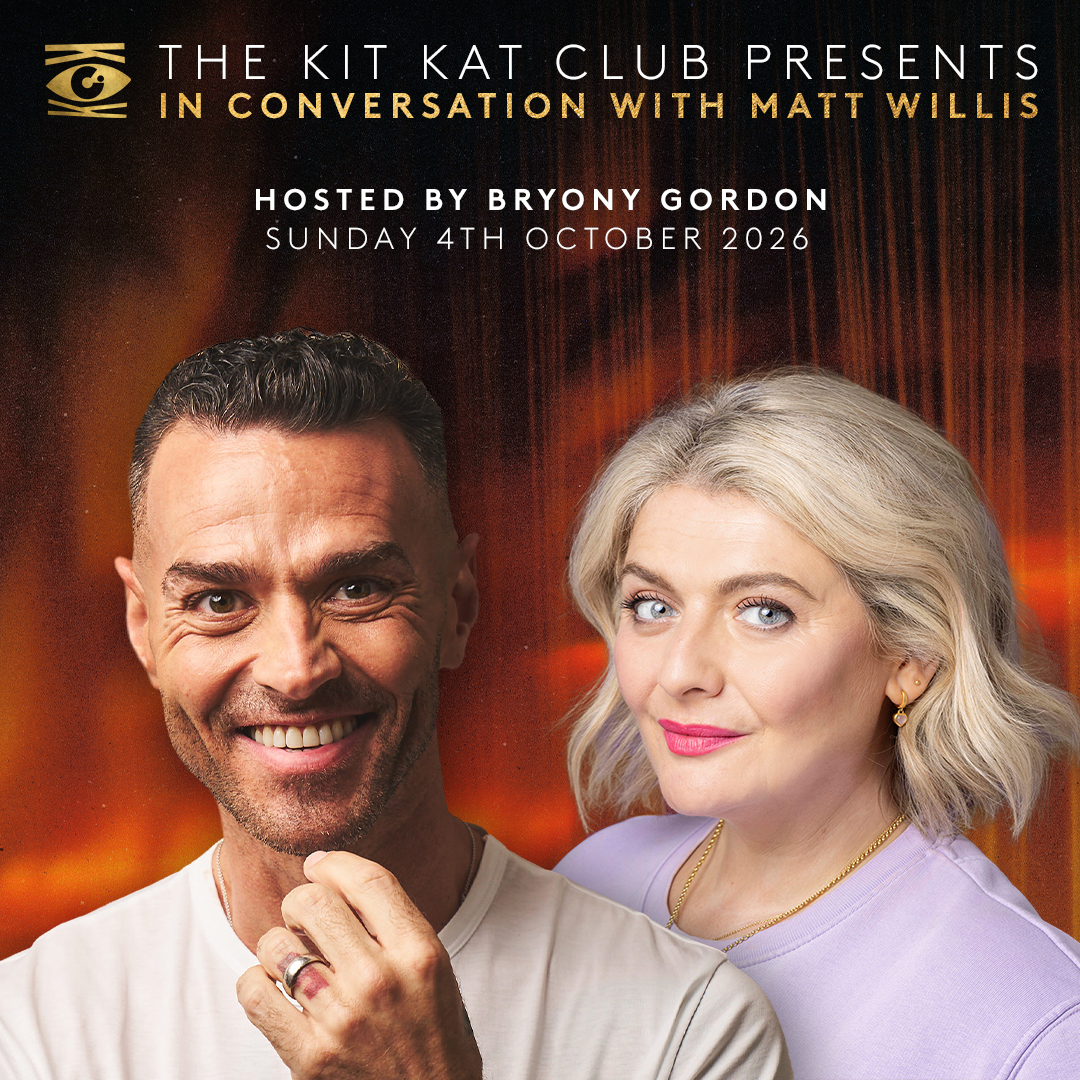
Join BRIT award winner, actor, presenter and celebrated Emcee in Cabaret, Matt Willis, as he returns to the Kit Kat Club for an intimate one-night-only event at 5.00pm onSunday 4 October. Matt will be in conversation with award-winning journalist and Sunday Times bestselling author Bryony Gordon, marking the release of his debut memoir, Mending: Busted, Breaking and Getting Better, a personal and universal story of rock bottom, recovery and how to get there.
Mending: Busted, Breaking and Getting Better is Willis’ debut memoir, sharing his story from a vulnerable start on a Surrey council estate, via stage school and finding his tribe, through relationships (good and bad), parenthood, huge success, rock bottom, to finally finding a way back to who he truly is. But it’s not your typical memoir. It’s also a story of how to recover: a roadmap of resilience and hope that shows that it’s not being fixed that’s the goal, it’s mending.
Join Matt in the Kit Kat Club for an unmissable night of honesty, hope and healing. Be amongst the very first to hear his story first, live and in his own words.
Bryony Gordon is an award-winning journalist, author and mental health campaigner. Currently, Bryony writes a weekly Daily Mail column, having previously written for the Telegraph for 24 years. In May 2025, Bryony was awarded Tabloid Columnist of the Year at the Press Awards. Bryony has penned six Sunday Times Bestselling books, two of which were #1 Sunday Times Bestsellers: “Mad Girl” and “You Got This”. She regularly features as a panellist on ITV’s Lorraine and This Morning. Additionally, Bryony hosted 2 top podcasts, The Life of Bryony and Mad World, which included an interview with Prince Harry.
In 2017, she won the Mind Making A Difference Award for her work in changing the perception of mental health in the media. In 2019 she was made Mental Health Advocate of the Year at the Stylist Remarkable Women Awards. In 2020 she won the Journalist’s Charity Special Award for her writing about mental health, and in 2023 she was given the President’s Medal by the Royal College of Psychiatrists. For the last decade, Bryony was at the helm of the peer support group she founded, Mental Health Mates. Bryony regularly campaigns for body positivity and has run the London Marathon, three times in her underwear. Most recently, Bryony has enjoyed sharing her fiercely funny and first novel, People Pleaser
The Questors Theatre Ealing – until 26 September 2026
Reviewed by Michael Linane
3***
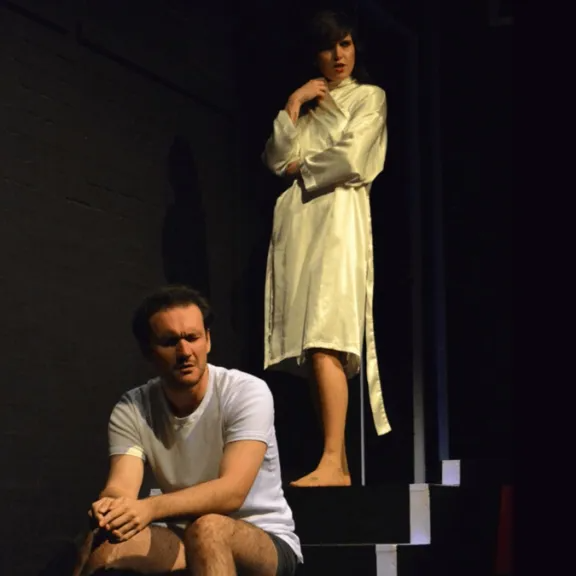
It is always difficult to review plays by Harold Pinter without giving away too much of the plots. “What plots?” you might ask as it is sometimes difficult to understand exactly what is going on between the characters on stage in front of you – such is the dichotomy of watching a play by Pinter.
The Lover and A Slight Ache is a double bill of plays that might feature the same characters at different points in their lives or it might not. They certainly have different names in each play but could so easily be the same people in the same marriage that is being portrayed before us.
To make matters even more confusing The Lover has two different casts performing on different evenings. One cast is younger than the other and each cast looks at the marriage from different perspectives – one from the point of view of the wife, the other of the husband. This review is of the younger cast.
It was originally written for television but subsequently performed on stage. It’s a play that contrasts bourgeois domesticity with sexual yearning.
Harry Roebuck plays Richard and Catherine Luff is Sarah – who appear to be an ordinary middle-class couple. Their calm discussion about Sarah’s lover initially suggests that their marriage lacks emotional attachment or that they have accepted an unconventional lifestyle. However, a later revelation completely changes this impression. The audience realizes that the couple has created an imaginative arrangement to preserve excitement and passion within their marriage. Pinter suggests that long-term relationships often require creativity and mutual understanding rather than merely following traditional expectations.
The play also examines the contrast between routine and excitement. Everyday married life is presented as orderly, predictable, and stable, while something else in this marriage introduces mystery, desire, and anticipation.
A significant strength of the play lies in its use of dialogue. The conversations appear simple and natural, yet they contain hidden meanings that only become clear as the story progresses. Pinter avoids lengthy explanations, allowing pauses, questions, and seemingly ordinary remarks to build suspense. The audience must pay close attention because every exchange contributes to the gradual revelation of the truth. This understated style encourages active participation and interpretation rather than providing immediate answers. As the dialogue continues, subtle hints suggest that appearances may be misleading.
The play also contains an effective blend of humour and seriousness. The calm conversation about adultery is initially amusing because it defies ordinary expectations. However, beneath this humour lies a serious examination of loneliness, desire, trust, and emotional fulfilment. Pinter balances these contrasting tones skilfully, ensuring that the play remains both entertaining and meaningful.
The setting contributes significantly to the play’s impact. The entire action takes place in the living room of an ordinary suburban house. This familiar domestic environment emphasizes that extraordinary emotional experiences can exist within ordinary lives. The simplicity of the setting keeps the audience focused on the characters and their conversations rather than on external events or elaborate stage effects.
The play’s language reflects Pinter’s distinctive dramatic style. The dialogue is concise, conversational, and often indirect. Important ideas are suggested rather than openly stated, allowing silence and implication to carry as much meaning as spoken words. This economical use of language creates tension and invites the audience to interpret the deeper significance of the characters’ exchanges.
The conclusion is deliberately open-ended yet satisfying.
In conclusion, The Lover is a masterfully constructed one-act play that explores marriage, identity, imagination, and emotional fulfilment through a deceptively simple story. Its realistic setting, carefully crafted dialogue, gradual revelation, and psychologically rich characters make it one of Harold Pinter’s most memorable dramatic works.
A Slight Ache is a one-act play first written for radio. It blends absurdist theatre with Pinter’s trademark “comedy of menace.” On the surface, it tells the story of Edward and Flora, a middle-class couple whose quiet domestic life is disturbed by the presence of a mysterious match seller outside their home. Yet beneath this simple setup, the play explores themes of aging, repression, desire, identity, and mortality.
Edward’s obsession with the old match seller reflects his fear of growing old and dying.
The match seller embodies decay, silence, and mortality—an unavoidable reality that Edward cannot confront. The match seller’s silence contrasts with Edward’s verbosity. Pinter suggests that silence may carry greater power than speech; Edward’s words fail to mask his vulnerability, while the match seller’s silence dominates the space. Edward’s aggressive questioning masks insecurity about his waning virility and authority. Flora’s attraction to the match seller further emasculates Edward, reversing traditional gender roles. Flora’s tenderness toward the match seller reveals her unfulfilled desires and dissatisfaction with Edward. Edward represses his fears and sexuality until they overwhelm him. The match seller is never explained—he may be a real figure, a projection of Edward’s psyche, or even a personification of death itself. His ambiguity is the source of both fear and fascination.
Wendy Megeney as Flora and David Hovatter as Edward give performances of such perfect nuance that they are worthy of gracing any West End stage and Iain Reid as the silent match seller is both menacing and confusing at the same time.
The set by Carla Evans works well for both plays even though they are set twenty years apart.
This is a double bill that will most certainly have you leaving the theatre wondering just what exactly you have just seen. Pinter makes nothing absolutely clear and it is up to the audience to decide exactly what is going on in front of you. If you like to be challenged by what you are watching these plays are most definitely for you. As I heard someone say as I left the theatre, “I haven’t a clue what it was all about but it was very good.”
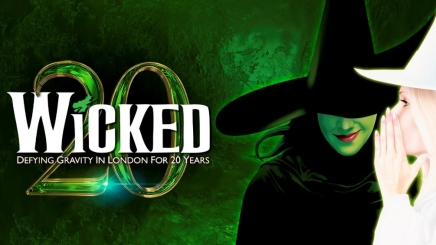
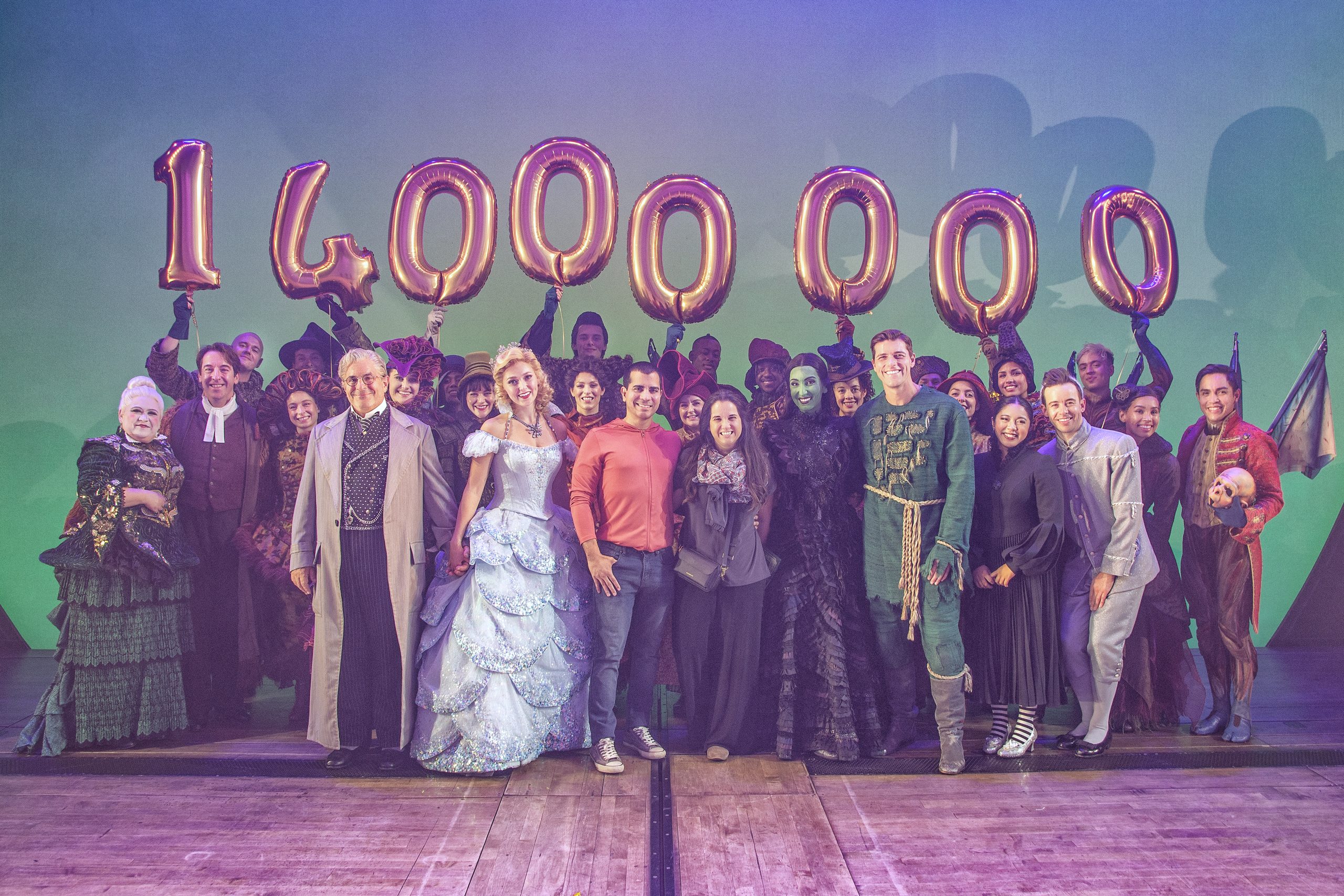
WICKED, the West End stage musical phenomenon that tells the incredible untold story of the Witches of Oz, this week (Wednesday 23 September 2026), welcomed its 14 millionth visitor to London’s Apollo Victoria Theatre, ahead of celebrations for its 20th anniversary this weekend. Pablo and Brenda Ernst, visitors from Arizona, are on holiday in London and attended the performance, the production’s 7784th in its West End home, to celebrate an event of their own – Pablo’s birthday. They were delighted by the birthday surprise and opportunity to meet the cast.
The current London company stars Emma Kingston (Elphaba), Zizi Strallen (Glinda),Jordan Litz (Fiyero), Claire Machin (Madame Morrible), Michael Matus (The Wizard),Ross Carpenter (Boq), Yara Fabricante (Nessarose), David McKechnie (Doctor Dillamond), Laura Emmitt(Alternate Elphaba),Lydia Gerrard (Standby for Glinda),Leo Abad, Iroy Abesamis, Elizabeth Armstrong, Steph Asamoah, Meg Astin, Rebecca Bowden, Shaun Chambers, Erin Gisele Chapman, Lauren Chia, Charles Croysdill, Oraine Frater, Emily Goodenough, Katy Hanna, Nat Ingham, Samuel John-Humphreys, Holly Lawrence, Jemima Loddy, Ellie Ann Lowe, Jamel Matthias, Marcus May, Conor O’Hara, Tom Oliver, Abbie Quinnen, Harry Robinson, Jeanie Ryan, Jessica Saisang-Rowe, Jonah Sercombe, Chris Tarsey, Hannah Taylor and Karen Wilkinson.
Wicked celebrates its landmark 20th Anniversary in its Apollo Victoria Theatre home on Sunday 27 September 2026, and the company will lead celebrations over the anniversary weekend.
SATURDAY 26 SEPTEMBER 2:30PM ‘PINK’ PERFORMANCE
“Let’s have a celebration the Glinda way!”
A celebration of Glinda for Wicked fans, including a Wicked20 commemorative programme and “Pink” gift bag for all ticketholders, with special Glinda costume displays throughout the theatre.
SATURDAY 26 SEPTEMBER 7:30PM ‘GREEN’ PERFORMANCE
“A celebration throughout Oz that’s all to do with me!”
A celebration of Elphaba for Wicked fans including a Wicked20 commemorative programme, and “Green” gift bag for all ticketholders, with special Elphaba costume displays throughout the theatre.
SUNDAY 27 SEPTEMBER GALA PERFORMANCE 2.30pm
“Oh what a celebration we’ll have today!”
All ticket holders will receive a Wicked20 commemorative programme and complimentary gift bag to celebrate Wicked’s 20th Anniversary in London.
Stephen Schwartz and Winnie Holzman’s celebrated stage musical is based on the acclaimed novel by Gregory Maguire and imagines a beguiling backstory and future possibilities to the lives of L. Frank Baum’s beloved characters from The Wonderful Wizard of Oz.Wicked reveals the decisions and events that shape the destinies of two unlikely university friends on their journey to becoming ‘Glinda The Good’ and the ‘Wicked Witch of the West’.
Wicked has music and lyrics by multi-Oscar® and Grammy® Award winner Stephen Schwartz (Godspell, Pippin, The Prince of Egypt,Disney’s Pocahontas, The Hunchback of Notre Dame and Enchanted). It is based on the multimillion-copy best-selling novel Wicked: The Life and Times of the Wicked Witch of the West by Gregory Maguire and written by Emmy® and Tony Award® nominee Winnie Holzman (creator of the landmark American television series ‘My So-Called Life’). Musical staging is by Tony Award® winner Wayne Cilento with direction by three-time Tony Award® winner Joe Mantello.
Stephen Schwartz and Winnie Holzman collaborated on the blockbuster two-part film version of WICKED. WICKED opened on November 22, 2024, and is the highest-grossing film based on a Broadway musical in history. The second film, WICKED: FOR GOOD, opened on November 21, 2025, and is currently the third highest-grossing film based on a Broadway musical. Both films, starring Cynthia Erivo and Ariana Grande, were directed by Jon M. Chu and produced by Marc Platt and David Stone.
The stage musical Wicked is produced by Marc Platt, Universal Stage Productions, The Araca Group, Jon B. Platt, and David Stone.
*Jordan Litz is appearing with the support of UK Equity, incorporating the Variety Artistes’ Federation, pursuant to an exchange program between American Equity and UK Equity.
The Apollo Victoria Theatre, Wilton Road, London, SW1V 1LG
Arena Theatre, Wolverhampton – Thursday 24th September 2026
Reviewed by Nadia Dodd
4****
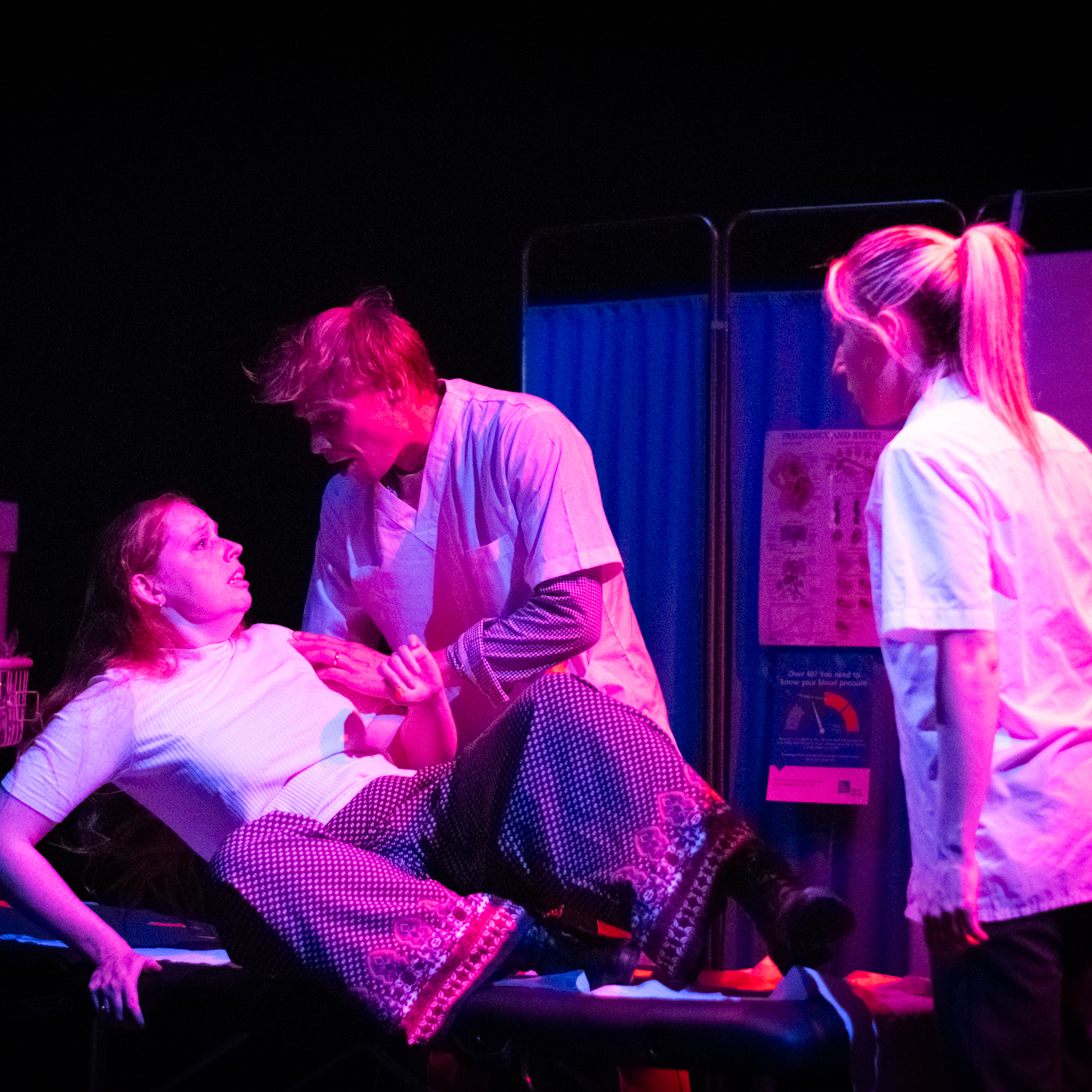
For a three-person production, Tell Me Where It Hurts was gripping from start to finish.
I had never heard of PMDD (Premenstrual Dysphoric Disorder) before this evening. After watching the play, I came away with a much greater understanding of what it is and how much it can affect lives.
Written by Tayla Kenyon and presented by Teepee Productions and Joe Brown, Tell Me Where It Hurts is a funny, touching and very human comedy-drama. It explores PMDD, mental health, relationships and, most importantly, what it feels like when nobody seems to be listening.
At the centre of the story is Chrissy, (Stephanie Booth) a dedicated drama teacher trying to keep her work, her relationships and her emotions under control. Alongside her is Annie, (Tayla Kenyon) a talented but troubled student hoping to win a place at a prestigious performing arts school. Chrissy’s husband Nathan (James Scofield), we see how difficult it is for him to watch someone he loves struggle while not always understanding what she is going through.
You can sense the effect Chrissy’s PMDD has on their relationship too. It isn’t easy for either of them. Nathan is trying to understand something that he cannot see or fully experience himself, while Chrissy is trying to cope with something that can completely overwhelm her.
What I found particularly touching was that Nathan’s character shows that PMDD doesn’t just affect the person living with it. It can affect partners, families and the people who are trying their best to help.
As their stories unfold, we see two women who, in very different ways, are struggling to be heard and understood.
What I really liked about this production is that it tackles such a serious subject without becoming a lecture. There is plenty of humour, and often it comes just when you need it.
The funny moments don’t take away from the more difficult parts of the story. Instead, they make the characters feel real. After all, that’s life. You can be having the worst day imaginable and still find yourself laughing at something completely ridiculous.
The three performers bring warmth and vulnerability to their roles. Chrissy’s experiences are particularly affecting. We see her trying to explain that something isn’t right, while struggling to get other people to understand what she is going through.
The play also highlights how easily women’s health problems can be dismissed or misunderstood.
What makes the story even more powerful is that it doesn’t give us perfect characters with easy answers. They are complicated, emotional, sometimes frustrating and occasionally make mistakes — in other words, they are human!
There are moments that hurt, moments that make you laugh and moments that make you sit quietly and think.
By the end, I found myself thinking about how important it is to listen a little more carefully, judge a little less quickly and perhaps ask someone we care about a very simple question:
“Are you actually okay?”
Tell Me Where It Hurts doesn’t promise easy answers. What it does offer is empathy, humour and a reminder that sometimes, simply being heard can be the beginning of feeling better.