The Grange Theatre, Northwich – until 10 October 2026
Reviewed by Carla Whittaker and E Sydney
5*****
Most of us know Romeo and Juliet in some shape or form. You have either read it, studied it at school as part of English GCSE or watched one of the films, seen another stage version or just know the basics of the story. Boy meets girl, their families hate each other, they fall hopelessly in love and, as we all know, it doesn’t exactly end well. As the story is so familiar, I think there is always an added challenge when somebody decides to put Romeo and Juliet on stage as you already know what is going to happen, know some of the famous lines and you know the ending before the lights even go down. So, the difficulty is how directors make an audience care about it all over again and how you make a story that is hundreds of years old feel fresh. For me, The Grange Theatre absolutely managed to do that in their version of Romeo and Juliet.
What I liked almost immediately was that this production didn’t feel like we were being asked to sit politely through Shakespeare because Shakespeare is something we are apparently supposed to appreciate. It didn’t feel heavy, overly formal or stuck in the past. It felt alive. It felt young. It was modern. At times it felt chaotic, but that worked as the story of Romeo and Juliet is chaotic. These are young people living in a world full of emotion, family conflict, anger, loyalty, impulsive decisions and enormous consequences. The pace and style of the production reflected that well and, for me, made the whole story much easier to connect with.
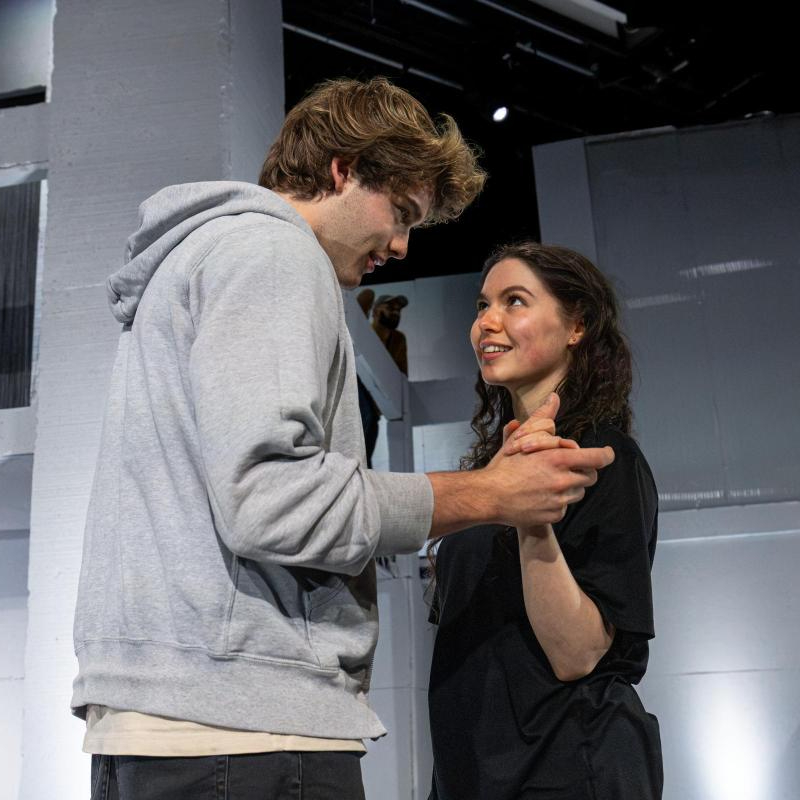
This performance was very much a modern Romeo and Juliet . The characters look and behave like young people rather than people who have stepped out of a history book, and there are contemporary touches throughout the production which bring the story into a world that feels much closer to our own. That kind of approach won’t work for everybody, and I completely understand that some people may prefer a much more traditional Shakespeare production. Personally, though, I loved it. I didn’t feel that modernising the setting took anything away from Shakespeare’s story. If anything, it helped me see parts of the story more clearly.
When you strip away all the things we associate with Shakespeare, Romeo and Juliet are simply two very young people who fall in love incredibly quickly and make huge decisions based on emotion. They are surrounded by adults who have their own ideas about what should happen, their families are locked into a feud that neither Romeo nor Juliet created, and yet they are both expected to live with the consequences of it. Watching that play out in a modern setting made those themes feel far more immediate. It stopped feeling like a distant story about people from another time and started to feel like a story about young people, family pressure, loyalty, anger, grief and love. None of those things have disappeared over the last four hundred years.
One of the things I had read before seeing the show was comment around the pace of the production and the suggestion that some of Shakespeare’s words could get lost because everything moves so quickly. I can understand where that view comes from as there are moments where the dialogue comes at you fast. Personally, though, I didn’t see that as a negative. In fact, I think slowing everything down too much would have taken something away from the story. Romeo and Juliet is an incredibly fast story when you stop and think about it. They meet, they fall completely in love, they make plans to be together, they marry, people die and everything begins to unravel over a very short period. These aren’t two people carefully weighing up every consequence and making sensible decisions. They are young, emotional, impulsive and completely swept up in what is happening around them.
For me, the pace reflected that brilliantly. It made everything feel increasingly frantic as the story developed and, rather than distracting from what was happening, I thought it helped. You get the sense that events are moving faster and that the characters are losing control of the situation. By the time everything starts to fall apart, you almost feel as though they are being dragged towards the ending with very little chance to stop and think. That worked for me because that is exactly how the story feels.
I also don’t think you need to understand every single Shakespearean word to understand Shakespeare. Sometimes I think that is one of the biggest things that puts people off. We become so focused on whether we understand every sentence that we forget to watch the actors and see what they are showing us. In this production, you understand the relationships. You see the anger. You understand the attraction between Romeo and Juliet . You know when somebody is joking, when somebody is frightened, when somebody is grieving and when everything is beginning to go horribly wrong. So much is communicated through expression, movement, tone of voice and the interactions between the characters that you don’t spend the whole performance mentally translating every line into modern English.
That is one of the reasons I genuinely think this production would be good for somebody who thinks they don’t like Shakespeare. If your memory of Shakespeare is sitting in a classroom taking turns reading lines out loud, trying to work out what on earth everybody is talking about, then I completely understand why the idea of voluntarily going to watch Romeo and Juliet might not immediately appeal. But this feels completely different. You are watching a story rather than studying a text. You are watching people rather than analysing characters for an exam. You can just allow the story to unfold in front of you, and I think that makes such a difference.
The performances also really helped with that. Olly Rhodes gives Romeo a very youthful quality and you can completely believe that this is somebody who is ruled by whatever emotion he is feeling at the time. Whether he is in love, angry, grieving or desperate, he throws himself into it. That makes Romeo’s decisions make more sense because you are constantly reminded that he is young and impulsive. There are moments where you want to shake him and tell him to stop and think for five minutes before doing anything dramatic, but that is also part of the character. Romeo is not someone who quietly reflects on things for several days. Everything is huge, everything is immediate and everything feels like the most important thing in the world to him at that moment.
Bea Glancy’s Juliet was another part of the production I really enjoyed. Her Juliet didn’t feel passive or as though she was simply being carried along by Romeo or by the adults around her. She had
personality, determination and strength, but you could also see the vulnerability underneath all of that. I think that balance is important as Juliet is still so young. There is something incredibly sad about watching a young girl trying to take control of her own life while the adults around her have already made decisions about what that life should look like. You can see her trying to make choices for herself while everything around her becomes more difficult and more dangerous.
I also enjoyed the way the production handled the wider characters. Rachael Gill-Davies taking on Mercutio and Lady Capulet could easily have been confusing, but it really wasn’t. They felt like two completely different people. Mercutio brings so much energy and humour to the production, while Lady Capulet is obviously a very different presence. The contrast between the two roles worked well and showed just how much can be done through performance, physicality and subtle changes. The wider cast also take on multiple parts, and again I didn’t find that distracting. If anything, it added to the stripped-back feel of the production and kept things moving without making the stage feel overcrowded.
The humour was another thing I really appreciated. I think people sometimes forget that Romeo and Juliet isn’t miserable from beginning to end. There are funny moments and there need to be funny moments. You need to see friendship, excitement, teasing and young love because those lighter moments make the tragedy later hit much harder. If everybody walked on stage looking doomed from the very beginning, there would be nowhere for the story to go. This production allows you to enjoy those moments and then gradually changes the tone as events become more serious. The atmosphere shifts, the consequences start to pile up and before long the production that had been making you laugh feels very different.
I also thought the modern setting worked as it didn’t feel like it was modern just for the sake of being modern. Sometimes contemporary versions of classic plays can feel as though somebody has simply handed the characters mobile phones, put them in trainers and decided that is enough to make it relevant. I didn’t feel that here. The modern touches fitted into the world of the production and helped make the characters feel recognisable without overwhelming the original story. It is still Romeo and Juliet . The language is still Shakespeare. The families are still divided, the love story is still there, and the tragedy is still coming. It has simply been placed into a world that feels closer to ours.
For younger audiences, I think that could make a huge difference. Shakespeare often comes with this reputation for being difficult, formal or something that you need to be knowledgeable about before you are allowed to enjoy it. This production challenges that. You don’t need to be a Shakespeare expert. You don’t need to remember studying the play. You don’t need to analyse every line. You can just watch it. You can watch the relationships develop, watch Romeo and Juliet become completely wrapped up in each other, watch the tension between the families and watch the humour slowly disappear as the consequences become more serious. That, to me, is exactly how Shakespeare should be experienced.
The strange thing about Romeo and Juliet is that there is almost no such thing as a spoiler. We all know what happens and Shakespeare basically tells us at the beginning anyway. Yet the final part of the story still works. I think that is one of the biggest tests of a production like this. You are not sitting there because you are desperate to find out what happens next. You are watching to see how everything gets to that point and, even though you know exactly where it is heading, there is still a part of you hoping that somebody will make a different decision.
There were several moments where I found myself thinking, just wait, don’t do that, speak to somebody, give it five minutes, please check properly before making another enormous life-changing decision. Of course, nobody does, because then we wouldn’t have Romeo and Juliet . But the fact that you still react like that to a story whose ending has been known for centuries says a lot about how well the production draws you in.
What I really enjoyed overall was that this didn’t feel like Shakespeare being performed at an audience. It felt like a story being told to us. There is a big difference. At no point did I feel like I needed to sit there appreciating it because it was Shakespeare. I was simply interested in the characters and what was happening to them. That is probably the biggest compliment I can give the production because, by the end, I wasn’t thinking about the fact that I was watching a play written hundreds of years ago. I was just watching Romeo and Juliet.
I would recommend this production, but I think the people I would particularly encourage to see it are the ones who would usually say, “Shakespeare isn’t really my thing.” I genuinely think this could change some minds. It is modern, energetic, accessible and not afraid to do something different with a story that everybody thinks they already know. Some people may prefer their Shakespeare slower and much more traditional, and that is completely fair, but for me the faster pace worked. It matched the chaos of the story, it gave the production energy and it kept everything moving.
Most importantly, it made Shakespeare feel accessible without making it feel dumbed down. It respected the original story while finding a way to make it feel current, relatable and emotionally immediate. That is not always easy to do, especially with a play as well-known as Romeo and Juliet , but this production manages it.
By the end, I wasn’t thinking, “That was a good Shakespeare production.” I was simply thinking, “That was a really good night at the theatre.” And for somebody who thinks they don’t like Shakespeare, that might be the best recommendation of all.
Romeo and Juliet is playing at The Grange Theatre in Hartford, Northwich, until 10 October 2026. Tickets are very reasonably priced, there is plenty of parking available, and the theatre has good accessibility for disabled guests. The hospitality is also excellent, with friendly, helpful staff who make you feel really welcome from the moment you arrive.