Cambridge Arts Theatre – until Saturday 17 October 2026
Reviewed by Steph Lott
5*****
The Cambridge Greek Play is something of a survivor. Since 1882, when undergraduates first staged Sophocles’ Ajax in the original Greek, the university has kept returning to the ancient stage, settling into a three-yearly rhythm that has outlasted two world wars and many changes in how the classics are taught. Over the years it has drawn on remarkable talent: Vaughan Williams wrote his still-popular overture for the 1909 Wasps, and the tradition of commissioning new music continues this year with a score by Richard Causton. There is a pleasing symmetry in this year’s choice, too. Ion was last performed here in 1890, so Rosalind Parker’s production is a return to one of the tradition’s earliest chapters and a rare chance to see a play that seldom reaches the stage in any language.
Anyone wary of an evening in Ancient Greek need not be. I loved simply listening to the language, its rhythms and textures, while the subtitles were clear, well-timed and never distracting. What impressed me most was how the young cast handled the challenge. Delivering every line in a language no one has spoken for two thousand years could easily sound stilted or recited. Instead, the dialogue was fluent and natural, spoken as if the actors had been arguing in Greek all their lives.
Causton’s score, under the musical direction of Elliot Park, was a real pleasure. The choice of instruments and the way the music supported the atmosphere did much to conjure the setting of Apollo’s temple at Delphi, shifting with the play’s changes of mood without ever overwhelming the words.
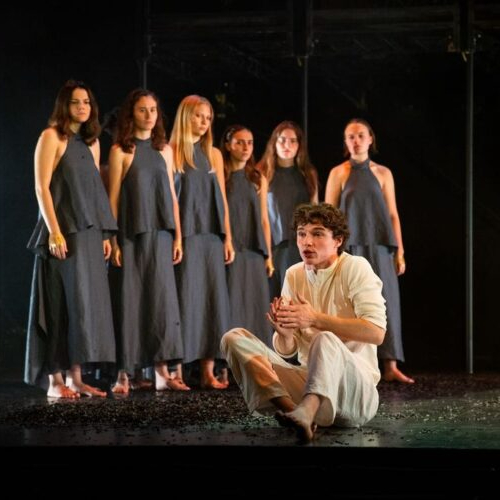
Among the cast, Dylan Hughes was particularly impressive as Ion, the foundling raised in the god’s service and now on the edge of adulthood. Iris Tadie gave a delicate, nuanced performance as Creusa, a woman carrying the long-buried trauma of Apollo’s assault and the loss of her child. It is a demanding role, and she never tipped it into melodrama. The chorus was outstanding. They moved and spoke with striking unity and their presence on stage was genuinely unsettling, a reminder of how powerful the Greek chorus can be when it is fully realised rather than treated as a convention. And when Daphne Stavride appeared as Athena, she was truly goddess-like; her entrance was one of the evening’s most memorable moments.
Ion is often described as a play with a “happy ending”, and in one sense it is: no one dies. Yet the reconciliation it offers is far from comfortable, and Creusa is given no real resolution for what she has suffered. The production’s decision to close with the fourteenth Homeric Hymn, To the Mother of the Gods, felt fitting on several counts. As a call to the divine feminine, it was a lovely resonance with a play so centred on motherhood. It acknowledged Creusa’s lack of closure rather than papering over it. And it eased the audience gently out of the world of Ancient Greece and back into our own.
This was a thoughtful, beautifully performed production that does credit to a tradition now almost 150 years old. If the Greek Play continues to be staged with this much skill and imagination, its future looks as secure as its past is distinguished.