Theatre@41, York – until Saturday 23 May 2026
Reviewed by Lauren Fordham
5*****
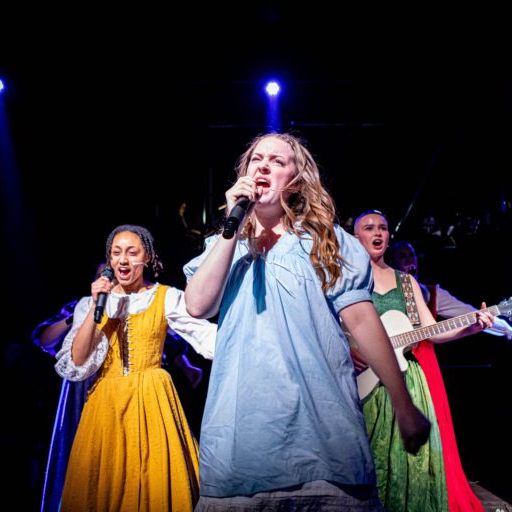
‘Spring Awakening’ is a folk-rock musical based on the play by Frank Wedekind set in late 19th-century Germany where a group of teenagers learn about and experience sex for the first time within the confines of a rigid, repressive, heteronormative and heavily patriarchal society. The book and lyrics of the musical were written by Steven Sater, and the music was devised by Duncan Sheik.
Wendla (played by Rianna Louise) is a teenage girl who pleads with her mother (Gemma McDonald) to tell her how babies are made, as she still does not know, despite becoming an aunt for the second time and no longer believing her mother’s tale that babies are delivered by a stork.
Wendla’s innocence and the sexually repressed nature of the time and culture she lives in are symbolised by her promise to hear the facts of life while her face is hidden under her mother’s skirt, like a child playing peekaboo, whilst also evoking the process of vaginal childbirth. Her mother still does not tell her the true process of sex, demurring that it is something that happens when a wife loves her husband.
Wendla’s innocence is also conveyed by her costume, a heavy, full length pale blue dress with a white petticoat underneath, concealing every inch of skin from the neck down. This is evocative of popular images of the Virgin Mary and Wendla’s own perceived ‘purity,’ as she is also (at the beginning of the show) untouched by man, a skilful and subtle choice by designer Julie Fisher. The idea of female purity is also conveyed by having Wendla and the rest of the female cast perform barefoot, and when Wendla steps into the soil-filled platform it represents the repressive, prevailing hegemonic idea of the time that girls and women learning of and leaning into their sexuality was to defile, or literally, soil themselves. To this modern, feminist, female reviewer it also recollected the misogynistic stereotype yet in this case contextually accurate concept of women being ‘barefoot and pregnant,’ without any agency over their finances, housing or bodies – a prescient image that foreshadows Wendla’s fate after she becomes pregnant by Melchior.
Fisher also utilises symbolism in her use of colour for the adolescent boys’ costumes; their khaki green blazers and trousers not only represent smart school uniforms but also evoke the title ‘Spring Awakening’ because they are reminiscent of budding saplings and act as metaphors for the teenagers’ emotional, psychological, physical and chronological growth.
This production of ‘Spring Awakening’ is staged in- the-round, meaning the audience surround the set on all sides. This means that for the front row audience, the cast are within touching distance and this hugely amplifies the emotional impact of what is thematically alone an unremittingly intense show. The set itself is simple yet powerful, a ground-level rectangular platform filled with earth, symbolising both growth of new life, and death, as it becomes a grave site for two of the characters.
Roses were placed on the invited press’ chairs to accentuate this symbolism. This and the use of lanterns later in the show bear similarity to the musical ‘Hadestown’ and I’m sure Dan Crawfurd-Porter, who plays the charismatic Melchior, could be equally beguiling as Orpheus, or even Fiyero in Wicked.
(Digressing from the review momentarily, as a wheelchair user it was really refreshing to see a set and backstage area that was fully accessible as most are not.)
Inspired By Theatre have an aptitude for technical and casting innovation, the latter demonstrated by their assigning a traditionally male role to a female-presenting actor (previously, Judas in ‘Jesus Christ Superstar’ played by Kelly Ann Bolland, in ‘Spring Awakening’ Moritz Stiefel, played by Eryn Grant.) Grant’s Stiefel is neurotic and possibly neurodivergent as they seemed to be stimming with anxiety in the school scene, an energy they carry with them as they plead with the much more worldly Melchior to explain the erotic dreams that they are having, but only by essay. Grant’s casting adds an extra, desperate, somewhat sexual tension between them and Melchior .
Stefan Michaels cuts a stern, Dickensian figure reminiscent of Nicholas Nickleby’s Wackford Squeers as the boys’ harsh Latin master and headteacher, Herr Sonnenstich, and a sinister, spine-chilling one as the abortionist. He and Gemma McDonald make a forbidding pair as they conspire to fail and exclude Moritz from school despite his successful exam performance. McDonald’s maroon dress made me think of Professor Quirrell, the two-faced killer Voldemort in the Harry Potter novels (McDonald could also be considered as two-faced, as she plays both Melchior’s mother, who is kind to Stiefel, as well as the teacher who sabotages him.) When Michaels is harassing Melchior to admit that he wrote the visual essay about sex it reminded me of Dumbledore shouting at Harry Potter repeatedly, ‘Did you put your name in the Goblet of Fire?’ Although, the latter supposedly had his student’s welfare in mind, which Michaels’ character definitely did not. This thought, along with the number ‘The Bitch of Living’, where the boys sing of their erotic fantasies, while crass, provided a welcome moment of levity in the show. The chauvinistic but annoyingly catchy lyrics such as Georg’s confession that ‘each night I toss and turn without rest because my day’s at the piano with my teacher and her breasts’ echo Busted’s 2003 anthem ‘What I Go To School For.’ Who knew that Charlie Simpson, Matt Willis and James Bourne walked so Sater and Sheik could run?
Lewis Jordan, who plays Georg, is a brilliant example of a quadruple threat, or should that be quintuple threat as he not only sings, dances and acts but also plays piano, glockenspiel, cajon and bass guitar! He and fellow singer-guitarists JJ Thornton, Oskar Nuttall, Kailum Farmery, Skye Pickford and Eryn Grant put the Broadway cast of Spring Awakening to shame.
The ‘Bitch Of Living’ also provided much-needed respite during the writing of this review, from the subsequent dark themes of parent-child sexual abuse that follow in Martha (Maz Nachif) and Ilse’s (Skye Pickford) song ‘The Dark I Know Well.’ During this number I loved the shadow dancing the fleet-footed, fairy-like Pickford’s Ilse did to match Martha, mirroring their shared pain.
The only criticism that I have is that it was difficult to discern some of the lyrics of the songs, especially when characters weren’t facing my side of the audience and where there was prose alongside singing, such as in Wendla and Melchior’s post-coital chanson, ‘The Guilty Ones’. This may be improved by adjusting microphone position or volume but in future it would be wonderful, and expand the audience, if captions could be provided.
This musical and these performers are mesmerising, go see it before 23rd May and awaken your mind to a show that will take root in your mind for long after you leave the theatre, from a cast and company that just keeps blossoming.