
Birmingham Rep – until Saturday 18th April 2026
Reviewed by Nadia Dodd
5*****
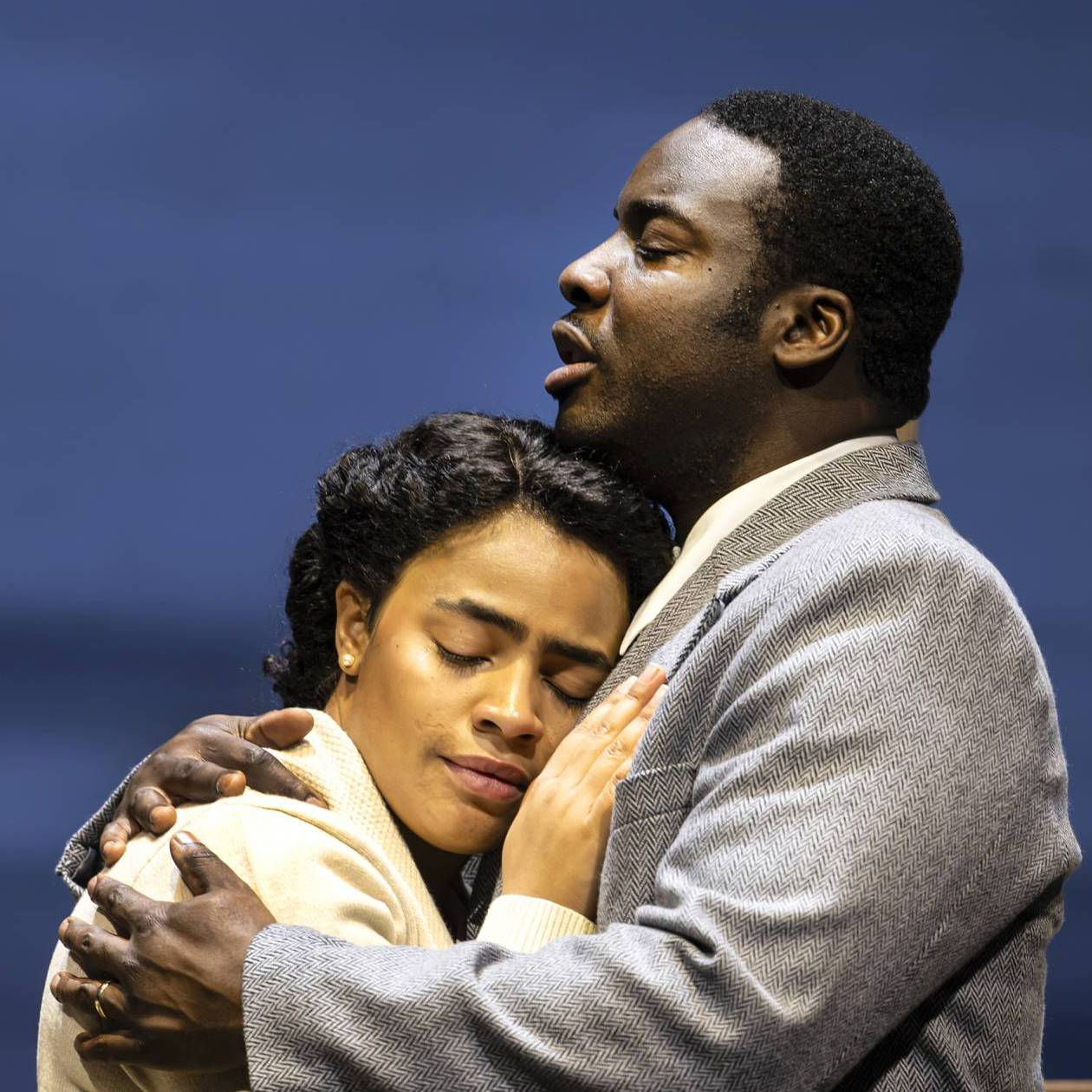
Last night’s production of Small Island at the Birmingham Rep proved to be an absorbing and deeply affecting piece of theatre, one that held our attention unwaveringly across its substantial three hours and twenty minutes, interval included. Adapted by Helen Edmundson from Andrea Levy’s celebrated novel, the production succeeds in translating an expansive, multi-layered narrative into a vivid and emotionally resonant stage experience.
Set against the backdrop of the Second World War and its aftermath, the story traces the lives of Jamaican and British characters, exploring themes of migration, identity, prejudice and hope. The adaptation moves fluidly between Jamaica and Britain, past and present, allowing each perspective to emerge with clarity while maintaining a strong narrative drive.
Central to the production’s success are its richly drawn performances. Bronte Barbe’s Queenie is warm, open and quietly complex, capturing both her kindness and her underlying loneliness. Mark Arends presents Bernard with a convincing rigidity that gradually gives way to vulnerability, revealing the psychological scars left by war. Anna Chrichlow is nothing short of remarkable as Hortense, embodying her character’s pride, ambition and eventual disillusionment with striking precision; her performance anchors much of the emotional weight of the piece.
Rhys Stephenson brings charisma and charm to the role of Michael, making his presence felt even in a relatively limited stage time. His portrayal of the “dashing” Michael adds both energy and poignancy to the narrative. Meanwhile, Daniel Ward’s Gilbert is a standout, offering a layered and evolving performance that reveals many sides of his personality. From optimism and humour to frustration and resilience, Ward ensures Gilbert feels fully realised and deeply human.
The staging is inventive and fluid, relying on minimal set pieces enhanced by effective lighting and choreography to transition between locations. This lends the production a cinematic quality, ensuring that momentum is rarely lost despite the lengthy runtime. The pacing is impressively controlled, maintaining engagement throughout and never allowing the story to stagnate.
What is particularly striking is the balance between humour and gravity. Moments of levity arise naturally from character interactions, providing relief without detracting from the serious themes of racism and displacement. These heavier moments are handled with sensitivity and honesty, never feeling overstated but always impactful.
Given its duration, one might expect the production to feel overlong, yet the richness of the storytelling and the strength of the performances ensure sustained engagement. By the final act, there is a palpable sense of emotional investment in the audience, a testament to how effectively the production draws viewers into its world.
It was only after the performance that I realised Small Island had previously been adapted as a BBC drama—something I am now keen to seek out. Nevertheless, this stage adaptation stands firmly on its own merits, offering an immediacy and intimacy that feels uniquely theatrical.
In sum, Birmingham Rep’s Small Island is a powerful and rewarding production. It is undeniably a long evening, but one that feels entirely justified by the depth and breadth of the story being told. We left the theatre not only moved but reflective, having been truly gripped from beginning to end.