
Birmingham Rep – until Saturday 28th March 2026
Reviewed by Nadia Dodd
5*****
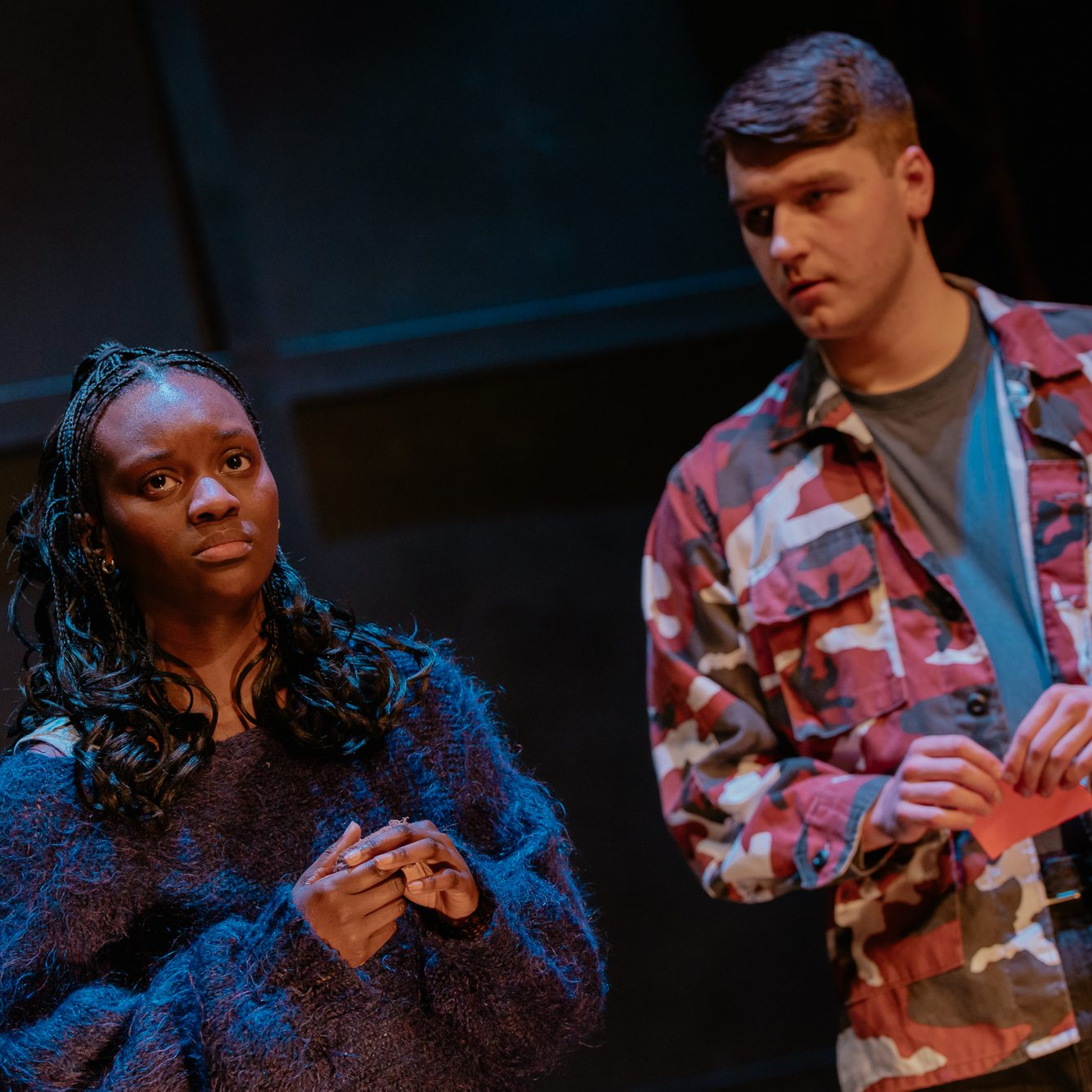
Last night’s performance of Noughts and Crosses at Birmingham Rep offered a striking and emotionally charged adaptation of Malorie Blackman’s novel, brought vividly to life by Sabrina Mahfouz’s dynamic script. From the moment the lights dimmed, it was clear this production was not only a retelling of a beloved story, but a reimagining that speaks directly to a contemporary audience—particularly the impressive number of teenagers and young adults in the theatre, whose engagement throughout was both encouraging and energising.
At its core, Noughts and Crosses remains a deeply affecting exploration of systemic inequality, prejudice, and forbidden love. The central relationship between Sephy and Callum was portrayed with nuance and sincerity by Brianna Douglas and Lewis Tidy. Douglas captured Sephy’s internal conflict—her privilege clashing with her compassion—with a compelling blend of vulnerability and determination. Opposite her, Tidy’s Callum was equally powerful, embodying both quiet resilience and simmering frustration. Their chemistry grounded the production, ensuring the emotional stakes remained high throughout.
What set this production apart was its ensemble-driven approach. Rather than relegating supporting characters to the background, the rest of the cast seamlessly transitioned between individual roles and collective storytelling. This fluidity added depth and texture to the narrative, reinforcing the sense that this is not just a story about two individuals, but an entire society grappling with division and unrest.
The staging and design were particularly noteworthy. The set was ingeniously multi-functional, transforming swiftly between locations with minimal disruption. Platforms, levels, and movable pieces created a sense of constant motion, mirroring the instability of the world being depicted. This adaptability allowed scenes to flow into one another with cinematic precision, maintaining momentum and keeping the audience fully immersed.
Equally impressive was the integration of media and interactive elements. Projections and digital visuals were used not as mere embellishments, but as integral storytelling tools—enhancing the emotional tone and providing context without overwhelming the live performance. These elements felt especially effective in connecting with the younger audience members, bridging the gap between traditional theatre and the digital landscapes they are so familiar with.
Perhaps the most heartening aspect of the evening was the audience itself. Seeing so many young people and visibly engaged with the performance was a reminder of theatre’s enduring relevance. Their reactions—laughter, gasps, and attentive silence—underscored the power of stories like Noughts and Crosses to resonate across generations.
Overall, this production was a bold and thoughtful interpretation that honoured the spirit of the original novel while embracing innovative theatrical techniques. With strong performances, inventive staging, and a palpable connection to its audience, it stands as a testament to the vitality of modern theatre and its ability to provoke, inspire, and unite.