
Tanya Moiseiwitsch Playhouse Sheffield– until Saturday 4th April 2026
Reviewed by Claire Moore
4****
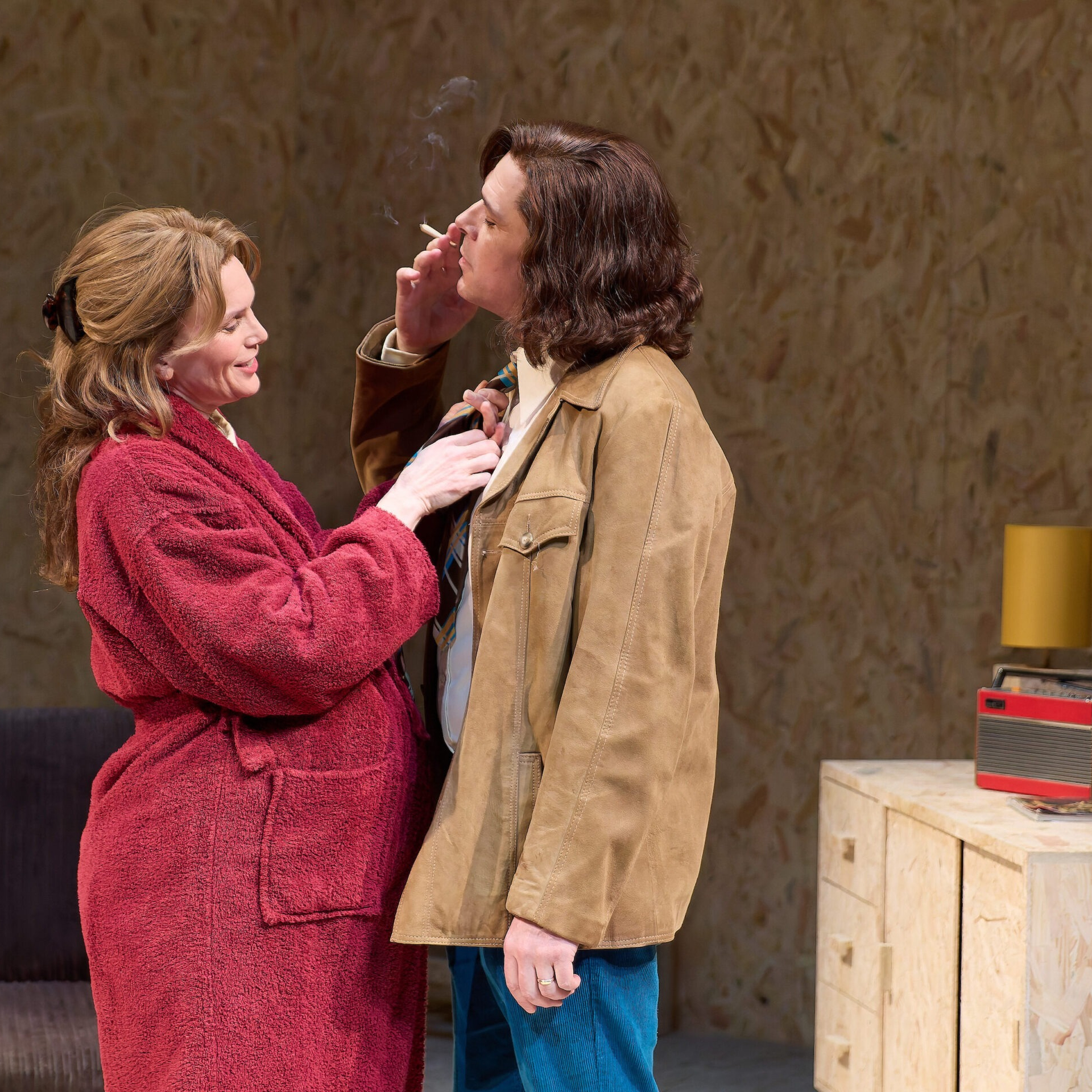
Set in Sheffield, the play begins in 1969 as Kathy and Brian move into their first home in Burngreave, full of hope as they start out in life. But as anyone who’s lived a bit knows, life rarely goes exactly to plan. What unfolds is a story that spans decades — raising a family, juggling money and work, and navigating a world that keeps changing around them.
Written by award-winning Sheffield playwright Leo Butler, this state-of-the-nation drama takes place entirely in the front room. A cast of eight perform over 30 roles, bringing to life a wide range of characters across the 55-year span of the play.
Liz White is outstanding as Kathy, capturing that northern mum resilience that’s equal parts inspiring and, as any northern kid knows, slightly terrifying. She holds everything together — raising two children, working every shift she can, and looking after everything and everyone around her. Which makes it all the more powerful when, by the end, she’s the one who needs looking after. It feels like life has slowly taken the fight out of her, and it’s portrayed so beautifully that it can’t help but break your heart a little.
Kenny Doughty brings a steady, grounded presence as Brian, her husband, as we watch their relationship shift and change over the years. They have both been cast well, and their relationship and love for each other feel completely believable.
Throughout the play we see their children grow up — Mike (Samuel Creasy) and Rebecca (Abby Vicky-Russell). There are arguments, worries and fallouts, often driven by that feeling each generation has that they’re facing the hardest time and carrying the biggest battles. But as the years unfold, you start to see that every generation has its own challenges — just in different forms.
All other roles are performed brilliantly by Harki Bhambra, Michelle Bonnard, Andrew Macklin and Melina Sinadinou. I was particularly impressed with how believable Harki Bhambra was as both an awkward schoolboy and a middle-aged carpet salesman.
The dialogue is fast paced, with a clever touch where the last word of one sentence becomes the first of the next, shifting us into a different time and scene. At times, it genuinely feels like you’re sitting in the front room with them — multiple conversations happening at once, with shifts in volume guiding where your attention should be. It feels real and authentic.
Sarah Beaton’s set design is simple but works well, with nostalgic props marking the passing of time — I’d forgotten the fun (and frustration!) of trying to work a new video recorder, and I’m quite happy to forget the shell suits. Scene changes are smooth and seamless, keeping everything moving without breaking the flow.
The second half felt a little longer than it needed to be at times. That said, the strength of the story still carries it through.
The play doesn’t shy away from difficult conversations or challenging opinions. But I suppose the front room is exactly where those conversations happen — where we feel safe enough to say what we really think and feel, the things we might not say anywhere else. A lot of it is hard to hear, and you hope that’s because those views are no longer tolerated. But then other moments still feel uncomfortably familiar, and it does make you wonder how much has really changed.
Living is one of those plays that stays with you long after you’ve left the theatre. Maybe it’s because I’m of a certain age, or because it’s set so close to home, but the names, places and moments made me feel part of it. The intimacy of the Playhouse means you feel every high and low, and as we’re taken through the decades, you start to notice the patterns. The struggles don’t disappear; they just change shape. It’s a reminder that there isn’t always a neat “happy ever after”, and maybe there never was. Instead, it brings you back to what really matters — making the most of your own life, and the people in it. In the end, all we can really do is start living.