
Birmingham Rep – Sunday 15th March 2026
Reviewed by Nadia Dodd
4****
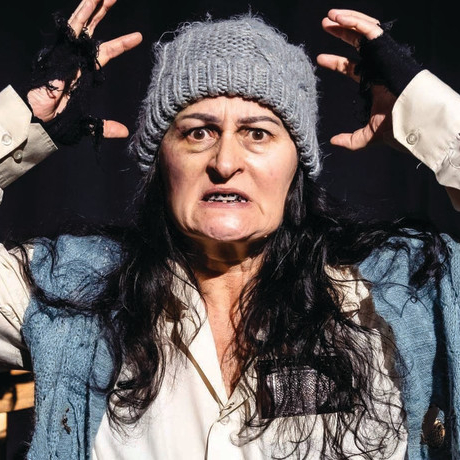
Myra’s Story arrives at The Birmingham Rep as a powerful reminder of how precarious life can be. Written by Irish playwright Brian Foster and performed as a one-woman show by Fionna Hewitt-Twamley, the production delivers a raw, intimate portrait of homelessness, addiction, and resilience. With nothing more than a few simple props and the strength of a single performer, the play reveals how easily an ordinary life can unravel.
At the centre of the story is Myra McLaughlin, a homeless woman living on the streets of Dublin. Over the course of the evening, she recounts the circumstances that brought her there: a childhood shaped by poverty, the loss of her child, and the slow descent into alcoholism that followed. Yet Myra’s Story is far from a simple monologue. Instead, Hewitt-Twamley inhabits an entire community around Myra, shifting seamlessly between fifteen different characters who have shaped her life.
The most striking achievement of the performance is Hewitt-Twamley’s remarkable versatility. With subtle shifts in posture, voice, and expression, she transforms from Myra into priests, social workers, pub regulars, family members, and fellow rough sleepers. Each character feels distinct and believable, bringing Dublin’s streets vividly to life. The transitions are so fluid that the audience quickly forgets they are watching a single performer.
Despite the heavy themes, the play is laced with humour and warmth. Myra herself is sharp-tongued, observant, and often disarmingly funny. Her anecdotes about Dublin life provoke genuine laughter, creating moments of relief before the story returns to darker territory. This balance between humour and heartbreak is one of the production’s greatest strengths. It ensures the audience connects with Myra not as a symbol of social hardship, but as a complex and deeply human individual.
Hewitt-Twamley’s portrayal never slips into sentimentality. Instead, she presents Myra with honesty and dignity, allowing the character’s flaws, regrets, and stubborn resilience to coexist. The performance invites empathy without demanding pity. By the end of the play, the audience feels they have been confided in rather than simply told a story.
The minimalist staging at The Birmingham Rep serves the piece well. With little in the way of scenery, the focus remains firmly on the storytelling. This simplicity allows the audience’s imagination to fill in the streets, pubs, and shelters of Dublin while keeping Myra’s voice front and centre.
Perhaps the most powerful aspect of Myra’s Story is its underlying message: that homelessness is not the result of a single failure but a chain of circumstances that can happen to anyone. The play quietly suggests that a few different turns of fate—“a flip of a coin,” as Myra implies—could lead many lives down a similar path.
By the final moments, the theatre sits in reflective silence. What begins as the story of one woman becomes something much broader: a compassionate reminder of shared vulnerability and humanity. Through a tour-de-force performance by Fionna Hewitt-Twamley, Myra’s Story proves that the simplest theatrical form—a single actor and a powerful story—can be the most affecting of all.