Birmingham Rep – until Saturday 7th March 2026
Reviewed by Nadia Dodd
5*****
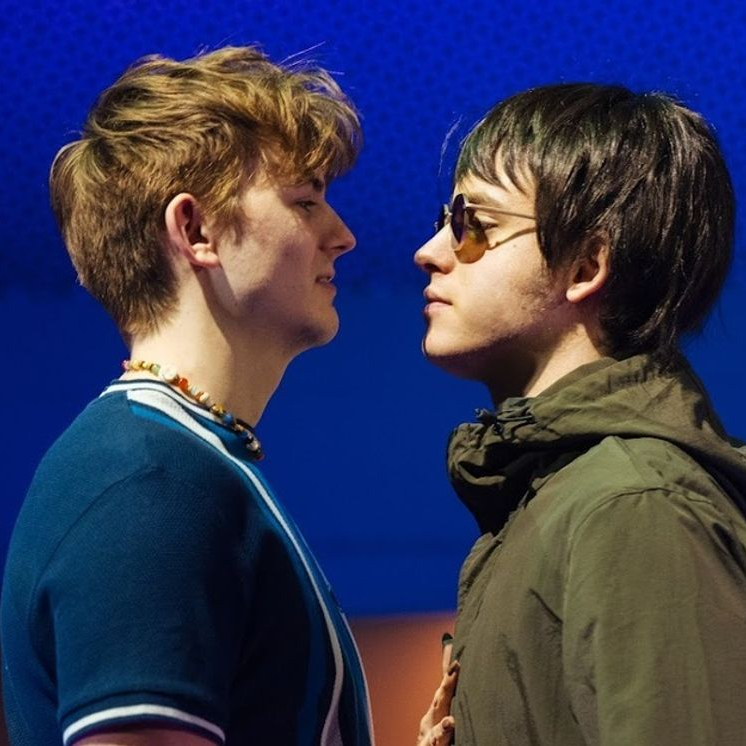
The Battle crashes onto the stage like a distorted guitar riff from 1995 — loud, cocky and absolutely gagging for a fight. Written by John Niven and directed with turbo-charged flair by Matthew Dunster, this gloriously profane comedy dives headfirst into the era of 90s Britpop and the legendary Oasis vs Blur chart war.
Front and centre are Damon and Liam, played with swaggering brilliance by Oscar Lloyd and George Usher. Lloyd’s Damon is all art-school smirk and calculated cool, relishing every smug aside, while Usher’s Liam is a firecracker in a parka — prowling, snarling and delivering insults like they’re platinum singles. Comic timing is razor sharp, each pause and pout milked for maximum effect. It’s less polite rivalry, more playground brawl with record deals attached.
The language? Filthy. Gloriously, creatively, unapologetically filthy. Audiences should prepare for industrial levels of swearing, deployed with such rhythm and invention that it becomes a kind of poetry. Niven’s script revels in the egos and excess of the era, and the cast hurl expletives with fearless commitment. If you’re easily shocked, bring earplugs. If not, buckle up.
Adding fuel to the chaos is Liam’s long-suffering brother Noel, played wonderfully by Paddy Stafford. Stafford’s Noel often appears as the only man in the room with a flicker of common sense, though he’s perpetually dragged back into the madness. His weary glances and simmering frustration provide some of the evening’s biggest laughs — a masterclass in saying everything with a single look.
There’s scene-stealing support, too, from Matthew Horne as Andy Ross, whose music industry polish barely disguises a man gleefully stoking the feud for sales. Horne leans beautifully into the opportunism, all nervous charm and corporate spin. Louisa Lytton brings warmth and steel as Meg, cutting through the laddish posturing with grounded intelligence. Lytton ensures Meg is far more than a bystander; she’s a steadying presence amid the testosterone storm.
The multi-dimensional set shifts and slides throughout, cleverly repositioned by members of the cast in full view of the audience. Platforms rotate, furniture glides, and entire scenes are reshaped on the fly, giving the show a restless energy that mirrors the volatile rivalry at its heart. These transitions feel choreographed rather than practical — the stage itself seems caught up in the battle.
Dunster’s direction keeps everything moving at breakneck speed. Just when an argument threatens to explode beyond control, a perfectly timed lighting shift or set change spins us into the next confrontation. It captures the sense of a cultural moment spiralling wildly, driven by ego, media hype and genuinely cracking tunes.
And then there’s the ending — which is, frankly, a little bit nuts. It tips gleefully over the edge into full-blown comic absurdity, escalating the madness to a level that has the audience roaring with laughter. It’s the kind of finale that has to be seen to be believed.
By curtain call, The Battle feels like you’ve survived (and thoroughly enjoyed) the Britpop wars all over again — only funnier, louder and with even more swearing. Whether you were Team Blur or Team Oasis, this production proves one thing: in this battle, the audience wins.