
The Little Theatre Leicester – until 31 January 2026
Reviewed by Leanne W
3***
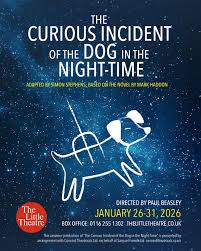
Mark Haddon’s much-loved novel is brought to life in a simple yet effective production at the Little Theatre Leicester. The play follows Christopher Boone, played with precision by Tristan Olesiak, a 15-year-old whose exceptional mathematical ability is matched by his logical and literal view of the world. When Christopher discovers his neighbour’s dog, Wellington, has been mysteriously killed—and is swiftly blamed—he sets out to uncover the truth. His investigation leads him far beyond the initial mystery, unearthing painful revelations within his own family and exposing the secrets his father has long concealed.
Gemma Greaves’ scenic design, constructed by Master Carpenter Dave Towers, cleverly evokes the feel of old-school graph paper. The white, blue-lined surfaces rise to different levels to form walls and doors, creating a visual environment that mirrors Christopher’s structured mindset.
Under the direction of Paul Beasley, a cast of ten brings the story to life. Four performers remain in fixed roles, while the others seamlessly take on multiple characters who populate Christopher’s world. Despite the absence of one cast member in this performance, the overall quality remained impressively unaffected.
The narrative is framed through Christopher’s own words, delivered with clarity and by Karen Sales in the role of his teacher, Siobhan. Making his stage debut, Chris Merricks offers a thoughtful, if not a little empty, portrayal of Ed, Christopher’s father, while Caitlin Mottram brings depth and nuance to the role of his mother.
While this is a solid and commendable amateur production, several roles feel underdeveloped, resulting in missed opportunities for humour and emotional resonance. As a result, the audience is not always given the chance to fully grasp the complexity of Christopher’s relationships or the subtleties of his inner world. Additionally, the inventive set—full of potential for dynamic storytelling—could be utilised more boldly. Props and items hidden within the walls are handled too subtly to be fully appreciated, raising questions about their intended impact. Several moments, unfortunately, slipped into noticeably amateur territory. The overly squeaky rat, the absence of any actual money when characters paid for items, and the use of both a toy dog and an invisible dog all detracted from the production’s realism. The “Swiss Army knife”—which was little more than a basic penknife—also felt inconsistent with the script’s detail. Most challenging to accept, however, was the knocking on invisible doors, a choice that undermined the otherwise thoughtful staging.
Beasley had a golden opportunity with this material, and while the production has many strengths, it ultimately falls short of achieving its full potential