New Wimbledon Theatre, Wimbledon – until 29 November 2025
Reviewed by Phil Brown
4****
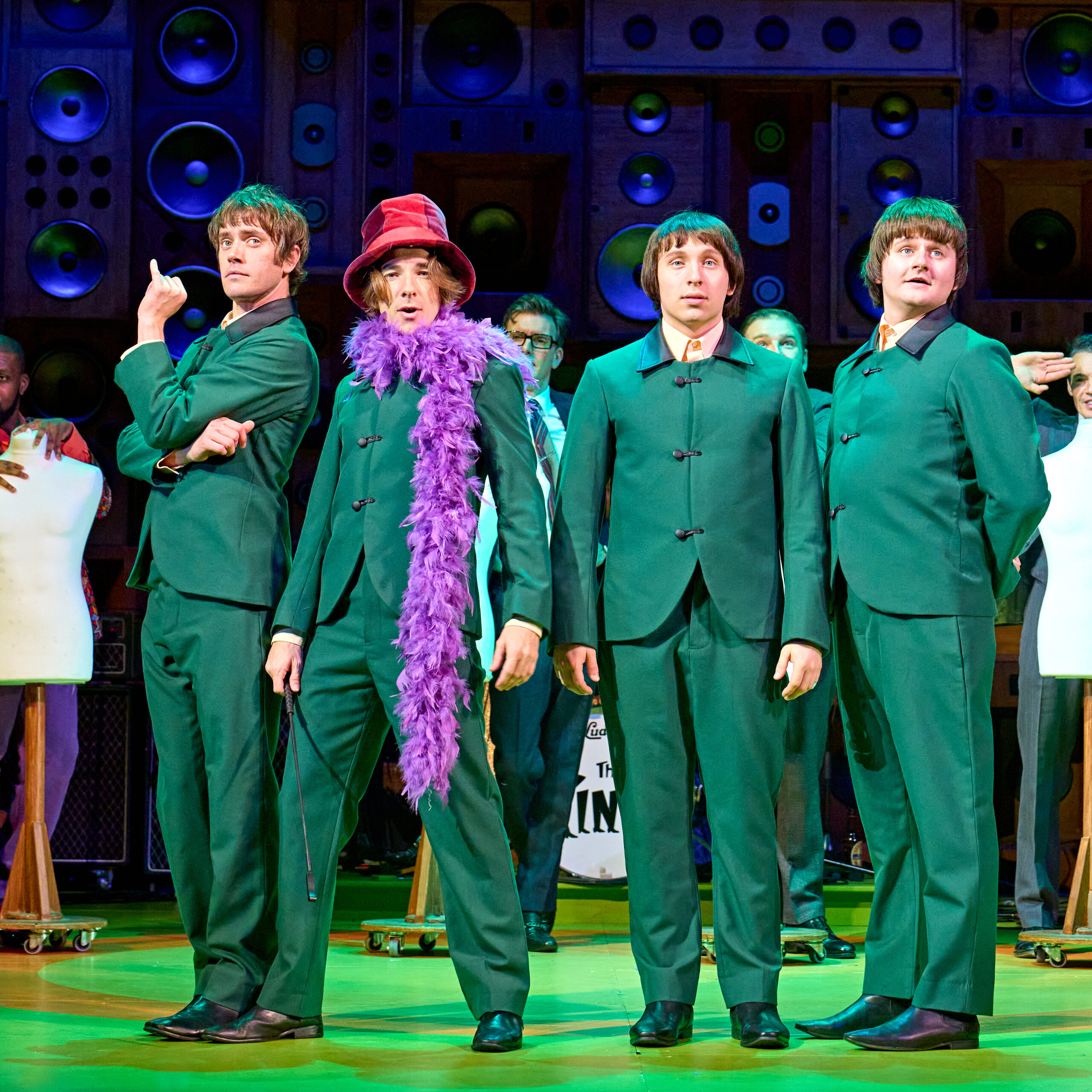
A welcome ray of sunshine to brighten 2025 UK – the brilliant KInks musical, Sunny Afternoon returns! Having premiered at the Hampstead Theatre in 2014, spending two successful years in London’s West End and completing a sensational first UK and Ireland tour, the OIivier award winning Best New Musical is erupting once again onto UK stages. As the most literate of all UK bands, and deeply rooted in British culture, the Kinks are as iconic as red phone boxes, black cabs and Carnaby Street. By rights, they should never have been away…
This well produced two act musical, which covers The Kinks’ early years – 1964 through to around 1970 – makes the compelling case for the band to be the equals of the Beatles and the Stones in the pantheon of British rock gods, courtesy of Ray Davies’ unique ability to combine musical-rhythmic intelligence with his sometimes caustic pinpoint reflections of real life. There is nothing confected about Davies’ songwriting – it is painfully honest but laced with humour and clever observation. A sample rhymes “regatta” with “get at her”. (I’ve heard of yacht rock, but how many times does “regatta” feature as a lyric in a rock song?)
Ray Davies is credited not only with music and lyrics, but also the original story for this musical. (He’s no stranger to musicals – this is his fourth project). That probably explains the intense focus on his concerns and perception of events whilst the other members of the Kinks feature less. Nevertheless, I think the script (Joe Penhall) does a skilful job of balancing the different personalities and it certainly weaves an absorbing story of the band’s progression, linking the different musical numbers cleverly and as smoothly as the lacquering on Ray’s Fender Telecaster. Even for fans of the Kinks, there are some revealing insights, decent jokes, great lines, and apart from the rather corny opening scene, the dialogue with management, promoters, other parasites (as Ray Davies might think of them) and between the band feels properly authentic.
But it’s the performers who have turned this story of a working class North London band into something rather special. I can’t praise the performance highly enough. It’s engrossing, moving and infectious. Director Edward Hall has pitched this well paced show perfectly with well timed moments of high energy, introspection and vulnerability. When the band is performing the musical numbers, it has all the thrill of a real gig and the performers are on superb form.
Casting Director Natalie Gallacher has played a blinder with the two leads – Danny Horn (Ray Davies) and Oliver Hoare (Dave Davies) mesh like real brothers. Both are consummate musicians and portray the contrasting personalities so convincingly, you can feel the sibling rivalry and tension between them.
Ray is a driven man who tries desperately not to be steamrollered. He is principled with experience of life’s ups and downs (like the death of an older sister who gave him his first guitar), but feels weighed down by the relentless pressure to feed the monster that is the music business. At the same time he can be surprisingly sensitive. Lead guitarist Dave on the other hand is an underage teenager in 1964 and a bit of a tearaway.
The other members of the band Harry Curley (bassist Pete Quaife) and Zakarie Stokes (drummer Mick Avory) provide sterling support in both acting their parts and as members of the band which is suitably raw and seriously rocking. Stokes plays an extended drum solo early in Act 2 ( a feature of most acts in those days) and does not miss the opportunity to impress working through an interesting repertoire of skills with precision and crucially not outstaying his welcome (not a feature of drum solos in those days…). Curley gets his chance to solo trying out the bass line to “Waterloo Sunset”.
The story has other key parts: the Kinks’ many managers including the infamous Allen Klein (a brilliant James Chisholm) and the original two, played rather as contenders for upper class twit of the year; Rasa (Lisa Wright), Ray Davies’ first wife has a big presence in the story but a relatively small role, doubling up well as a backing singer; and the Davies family make brief appearances with Dad memorably saying that “Dave’s got straight fingers, good strong hands, but Ray, he boils at a different temperature”.
The stage set is simple but imaginatively appropriate (Miriam Buether) – three walls lined with various speaker cabinets and a studio control room behind visible from time to time. Sound (Matt McKenzie) is superb and the “on stage Kinks” are well accompanied by Michel Cullen (Music Director) and various brass instrumentalists from the cast.
Apparently there are 30 songs crammed into Sunny Afternoon. The show band works almost as hard as the actual Kinks did! Mostly the hits but all are top quality – highly original and superbly crafted. The very helpful Kinks discography in the programme shows how productive they were in the seven years up to the single “Lola” which is the final song of the show. No wonder Ray Davies felt over worked and under rewarded. All songs hit the spot but particularly stand out performances include “You Really Got Me”, “This Strange Effect”, “Sunny Afternoon”, “A Rock and Roll Fantasy”, the beautiful acapella “Days” and of course “Waterloo Sunset”.
This is a proven hit show that most definitely warrants revisiting. It reminds us The Kinks were an essential part of the soundtrack of the 60s and 70s. But it’s neither a soulless run through of The Kinks’ discography nor a particularly feel good story – there is an undercurrent of sadness starting with the death of Ray’s sister, and continuing with the long periods away from home and Rasa, not helped by business struggles, the work schedule, run-ins with publishers and unions and inter band dissatisfaction.
As the final chords of “Lola” ring out and the spotlight fades — you marvel at the passion shown by the performers for the genius of Ray Davies and an incredible body of work and thrill at seeing it performed live. For fans of The Kinks, or of ’60s rock in general, this remains a wonderfully nostalgic and deeply satisfying ride.