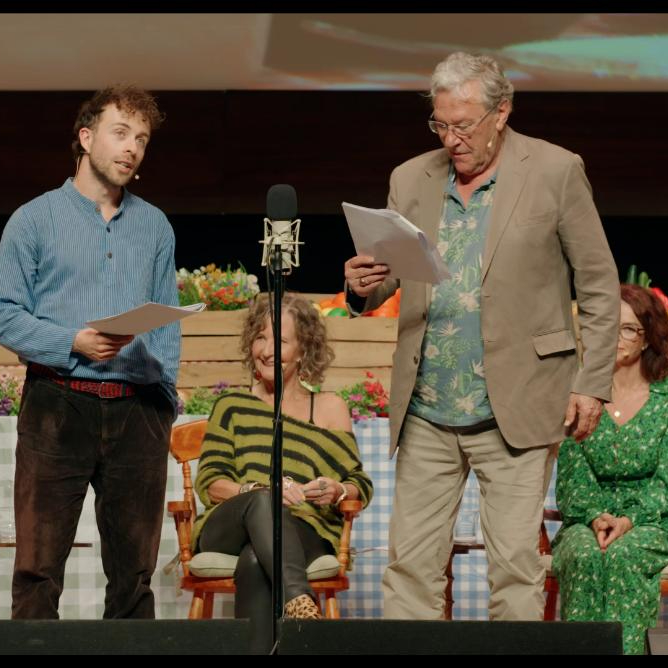
Site Specific Play, Dancing In The Mirror, celebrating legendary boxer

New Play Celebrating the Life of Boxing Legend to Open this Spring

  • Inspired by the life of Sir Henry Cooper, Dancing In The Mirror follows a young boxer on a journey of self-discovery, performed in the iconic boxer’s former Lewisham training ground 
  • Sunday Times best-selling author Rhik Samadder makes his playwrighting debut in collaboration with Lewisham Creative Chorus who will also appear alongside professional actors and musicians 
  • Sir Henry’s nephew will appear as his uncle in the production
  • To raise funds for the show, director Thomas Guthrie will take on British and Commonwealth Heavyweight Boxing Champion Julius Francis on 23rd March as part of the Big Give Arts for Impact week 

The Fellowship Inn, Lewisham 22 – 23 May

Instagram: @musicandtheatre4all | musicandtheatreforall.org 

A new play inspired by legendary boxer Sir Henry Cooper Dancing in the Mirror will open in late May with a site-specific performance in his former training ground, The Fellowship Inn in Lewisham. Cooper’s nephew, opera singer Neal Cooper will make an appearance as his uncle alongside a cast of professional actors and community players in this play with live music written by Sunday Times best-selling author Rhik Samadder. 

Dancing in the Mirror follows Jade, a young boxer living in Belingham who is drawn into a world of buried secrets when she discovers her estranged father is still alive. Spanning a century of South London life from 1919 to the present, this story of identity, belonging and the weight of the past features a professional cast of eight alongside forty members of the Lewisham Creative Chorus, a local performance group based at  The Fellowship Inn since 2022. 

The Fellowship Inn is a Grade II listed 1920s pub famous for being the training ground of Cooper before his iconic 1963 fight with Muhammad Ali. The production marks the centenary of the pub, originally purpose-built as a community arts hub for the Bellingham Estate which has seen local gigs from the likes of Fleetwood Mac, Eric Clapton and John Mayall & the Bluesbreakers. 

Sir Henry Cooper was a British professional boxer, undefeated in British and Commonwealth heavyweight championship contests for twelve years. The only British boxer to have been awarded a knighthood, he is best known for his 1963 fight against Muhammad Ali and was twice voted BBC Sports Personality of the Year. Cooper grew up on the Bellingham Estate in Lewisham where he started his boxing career in 1949, as an amateur with the Bellingham Boxing Club. 

To support the production costs of the show, director Thomas Guthrie will step into the ring at Miguel’s Boxing Gym in Brixton on Monday 23rd March to face Julius Francis, former British and Commonwealth Heavyweight Boxing Championknown for fighting Lennox Lewis and Mike Tyson,. The special fundraising match is part of the Big Give Arts for Impact week (17 – 24 March) a seven-day online match funding campaign supporting arts and culture charities working to achieve societal impact across the UK, run in partnership with Figurative Philanthropy for Arts & Culture (FPAC). Guthrie has been training with Lewisham Creative Chorus member Richard Simms. An ex-con, lifelong boxer, community activist, Richard’s life journey and transformation through community arts reflects the lived-experience of the local community which runs through Dancing in the Mirror

Playwright Rhik Samadder said, “Spending a year embedded in the Lewisham Creative Chorus has been profound. What a wealth of experience, talent, and ideas there is in this extraordinary group, and artistic seriousness. I can’t wait for them to show the world. It has also been a joy to spend creative time with my mother- who it turns out is an inspiration to everyone. She’s far more popular than I could ever be, and the therapy bills for coming to terms with this will surely bankrupt me”.

Director Thomas Guthrie said, “All art, all storytelling is communal. The idea that ‘community art’ is somehow lesser makes no sense at all to me. The more human, the more connecting, the more rooted in a time and place, the better. Working with Rhik, the Lewisham Creative Chorus and the whole creative team here has been extraordinary. We can grow from project to project in a way that isn’t possible in a one-off production. Dancing in the Mirror is the fruit of many lives’ work – and an enormous joy.” 

On training for the fundraising boxing match, Guthrie added, “Training with Richie has not only been an extraordinary experience in itself, it’s deepened how I understand Jade, the whole show even. The mental focus, the physical courage, the particular kind of pride involved in standing in front of someone who wants to beat you down and holding your ground – that’s what this play is about –  and what Henry Cooper was all about too.”

Rhik Samadder is an author, journalist and actor local to Lewisham. Rhik is the Sunday Times best-selling author of I Never Said I Loved You, an autobiographical memoir which is currently being adapted for television. His acting work includes The Indian Boy(Royal Shakespeare Company), Romeo and Juliet (Salisbury Playhouse), King Saturn (Soho Theatre), Fewer Emergencies (Oxford Playhouse), and No Smoke (Arcola Theatre). Rhik is a regular columnist for the Guardian with his feature series Inspect a gadgetand Rhik Samadder tries something newDancing In The Mirror marks Rhik’s playwrighting debut. 

Thomas Guthrie is an award-winning British director and musician working in theatre and music with a conviction that community-led creative projects can be among the most valuable and life-affirming. A former Jette Parker Young Artist Stage Director at the Royal Ballet and Opera in London, Thomas’s previous productions include Aida at Barcelona’s Liceu, the opening of the Edinburgh International Festival 2025 and productions at La Scala, Longborough and RBO itself. Thomas founded MTFA in 2014 with a passion to connect social and local issues with storytelling of the highest quality. He launched the Lewisham Creative Chorus in 2021, and together they have written, produced and performed productions including Our Street and Stories We Tell Ourselves.

Music and Theatre For All (MTFA) is a Lewisham based arts organisation dedicated to making the best quality live music, theatre and storytelling available to as many people as possible. Through aspirational productions, collaborative programmes and transformational thinking, much of its work brings local participants together with professional artists to create original work inspired by lived experience. At its core, the organisation champions excellence through inclusivity, accessibility and the transformative power of live performance.

Company information

Writer Rhik Samadder                           Director and Composer Thomas Guthrie          
Associate Director Vicky Olusanya       Designer Charlina Lucas           Choreographer Maria Ghoumrassi
Music performed by Vox Urbane, Outcry Ensemble & Lewisham Creative Chorus

Produced by Music and Theatre for All (MTFA)

Cast

Neal Cooper as Sir Henry Cooper 
Further casting TBC 

Listings information

22 – 23 May 

The Fellowship Inn, Randlesdown Rd, London SE6 3BT

Fri – Sat, 3pm & 7pm 

£17.00 | musicandtheatreforall.org 

Social media
Instagram         @musicandtheatre4allFacebook         www.facebook.com/musicandtheatre4all#DancingInTheMirror

Supported by Arts Council England

The Choir of Man Review

New Wimbledon Theatre – until 21st March 2026

Reviewed by Carly  

5***** 

The Choir of Man is an absolute triumph of feel-good theatre—uplifting, heartfelt, and bursting with energy from start to finish. From the moment you enter the auditorium, the production breaks down the traditional barriers of theatre. The stage is already alive, transformed into a fully functioning pub where pints are poured and music hums in the background. It’s an inviting, immersive opening that makes you feel less like a spectator and more like a welcome guest settling in for the night. 

At its core, the show is a celebration of community, vulnerability, and the power of human connection. There’s no conventional plot driving the action; instead, the narrative unfolds through a series of songs and spoken-word moments, each revealing something deeper about the characters. What could feel fragmented instead comes across as refreshingly honest and sincere. The show doesn’t try to overcomplicate its message—it simply invites you to listen, reflect, and enjoy. 

The cast is nothing short of exceptional. Their chemistry feels completely natural, as though you are watching a real group of friends rather than a rehearsed ensemble. Vocally, the production is consistently outstanding. The harmonies are rich and powerful, capable of filling the space with electrifying intensity, yet they can just as easily soften into delicate, emotional moments that hold the audience in silence. 

The music itself is another highlight. Familiar songs are reimagined with creativity and care, giving them new emotional weight and relevance. Rather than feeling like a simple jukebox musical, each number feels purposeful, woven seamlessly into the fabric of the show. The transitions between songs and monologues are fluid, maintaining a strong sense of momentum while still allowing space for quieter, more reflective beats to land. 

Visually, the staging is deceptively simple but highly effective. The pub setting never changes, yet it never feels static. Through subtle lighting shifts and clever movement, the space evolves to match the tone of each moment—whether it’s raucous and celebratory or intimate and introspective. This balance keeps the audience engaged throughout, ensuring the pacing remains tight without sacrificing emotional depth. 

What truly elevates The Choir of Man is the genuine warmth and inclusivity that runs through the entire production. It’s not just a performance; it’s an experience that invites you to be part of something bigger. By the final number, the sense of shared joy is undeniable. 

Ultimately, The Choir of Man is about connection—between the performers, the audience, and the stories being told. It’s joyous, unpretentious, and deeply human. As the lights go down, you’re left not only applauding but smiling, uplifted, and wishing you could stay for just one more round. 

Single White Female Review

Everyman Theatre, Cheltenham – until 21st March 2026

Reviewed by Jacqui Radford

4****

Inspired by the iconic 90s psychological thriller film and book and written for the stage by Rebecca Reid, this production is one that keeps everyone guessing at every turn.

The scene is set from the outset; something untoward has happened. The seemingly bland introduction to the challenges faced by divorcee Allie is bound to take a turn for the worst, but the question is, ‘how?’

To make ends meet and provide the ‘very best’ for her teenage daughter, Allie advertises for a lodger. The ideal solution arrives in next to no time; Heddy has a job that fits the brief for a lodger who won’t get in the way and swiftly establishes a rapport with Allie’s daughter Bella.

Immediately we meet Hedy, there are warning signs that she may be more obsessive than anyone could anticipate. Kym Marsh portrays a character who is unnerving; always at the heart of any upset, driving a wedge between Allie’s relationship with her daughter, friend and ex-husband. The audience is on high alert throughout, fully aware of her dangerous influence on Allie’s daughter.

Allie is negotiating the turmoil of parenting a teenage daughter and managing the demands of her career. Lisa Faulkner has created a character who is relatable on every level and that is what leaves the audience more despairing Heddy’s unhinged behaviour.

Amy Snudden, playing Bella, adds a third dimension to the events that unfurl. Bella is central to the entire plot and as onlookers, the audience cannot help but relate to the tension between needing to belong and the vulnerability that creates.

The stage set, lighting, and sound all add to the tension and mystery woven through this production. If you enter the theatre as someone who gives everyone the benefit of the doubt, you may leave with a touch of distrust but don’t let that stop you!

ROCK & ROLL MAN REVIEW

Cambridge Arts Theatre – until 21 March 2026

Reviewed Steph Lott

5*****

I’ll be honest — I wasn’t entirely sure what to expect when I took my seat at the Cambridge Arts Theatre on Tuesday evening for Rock & Roll Man. I knew vaguely who Alan Freed was — the American disc jockey credited with bringing rock ‘n’ roll to the mainstream — but a musical about a DJ? I needn’t have worried. Within minutes, I was grinning from ear to ear and tapping my feet like a teenager.

The show tells the remarkable story of Freed, the man who arguably did more than anyone to bridge the gap between Black musical culture and white mainstream America in the 1950s. It’s a story with real historical weight — themes of personal freedom, racial barriers, and the unstoppable power of music run through every scene. Director Randal Tyler handles this material with real confidence, keeping the energy sky-high while never losing sight of the human story at the centre of it all.

The vintage rock ‘n’ roll material — crafted by Marshak Classic Music and Gary Kupper — is simply glorious. Every song felt authentic, transporting the audience back in time with remarkable ease. These weren’t pale imitations; they crackled with the energy and spirit of the era. Paired with Stephanie Klemons’s choreography, which was sharp, sassy, and enormously fun, the stage fairly pulsed with life.

A huge part of the evening’s success belongs to musical director Dominique Scott and his house band. They didn’t just play the music — they lived it. Scott himself seemed to be having the time of his life throughout, and his portrayal of Jerry Lee Lewis was a highlight of the whole show — a wild, electrifying burst of showmanship that brought the house down. The band took the roof off, quite literally, on more than one occasion.

The whole cast delivered a storming performance, but special mention must go to Shelby Speed, who tackled a dazzling array of roles with tremendous energy and real expertise. Watching her move seamlessly between characters was one of the great pleasures of the evening. Equally delightful were the contributions of The Quartet, who provided some lovely cameo moments and added real warmth and texture to the show.

The audience — a predominantly older crowd, many of whom, I suspect, lived through this era the first time around — were absolutely swept away. The collective joy in that theatre was palpable, and by the time the final number arrived, everyone was on their feet. The standing ovation was entirely deserved and felt like it came from the heart.

Rock & Roll Man is a lovely, warm, and thoroughly entertaining piece of theatre. It works both as a foot-stomping celebration of a golden musical era and as a thoughtful tribute to a man who helped change American culture forever. If you get the chance to see it, don’t hesitate. You’ll leave the theatre feeling ten years younger and very glad you went.

Small Island Review

Leeds Playhouse – until 28 March 2026 (and on tour)

Reviewed by Dawn Smallwood

5*****

Andrea Levy’s Small Island comes to life on stage at the Leeds Playhouse produced jointly by them, Birmingham Rep, Nottingham Playhouse and Actors Touring Company, in association. Levy’s novel examines the history and experiences of Britons and Jamaicans, during World War II and post war migration. Adapted by Helen Edmundson, for its first staging in 2019 at the National Theatre in London, and directed by Matthew Xia. The novel centres around four characters; Hortense (Anna Crichlow), Queenie (Bronté Barbé), Gilbert (Daniel Ward) and Bernard (Mark Arends).

Small Island chronologically documents each of the characters journeys on stage and each of them narrates their experiences. Hortense (Crichlow) yearns to live in England with its polite society but is naïve about actual reality and expectations. She joins her husband, Gilbert (Ward), who served in the Royal Air Force during World War II and faces challenges living as a migrant, in London. There is Queenie (Barbé), an English woman, who hosts servicemen from the Caribbean during the Second World War and post war, newly arrived migrants. This estranges the relationship between her and her husband, Bernie (Arends), who has fixated views on race.

Small Island powerfully and boldly projects the challenges each character faces including colonial and war experiences, racial relations, and tensions, naivety, interracial interactions and relationships and placements issues which migrants face. All the characters reflectively bring varying perspectives, humour, and warmth amid ignorance. These are roused from misinformation and poignancy which ultimately a difficult decision is made and agreed at the end because of the societal attitudes and race relations at the time.

Simon Kenny’s spectacular staging works extremely well with the production, particularly the videography and projections, courtesy of Gino Ricardo Green, from past events during the 1930s and 1940s in both Jamaica and Britain. The videography and projections enhance the characters and the narrations they share. Both creatives are supported by Luke Bacchus’ music, Ciarán Cunningham’s lighting, and Adrienne Quartly’s soundscapes.

Character portrayals from each of the cast are of the highest standard and each portray brings the roles and narration to life. The moving audience is fully informed how each of the characters is feeling with their experiences in hand. One must agree with Levy when she wanted to write this story in that it is a shared history between the British and the Caribbean people, and crucially both stories need to be told to aid rounded understanding. This production certainly consciously and successfully fulfils this.

Small Island offers a lot and how the stories resonate today and the importance of being informed from all perspectives to tackle ignorance, misinformation, and prejudices today. This excellent production is the best opportunity to be acquainted with the shared history and how sharing such stories are so crucial today as it was then. An unmissable production!

DIVERSITY – SOUL UK TOUR 2026

EMPIRE THEATRE, LIVERPOOL – TUESDAY 17TH MARCH 2026

REVIEWED BY MIA BOWEN

5*****

On 30 May 2009, more than 20 million viewers across the UK watched the finale of Britain’s Got Talent, where the London-based street dance group Diversity captivated the nation and emerged victorious. They triumphed over the heavily favoured Susan Boyle with a performance so remarkable that Simon Cowell famously referred to it as “sheer and utter perfection.” Years later, after finally witnessing them live during their Soul tour at the Empire Theatre, it is evident that this description remains entirely fitting.

As I entered the performance, I was uncertain about what to expect. A two-hour live street dance show felt ambitious, and I questioned how the performers would maintain energy, creativity, and audience engagement throughout. What followed, however, was truly breathtaking. From the very first moment, Diversity demonstrated that they are not merely dancers; they are storytellers, innovators, and masters of the theatrical experience.

The show opens with a nostalgic theme focused on “Computers – now and then,” quickly engaging the audience with a playful and relatable atmosphere. A particularly memorable moment sees Ashley Banjo ‘playing’ Super Mario, as the troupe morphs into characters from the beloved game. This clever and vibrant scene, brimming with personality, is an immediate hit with the crowd and establishes the tone for the rest of the performance.

As the evening unfolds, the narrative develops in an unexpected and deeply poignant manner. Ashley Banjo, who takes on the roles of writer, director, and choreographer, has created a production that transcends mere dance. A chance meeting with a stranger named George prompts the performance to evolve into a thoughtful examination of humanity in an age increasingly influenced by technology and artificial intelligence. These reflective moments are presented through exquisitely filmed sequences projected above the stage, intricately interwoven with the live performance.

George’s discussions with Ashley are both poignant and thought-provoking, raising questions that resonate long after the show concludes: What is real? What holds meaning? What does it genuinely mean to be human? These segments infuse emotional weight and depth into the performance, balancing the dynamic choreography with sincerity and reflection.

The choreography is, as anticipated, outstanding. Diversity’s signature style—characterised by sharpness, creativity, and perfect synchronisation—is prominently showcased. The dancers operate as a cohesive unit, their movements intertwining, colliding, and transitioning fluidly between chaos and control. Each routine alternates between moments of explosive energy and intimate stillness, imbuing the performance with a sense of purpose and emotional depth.

Accompanied by breathtaking lighting, creative costumes, and remarkable set design, the show transforms into a complete sensory experience. Every detail is carefully considered, yet nothing seems excessive.

Without a doubt, this is a five-star performance. It captivates, motivates, and lingers in your thoughts long after the curtain descends. More than merely a dance performance, it serves as a poignant reminder to pause, reflect, and be present—an insight I continue to carry with me.

Percy Jackson and the Lightning Thief Review

Leicester Curve – until Saturday 21 March 2026

Reviewed by Leanne W

4****

This stage adaptation of Percy Jackson and the Lightning Thief captures the story’s momentum and humour with confidence, delivering a fast-paced evening that balances spectacle with heart. It’s a show that leans into its mythic adventure while keeping the focus firmly on character and connection. Based on the book by Rick Riordan, and the subsequent films, this is set to be a firm family favourite.

The set design (Ryan Dawson Laight) was particularly effective: industrial in look, but clever and versatile in execution. With simple transformations and smart staging choices, the same core structure shifted seamlessly between camp, classroom, roadway and underworld, keeping the action fluid and the storytelling clear.

The use of projections really enhanced the performance, expanding the world beyond the physical stage and sharpening the sense of place. They added texture and scale to key moments, supporting the pace of the storytelling without ever feeling like a distraction.

The energy of the young cast, under the direction of Lizzi Gee, was great to see, bringing an infectious drive to the fight choreography, comic beats and ensemble movement. Vasco Emauz is a strong Percy, ably supported by Cahir O’Neill as Grover and the fantastic Kayna Montecillo as Annabeth Chase. Simone Robinson was outstanding in all of her roles, with clear definition between each one and the addition of strong vocal ability. Many performers were multi-rolling, switching characters with impressive clarity and timing, which kept the production tight and constantly engaging.

Musically, with direction from Will Joy, the show lands well: there are plenty of uplifting songs that carry the adventure forward and leave the audience buoyed by the ensemble’s momentum. Standout numbers included “The Day I Got Expelled”, “Put You in Your Place” and “The Last Day of Summer”, each bringing a distinct lift in pace, humour and momentum. When the score shifts into more emotional territory, the feeling is palpable, and those quieter moments give the story a welcome depth.

Overall, Percy Jackson and the Lightning Thief is an imaginative, high-energy production with strong visual storytelling and a committed ensemble at its centre. It’s a family show that will clearly delight fans of the books and films, and a great opportunity for young people to experience the magic of theatre. For anyone looking for a lively night at the theatre—packed with invention, warmth and songs that stick—this one is well worth catching.

RSC Hamlet Review

Nottingham Theatre Royal – until Saturday 21 March 2026

Reviewed by Louise Ford

5*****

To sea or not to sea

It seems that the stars are aligned for last night’s performance, with the recent success at the various film awards for the film Hamnet. It always feels good to be ahead of the curve!
Hamlet is regarded as one of Shakespeare’s longest plays, last night’s offering was cut down to a modest 2 hours and 40 minutes, including the interval. So we had an early start and were out before 10.00pm.

It is also worth taking a moment to reflect on how can plays, stories and sonnets written over 400 years ago still be popular, performed,reinterpreted and resonate today? Whilst this review isn’t the place for an examination, and I’m certainly not qualified to attempt this, it has to be that the works cover a whole range of human emotions  that resonate today.

Hamlet the play is believed to have been written towards the end of the 1500s,and is regarded as Shakespeare’s greatest tragedy.

So back to last night’s production ( directed by Rupert Goold) we are presented, as we enter the auditorium, with a dark stage, bare except for a coffin draped in a red flag with a white cross. The set is designed by Es Devlin. As the actors enter the stage the whole set is illuminated, lighting by Jack Knowles. We are surrounded by a moving backdrop of waves and the sea. The video design is by Akhila  Krishnan. The sea is at times calm and gentle at others it is dark and menacing, as the story becomes more dangerous. Oh the perils of being out at sea!

The year is 1912 (I’m not quite sure why perhaps the sinking of the Titanic or the release of the first Shakespeare silent film Richard III) and the story unfolds over a 24 hour period, with the time counted down on digital clocks.

The  action is on the whole set on the deck of the ship, although at times we are taken down into the cabins or the engine room. The set design is on the whole quite minimalistic with the sea taking centre stage. The stage is both slippery and unpredictable as befits a vessel and story charting stormy waters. At times it lurches and bucks and the whole cast are set scurrying from side to side.

As this production is by the RSC we are expecting quality acting and delivery,and we are not disappointed.

The titular role is played by Ralph Davis. He has a commanding stage presence and delivers all of the iconic speeches with humanity. His decent into madness (feigned or otherwise) is prolonged and his appearance becomes more dishevelled as the story progresses. His friend and confidant Horatio (Colin Ryan), brings an energy and lightness to the role. Hamlet’s mother, Gertrude, is played by Poppy Miller, she is not quite the ice queen but she has a coldness until she unravels in the second act. Hamlet’s stepfather, Claudius, is played with dignity and cunning by Raymond Coulthard. He really is quite ruthless but exudes a “silver fox” sexual allure.

Poor old Ophelia (Georgie-Mae Myers) the innocent victim of this play for the crown, is at times physically tossed around before she meets a sad end in the brink.

Everyone’s favourite double act Rozencrantz (Jamie Sayers) and Gildenstern (Julia Kass) are a likeable couple,with a touch of role reversal.

So in summary we have a tale of grief and sadness as well as political manoeuvrings and succession all delivered out at sea. And to butcher a well known phrase there is nothing rotten in the state of this production.

Glorious Review

Windsor Theatre Royal – until 21 March 2026

5*****

Five stars hardly feel enough for Glorious! at Windsor Theatre Royal, a production that delivers laughter, warmth, and surprising tenderness in equal measure. Based on the true story of Florence Foster Jenkins — the famously enthusiastic but catastrophically off-key soprano — this show is a delight from start to finish, and this cast makes it shine.

Wendi Peters takes on the formidable role of Florence, and what a performance it is. It must be incredibly difficult to sing that badly on purpose, yet Peters does so with astonishing precision. Every note is gloriously wrong, every phrase wildly misplaced, and yet the control required to make it sound so convincingly awful is clearly the work of a hugely skilled performer. More than that, she captures Florence’s spirit perfectly – optimistic, determined, and utterly convinced of her own talent. It would be easy to play the role for simple laughs, but Peters gives Florence real vulnerability. Beneath the comedy is a woman who simply loves music and wants to share that love with the world, no matter what anyone else thinks.

Matthew James Morrison is superb as Cosme McMoon, Florence’s long-suffering pianist. His reactions throughout the show are priceless, often saying more with a glance than with a line. The balance between exasperation and affection is spot-on, and his musical partnership with Peters provides some of the funniest moments of the evening. You can almost feel his internal struggle as he tries to keep the performance together while everything around him falls spectacularly apart.

Sioned Jones also deserves huge praise as Dorothy, Florence’s loyal friend and greatest supporter. Jones brings warmth and charm to the role, making Dorothy far more than just a comic side character. Her unwavering belief in Florence adds a touching layer to the story. And Caroline Gruber as Italian maid Maria is hilarious

The production itself is slick and beautifully paced, allowing the humour to land perfectly while never losing sight of the humanity behind the story. The audience laughed constantly, but there were also moments of genuine emotion that caught everyone by surprise. That balance is what makes Glorious! more than just a comedy – it becomes a celebration of individuality, passion, and the courage to follow your dreams, no matter how unconventional they may be.

By the time the final note rang out, the audience was on its feet, and rightly so. This is a five-star performance in every sense: hilarious, heartfelt, and performed with extraordinary skill.

A truly glorious night at the theatre.

Doric String Quartet Review

Festival Theatre, Malvern – 15th March 2026

Reviewed by Courie Amado Juneau

5*****

It was a cold, blustery night that made one question if it was worth going out. Since it was Malvern Theatre for a Malvern Concert Club appearance of the Doric String Quartet I forced myself. And boy was I glad!

First up was Mendelssohn’s String Quartet No. 1. I love it when musicians give us a talk from the stage, perhaps with a little anecdote to illuminate our understanding – and tonight Cellist John Myerscough did just that with several fascinating introductions. The first of these highlighted the similarities between this quartet and the Beethoven later, complete with the quartet playing the first sections of each. Very much enhancing our enjoyment.

From the Beethoven inspired opening sighs to the crushing chords and surprising key centre of much of the last movement, the Mendelssohn piece was a revelation. I had always thought this composer to be a bit conservative, even boring and predictable. But this was nothing like that. Inspired work and playing.

Janáček’s String Quartet No.1 The Kreutzer Sonata was next up. John had described the piece as an intense 15 minutes and he wasn’t wrong. Or exaggerating. The piece was inspired by a novel regarding a rehearsal of Beethoven’s Kreutzer Quartet. If you like early 20th Century music you will love this piece as it is full of that era’s drama, outbursts and use of modes. It reminded me of a Hitchcock or melodramatic silent movie film score – I will certainly be searching out the piece again!

After the interval, during which we got the opportunity to thank two of the musicians in person at the Merch stand (yes, I did buy a CD), it was the Harp String Quartet (No 10) by Beethoven. The piece got its nickname due to the harp like effect as the tune is shared around the Cello, Viola (Emma Wernig) and second Violin (Ying Xue) – and what a miraculous effect was wrought by those three; truly awe inspiring. The Violin cadenza (from first Violinist Maia Cabeza) was also a thing of wonder to thrill the senses – and that’s not even mentioning the frenetic end to the opening movement with the Violin racing along like a runaway train hurtling downhill.

With a gentle lullaby of a 2nd movement, a 3rd movement showing echoes of his 5th symphony and a last movement of variations for various instruments and combinations giving each musician a chance to shine, it was a stunning performance throughout – displaying a breadth of emotion and depth of musicianship that is hard to surpass.

The Doric’s are incredibly tight unit musically, often sounding like one person doing double stops (playing two strings at once) rather than 2 separate musicians. Though technically dazzling it was also the physicality that held my attention. This was a visceral performance with everyone off their chairs, in the air and digging into their instruments when the music demanded it. Don’t get me wrong though – the tone and balance of the group was absolutely first class too.

In short, it was an evening of wonderful music played to the highest calibre! I cannot wait for their return (or the next concert in the series). Bravo to all concerned.