Grand Opera House York – until Saturday 24th October 2026
Reviewed by Michelle Richardson
4.5****
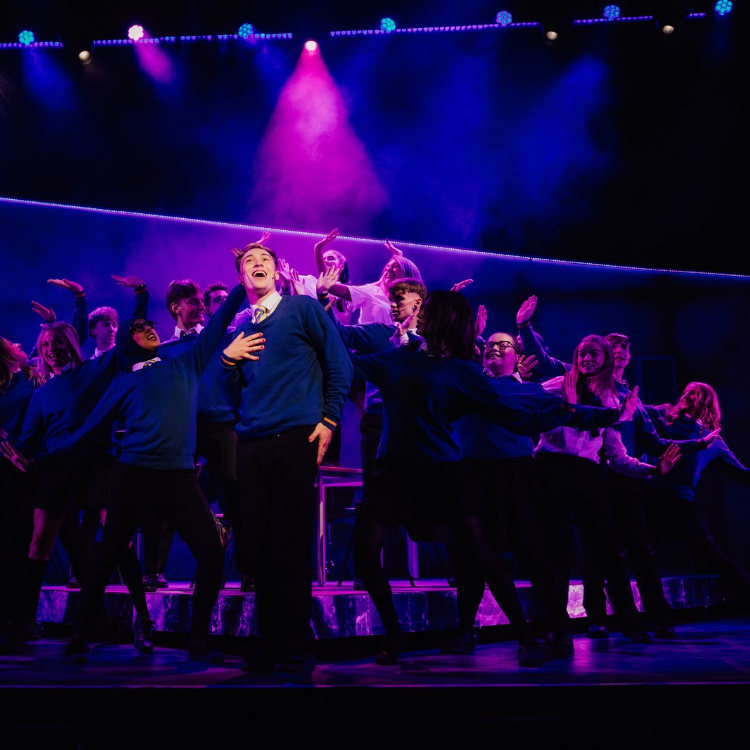
I was delighted to join York Stage for the opening night of its latest production, Everybody’s Talking About Jamie, at the Grand Opera House York. Under Nik Briggs’s direction, this wonderfully talented company brings local and professional performers together to create musical theatre to a superb standard.
Based on an idea by Jonathan Butterell, with book and lyrics by Tom MacRae, music by Dan Gillespie Sells, it is centred around a 16 year old schoolboy. Loosely based on the remarkable story Jamie Campbell and his mother Margaret, which hit the headlines after he wanted to go to prom in a dress.
Set in Sheffield, the story follows Jamie New (Frankie Bounds) and his classmates as they consider their future careers. Despite being teased for being gay, Jamie dismisses Miss Hedge (Katie Spencer), and the computer’s suggestion that he become a forklift driver and reveals his dream of becoming a drag queen. This creates even more ridicule, especially from Dean (Cain Branton), the school bully. He is supported throughout this turbulent journey by his best friend and aspiring doctor, Pritti (Roxanne Hall), his mum (Joanne Theaker), and close family friend Ray (Julie-Ann Smith). His dream begins to take shape when he meets Hugo and his drag alter ego, Loco Chanelle (Grant McIntyre). Through the challenges and triumphs that follow, Jamie discovers his authentic self and gains the confidence to embrace who he is.
Bounds grows confidently into the role of Jamie, embracing the character’s highs and lows with infectious enthusiasm. He shows off both Jamie’s confidence and vulnerability. He certainly rocks those vibrant crimson red stilettoes and sparkly eyelashes. Theaker gives a heart-wrenching performance as a mother who is barely making ends meet, yet supports her son in any way she can. Her rendition of He’s My Boy is stunningly powerful, I had goosebumps just listening to her. Smith, as Ray, delivers the sharpest one-liners, making her the kind of friend everyone would love to have. McIntyre is outstanding, I loved his portrayal of Hugo, giving Right Said Fred vibes during the finale, and as Loco Chanelle he looked utterly gorgeous. The other drag queens also deserve praise, particularly for letting it all hang out.
The three-part revolving set moves seamlessly between a classroom, garden, kitchen, Pritti’s bedroom and the Legs Eleven nightclub, to name just a few of the scenes. A live band, led by musical director Jessica Viner, adds real energy to the production. At times, however, the music is too loud, unfortunately drowning out some of the lyrics. AJ Powell’s choreography complements the score, while the energetic ensemble fully commits to every role and shines in group numbers, especially Everybody’s Talking About Jamie and The Prom Song.
Everybody’s Talking About Jamie will make you laugh, may bring a tear to your eye, as it celebrates individuality, inclusivity and acceptance. The enthusiastic, captivated audience was wonderful to see and hear. Once again, York Stage does not disappoint and has delivered another must-see production.
Tabard Theatre, Chiswick – until 7th November 2026
Reviewed by Phil Brown
5*****
The 80+ seat Tabard Theatre above the Tabard pub in a grade 2 listed structure around the corner from Turnham Green station, is something of a bijou pleasure dome. So intimate, the “fourth wall” doesn’t really exist, making for a particularly engaging and rewarding audience experience.
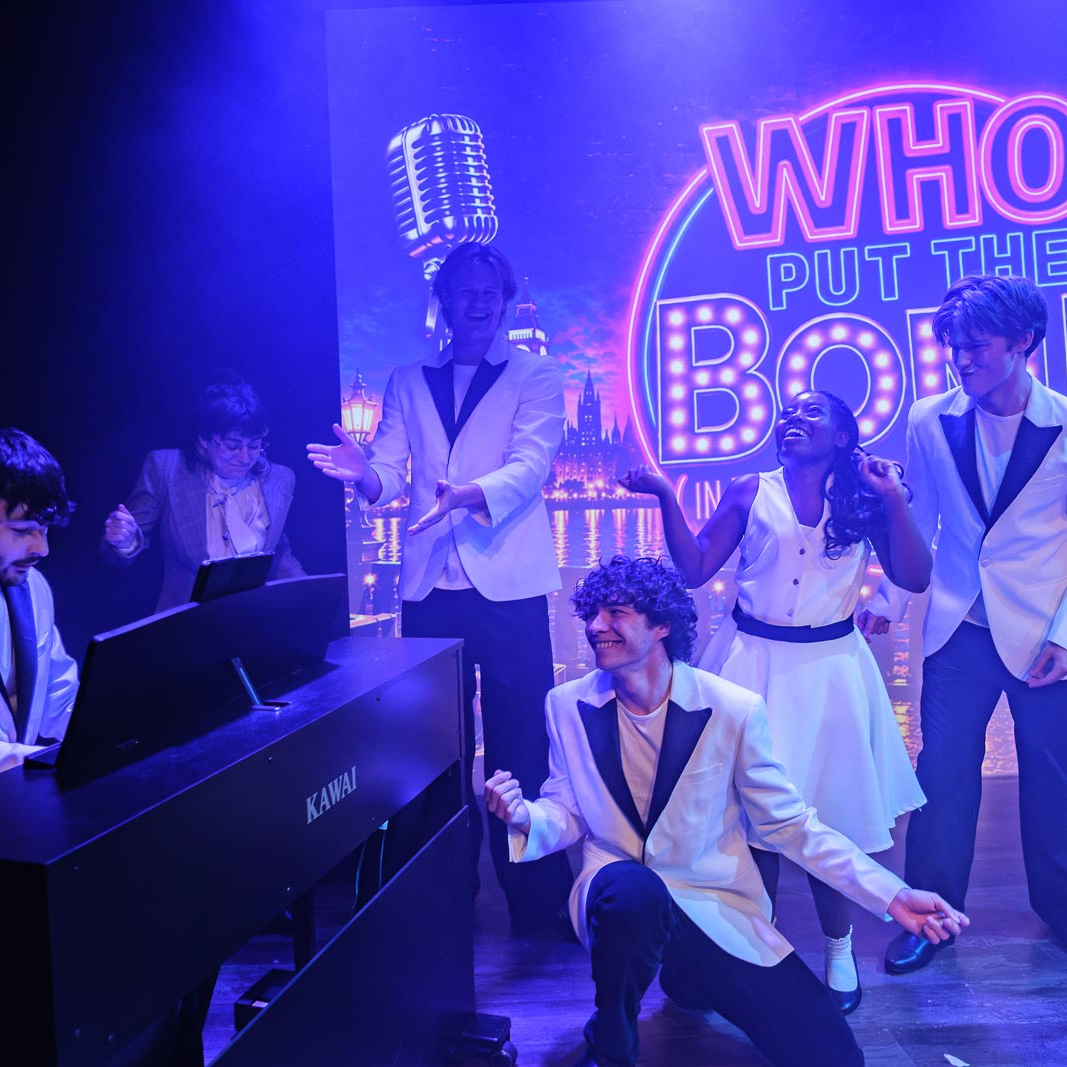
Who Put the Bomp is a show in two exhilarating one hour parts. I knew I would enjoy it, just from the title, but I didn’t expect to be completely bowled over by such an exuberant, accomplished and as far as I could tell, near perfect performance by a young cast, most of whom would have been born in the twenty first century – more than 50 years after the doo-wop genre became a thing. I really can’t remember enjoying a show so much in ages.
There is a freshness, a zing and an energy that fairly explodes off the stage, possibly because several of the cast are making their professional debuts and adrenaline and commitment are off the scale. Whilst being well rehearsed and superbly professional, there is a still a charming sense they can’t quite believe they’ve made it into a professional production and are having the best fun. To use a musical term – this is song (and dance) con brio – molto brio.
There are few musical genres more gloriously infectious than doo-wop. It was born in US urban neighbourhoods and post-war ghettos, rising to prominence in the 1950s and early 1960s, with mainly young Black teenagers—often lacking money for instruments—practicing a cappella vocal harmony on street corners, in school gyms, and at subway entrances. Key ingredients are harmonisation, nonsense lyrics (eg shboom, ram a lam a ding dong etc), and no or minimal instrumentation. It fundamentally shaped popular music.
Writer and director Keith Strachan, whose previous musical successes include Dreamboats and Petticoats, and many associated record releases, clearly loves the music of the 1950s and 60s. Rather than simply recreating a bygone era, his well written and structured production imagines a group of contemporary teenagers discovering doo-wop from their grandparents’ record collections, digging it, and having some fun recreating those swooning harmonies themselves. Meanwhile, with progress posted on TikTok (other apps are available), they become unlikely stars in the world of social media earning a shock invitation to perform at the Brits!
It may seem a touch unlikely, but it’s a plausible enough story that acts as a neat framework for the songs whilst covering themes of group dynamics and relationships, sexuality, responsibility, rehabilitation and social media. It moves at pace, the dialogue feels authentic, the acting nicely nuanced and there is no shortage of laughs.
There is a briefly awkward start where Billy Johnson (played by Billy Michael), a shy young man whose grandfather loved doo-wop, is playing it through his phone when cornered into revealing his hidden passion by secret admirer Summer Brown (Joy Silweya). She teases him relentlessly but wants into the band Billy has in mind to form with choir soloist and school mate Cole Williams (Joshua Webster). Cole duly rocks up, validates Billy through his own familiarity with the genre, and they break into a nicely arranged classic, Why Do Fools Fall in Love (Frankie Lymon & the Teenagers) unaccompanied. The show is now off and running.
Next to appear is the physically imposing, slightly cocky Danny Phillips (Aidan Spicer) who immediately tries to elect himself leader of the band. Having enlisted the help of formidable school music teacher/choir convenor Miss McTavish (Marissa Landy) in exchange for choir attendance, Billy recruits wonderful bassman Jack B Smith (Finn Williams) who puts Danny firmly in his place and the group named the Doo-Woppers is complete and ready to rock. In a reminder that we are actually in 2026, they are never without their mobile phones and naturally share song suggestions and details using group chat. Summer is the unofficial content creator which does create some friction with Billy.
In a small space like the Tabard, there is no need for amplification although I thought I detected some echo at the start. The sound is pure harmony singing with Summer on soprano voice, Billy and Danny on tenor, Cole on baritone plus Jack on basso profondo accompanied most of the time by Miss McTavish on piano. I have to commend Strachan on the casting for this show. He has assembled a team oozing talent. The complementary personalities and voices work so well and the ensemble really does function like a well oiled team.
As Miss McTavish points out early on, a doo-wop performance has to cover rhythm as well as harmony, and the ensemble performs an extensive catalogue of sophisticated arrangements to perfection. These vocal performances are truly wonderful throughout the evening, across 29 or 30 first rate songs. I particularly enjoyed It’s Only Make Believe (Conway Twitty), Be My Baby (Ronettes), Blue Moon (Marcels), My Prayer (Platters), and Crying (Roy Orbison).
Strachan or possibly Anne-Marie Lewis Thomas (Musical Supervisor) has exercised some artistic licence in stretching what is usually classed as doo-wop to include material that owes a debt to the genre but is probably seen more as straight ahead pop music – songs such as Be My Baby, Poetry in Motion (Johnny Tillotson), Shout (Isley Brothers), Going to the Chapel (Dixie Cups), Let it Be Me (Everlys) and Crying. If anything it adds to the story and enjoyment, making for an evening rich in nostalgia. The folk behind me couldn’t help but sing along.
Lighting (Callum Bruce) is spot on and costumes (Faith Powlett) are very fitting (boom boom). The stage set is essentially done by projecting well rendered scenes onto the back wall which is not only incredibly effective (Charlie Stace) but maximises the performance area for some fabulous choreography (Carole Todd) which gets more elaborate as the group develops.
This is a versatile group of performers. At one point, Cole (Joshua Webster also acting as Dance Captain) did an impressively gymnastic solo combining break dancing and back flip and Marissa Landy as Miss McTavish performs a nice tap dance solo in the finale. Finn Williams as Jack also springs a surprise in the second half of the show by taking over some of the piano duties
Congratulations to the outrageously talented cast and company of Who Put the Bomp for a sumptuous performance which deserves to be a huge hit. Feel-good is overused as a sound bite to describe entertainment, but this is the real deal. Trust me on this. Whether or not you love doo-wop, I guarantee you will love this show.
Sheffield Crucible – until Saturday 31st October 2026
Reviewed by Claire Moore
5*****
Following their recent production of King Lear, Sheffield Theatres’ Shakespearean company returns to the Crucible, but this time with something a little more light-hearted.
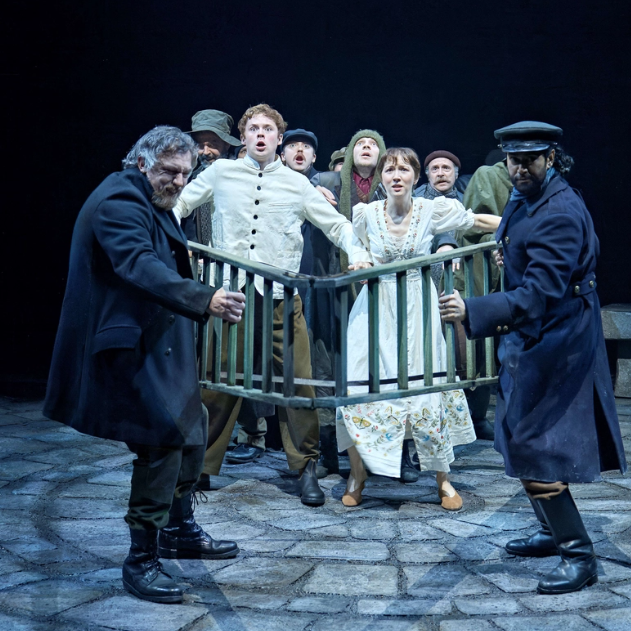
Twelfth Night is one of Shakespeare’s best-known comedies, full of mistaken identities, practical jokes, romance and plenty of confusion. When Viola (Bebe Sanders) is shipwrecked and separated from her twin brother Sebastian (Harry Redding) she disguises herself as a man and takes a job working for Duke Orsino (Fode Simbo). But when she falls for the Duke, who is himself in love with Olivia (Justina Kehinde), things soon become rather complicated!
Following Ian McDiarmid’s appearance in King Lear, another familiar face joins the company, with Mathew Horne, best known for Gavin and Stacey, taking on the role of Malvolio. A rather serious, self-important character, Malvolio finds himself on the receiving end of a particularly cruel practical joke. Horne takes us from laughing at him to genuinely feeling sorry for him as the joke goes further than anyone expected.
Shakespeare once again feels right at home in the round at the Crucible. The set is simple, with just three movable benches and the occasional prop, but that’s all it needs. The direction makes full use of the space, with the cast coming and going through the various entrances and exits, keeping the action moving at a good pace. At times, it feels as though there are far more people on stage than there actually are.
It’s great to see so many of the actors from King Lear taking on completely different roles. Katie Wimpenny is a perfect example, going from the cold-hearted Goneril to the mischievous Maria. She’s full of energy, clearly enjoying every moment of Maria’s scheming and bringing plenty of laughs along the way.
The whole cast is superb, but Milo Twomey and James Chetwood as Sir Toby Belch and Sir Andrew Aguecheek are particularly entertaining. They’re a hilarious pairing, with excellent comic timing and some wonderful mannerisms, especially from Sir Andrew. Their scenes together provide some of the biggest laughs of the evening.
Another lovely touch is having the musicians on stage. The music adds so much to the show, captivating the singing voice of David Birrell as Feste.
The lighting is equally impressive, especially during the prison scene, where it completely changes the atmosphere. It shows just how much can be achieved without an elaborate set. The more contemporary costumes also fit perfectly, giving the production a modern feel without taking anything away from Shakespeare’s story.
I’m no Shakespeare expert, and I’ll be honest, there are times when the language still leaves me completely baffled! But that’s what makes this production so good. The characters, the performances and the way the story is told mean that even when you don’t understand every word, you still know exactly what’s going on and can enjoy every minute of it.
My five stars aren’t just for a fantastic production of Twelfth Night. They’re also for making Shakespeare accessible, entertaining and enjoyable for everyone. So even if you’re not a Shakespeare fan, don’t dismiss this one — you’ll be missing a real treat.
Cambridge Arts Theatre – until Saturday 17 October 2026
Reviewed by Steph Lott
5*****
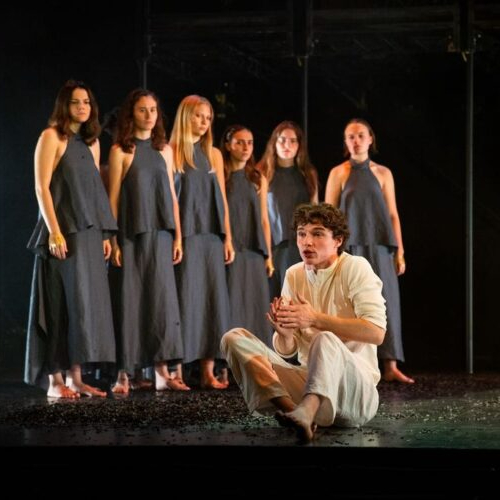
The Cambridge Greek Play is something of a survivor. Since 1882, when undergraduates first staged Sophocles’ Ajax in the original Greek, the university has kept returning to the ancient stage, settling into a three-yearly rhythm that has outlasted two world wars and many changes in how the classics are taught. Over the years it has drawn on remarkable talent: Vaughan Williams wrote his still-popular overture for the 1909 Wasps, and the tradition of commissioning new music continues this year with a score by Richard Causton. There is a pleasing symmetry in this year’s choice, too. Ion was last performed here in 1890, so Rosalind Parker’s production is a return to one of the tradition’s earliest chapters and a rare chance to see a play that seldom reaches the stage in any language.
Anyone wary of an evening in Ancient Greek need not be. I loved simply listening to the language, its rhythms and textures, while the subtitles were clear, well-timed and never distracting. What impressed me most was how the young cast handled the challenge. Delivering every line in a language no one has spoken for two thousand years could easily sound stilted or recited. Instead, the dialogue was fluent and natural, spoken as if the actors had been arguing in Greek all their lives.
Causton’s score, under the musical direction of Elliot Park, was a real pleasure. The choice of instruments and the way the music supported the atmosphere did much to conjure the setting of Apollo’s temple at Delphi, shifting with the play’s changes of mood without ever overwhelming the words.
Among the cast, Dylan Hughes was particularly impressive as Ion, the foundling raised in the god’s service and now on the edge of adulthood. Iris Tadie gave a delicate, nuanced performance as Creusa, a woman carrying the long-buried trauma of Apollo’s assault and the loss of her child. It is a demanding role, and she never tipped it into melodrama. The chorus was outstanding. They moved and spoke with striking unity and their presence on stage was genuinely unsettling, a reminder of how powerful the Greek chorus can be when it is fully realised rather than treated as a convention. And when Daphne Stavride appeared as Athena, she was truly goddess-like; her entrance was one of the evening’s most memorable moments.
Ion is often described as a play with a “happy ending”, and in one sense it is: no one dies. Yet the reconciliation it offers is far from comfortable, and Creusa is given no real resolution for what she has suffered. The production’s decision to close with the fourteenth Homeric Hymn, To the Mother of the Gods, felt fitting on several counts. As a call to the divine feminine, it was a lovely resonance with a play so centred on motherhood. It acknowledged Creusa’s lack of closure rather than papering over it. And it eased the audience gently out of the world of Ancient Greece and back into our own.
This was a thoughtful, beautifully performed production that does credit to a tradition now almost 150 years old. If the Greek Play continues to be staged with this much skill and imagination, its future looks as secure as its past is distinguished.
STORYHOUSE THEATRE, CHESTER – UNTIL 17TH OCTOBER 2026
REVIEWED BY MIA BOWEN
5*****
Last night, I had the great pleasure of watching Blood Brothers on press night, and what a night it was! The theatre was packed, with row after row filled with students studying for their courses, alongside an audience who clearly knew exactly what they had come to see. This was my second time seeing Willy Russell’s iconic musical, and as I took my seat, I could hear people around me telling each other how many times they had seen it. Seventeen times was the record I heard! That says everything about just how loved Blood Brothers is here in the North West.
And it’s easy to understand why. People know the lines off by heart, yet the story still has the power to make an audience laugh, wince and ultimately break their hearts.
Set in 1960s Liverpool, Blood Brothers follows Mrs Johnstone, played brilliantly by Vivienne Carlyle, a mother struggling to raise her growing family. When circumstances lead her to make an extraordinary decision concerning one of her newborn sons, the twins grow up in very different worlds, unaware of the connection between them. Sean Jones’ Mickey and Joe Sleight’s Eddie grow up on opposite sides of the social divide, while Beth Danher’s Linda becomes an important part of their shared childhood and, later, their lives. Meanwhile, Tricia Adele Turner’s Mrs Lyons finds herself increasingly consumed by the consequences of the decision she has made. Michael Gillette’s Sammy brings another layer to Mickey’s journey as the brothers grow older.
What follows is a powerful exploration of nature versus nurture, social class, friendship, love, jealousy and fate. It’s a story that gradually tightens its emotional grip, showing how two children raised in completely different circumstances can still be connected by an unbreakable bond.
Sean Jones, Beth Danher and Tricia Adele Turner were particular standouts for me. Sean Jones and Joe Sleight portraying Mickey and Eddie at seven years old, nearly eight, were fantastic — capturing the innocence, mischief and unmistakable bond of childhood beautifully.
And then there is the music. It doesn’t simply accompany the story; it tells it. Marilyn Monroe, Easy Terms and Tell Me It’s Not True had me reaching for the tissues. The music carries so much of the emotion, making the story’s quieter moments just as powerful as its biggest scenes.
The set deserves a special mention too, creating a wonderful backdrop to this very Liverpool story, with the Liver Building proudly standing in the background.
And that ending… Even when you’ve seen Blood Brothers before, and you know that gunshot is coming, somehow, it still catches you out. You find yourself holding your breath, hoping that perhaps this time it will be different — even though you know it won’t.
As the Narrator delivered that final line, some of the audience were already on their feet, applauding, and a standing ovation quickly followed. As people began making their way out, I could hear members of the audience crying. That, to me, says everything.
Funny, powerful, beautifully performed and utterly heartbreaking, Blood Brothers remains a true North West favourite for very good reason. A timeless piece of musical theatre that still packs one hell of an emotional punch.
Sheffield Lyceum – until Saturday 17th October 2026
Reviewed by Claire Moore
4****
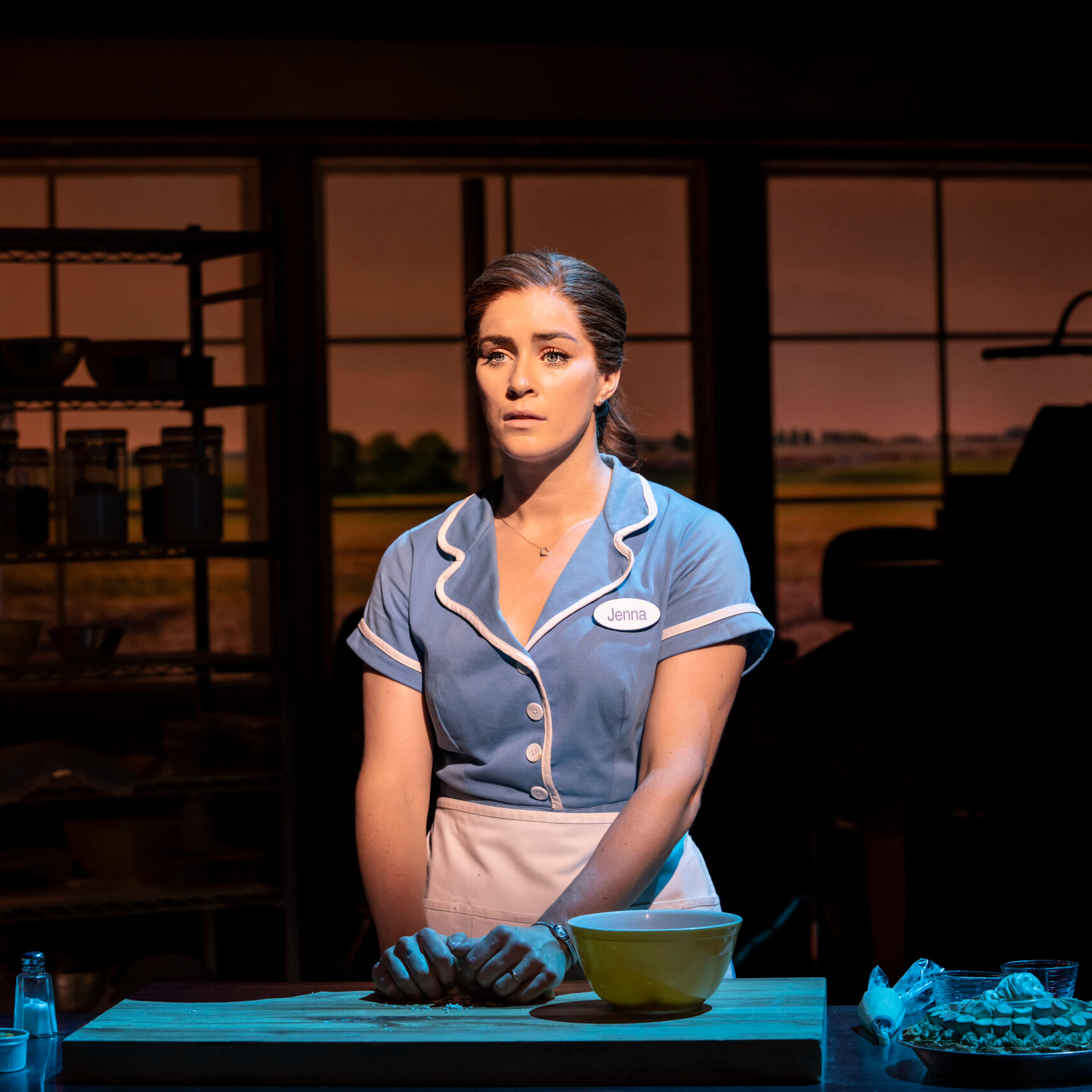
Waitress arrives in Sheffield with West End star Lucie Jones returning to the role of Jenna, alongside Les Dennis as Old Joe.
Set in a small American town, the musical tells the story of Jenna, a talented pie-maker working in a local diner who dreams of a happier life. Stuck in an unhappy marriage, she finds comfort in baking and the friendship of her fellow waitresses, Becky (Bernadette Bangura) and Dawn (Evie Hoskins). But when an unexpected pregnancy and a handsome new doctor (Dan Partridge) turn her world upside down, Jenna is forced to think about what she really wants from life.
Based on the 2007 film written and directed by Adrienne Shelly, Waitress features music and lyrics by Grammy Award-winning Sara Bareilles and a book by Jessie Nelson. It combines humour, friendship and romance with some much more serious themes, exploring what it takes to find the courage to change your life.
Jenna puts on a brave face each day, telling the world she’s ‘happy enough’, but her daydreams tell a different story. With a change in lighting, and soft music the real world fades and we’re taken into Jenna’s imagination as she dreams up new pie recipes. It’s a lovely way of showing us what’s going on in her head and giving her a brief escape from the reality of her life.
Although the show deals with some tough real-life situations, there’s plenty of humour to lighten the mood. In particular, the developing relationship between Dawn and Ogie (Mark Anderson), who are both a little awkward but soon discover just how much they have in common. Including a shared love of American Revolution reenactments — trust me, it’s much funnier than it sounds!
Lucie Jones is fabulous as Jenna. Her voice is outstanding, but it’s also the way she portrays Jenna’s emotions that makes her performance so believable. You really find yourself rooting for her. The friendship between Jenna, Dawn and Becky is another highlight, with the three women supporting each other through whatever life throws at them. There’s a lovely message about female friendship and the importance of having people in your corner.
The choreography is very cleverly done, particularly the way props are passed between characters as scenes unfold. Plates, ingredients, bowls move seamlessly from one person to another, turning even the simplest movements into part of the performance. It keeps everything flowing and adds a real sense of energy to the diner scenes.
It was also great to see the live band on stage. With the limited space at Sheffield’s Lyceum, this can’t have been easy to achieve, but having the piano as part of the diner and musicians joining the action works really well.
The set moves smoothly between the diner, the doctor’s surgery and Jenna’s home. The contrast between the bright, colourful diner and the bleakness of her home is particularly effective, showing just how much happier Jenna is at work baking pies than she is in her own house.
But will life improve for Jenna? No spoilers for those who haven’t seen it, but it’s fair to say you’ll leave the theatre feeling a little more joyful, perhaps a little more grateful for the friends and family in your life — and probably wanting some pie.
Nottingham Theatre Royal – until Saturday 17th October 2026
Reviewed by Louise Ford
5*****
Lots of things are mysteries.
Last night’s production of The Curious Incident of the Dog in the Night-time was a Gentle Performance. This meant that the lights would be turned down but not turned off, and any frightening or worrying scenes would be signposted by a low rumbling sound. This announcement was made by Chris’s teacher, Siobhan (Bridgette Amofah), it seemed to resonate with the audience who were predominantly young. The book is a GCSE set text, which is studied as a stage play, adapted by Simon Stephens. It was lovely to go to a production with a young and lively audience. There was a real buzz and energy in the theatre. They were all so engaged with the production.
The original book by Mark Haddon was published in 2003 and at the time was groundbreaking in that the story is told from the perspective of Chris Boone, a 15 year old who is neurodivergent. It takes its title from a line in Sherlock Holmes’s The Adventure of Silver Blaze. The master detective is one of Chris’s heroes. The book was adapted in 2013 for the stage to international acclaim, winning several Olivier Awards and a Tony when it transferred to Broadway. The current adaptation is by Simon Stephens and is directed by Ned Bennett for Birmingham Rep.
The story is, on one level, a murder mystery (just who did kill the eponymous dog?) with Chris as the detective aiming to solve the mystery. On another level, it is a study of a family in crisis and, finally, and perhaps its USP, it is told from the perspective of a neurodivergent adolescent who is struggling to make sense of the world.
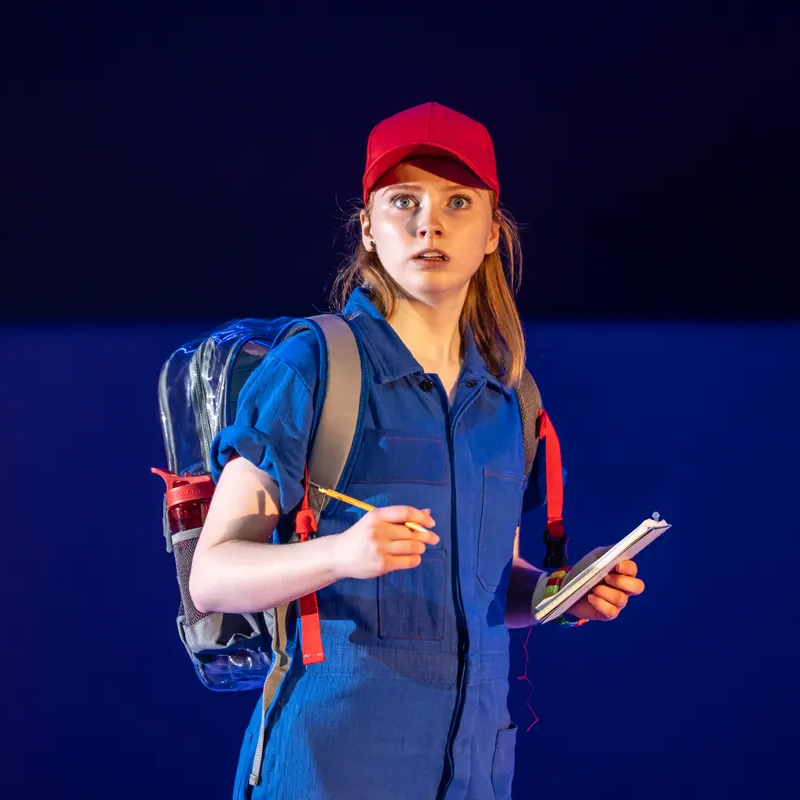
In this production, the role of Chris has been rejigged so that Chris is a teenage girl. The part was played by Alex Keenan (alternating with Imi Price), both of whom are neurodivergent. In last night’s performance, it was Alex who was on the stage for the whole evening. She was amazing. She was able to draw us into her world and show us how absurd and confusing the “normal“ world is. From not only how adults behave, to the language that we use, to the overwhelming signage and noise, once we leave our home.
The sense of chaos and confusion is contrasted with the order and safety of home. However, even everyday objects, when projected onto the screen, make them seem threatening and strange. The video backdrop is by Hayley Egen. The largely bare staging is by Eleanor Bull. At times, the stage is crowded with people and props and at others, it is a simple row of cartoon houses. The scenes in the underground are particularly effective. The chaos and confusion are further enhanced, and add a surreal element, by bouncing yellow balls and tumblers doing cartwheels.
Siobhan is Chris’s trusted adult and helps her (and us) to navigate the world. Siobhan appears to have endless patience and understanding. Whereas Chris’s parents (played by Joe McFadden (Ed) and Charlie Brooks (Judy)) have their own issues to navigate. Family life is messy and chaotic. The parents make mistakes, and their actions show that they cannot always deal with their own lives. Chris’s lawn-mowing neighbour is Mrs Alexander (Alex Murdoch), she is kind and provides valuable details about the neighbourhood.
The production is a refreshing look at a much-loved story. It uses a lot of different theatrical devices (lighting, sound, visual) to highlight the chaos of modern life through a neurodivergent lens. From the start, we are invested in Chris and her courage to travel through an unpredictable world and to solve the mystery. We are also delighted that she succeeds with her exams, and whilst she may not become an astronaut, she’ll certainly have a brilliant career as a scientist.
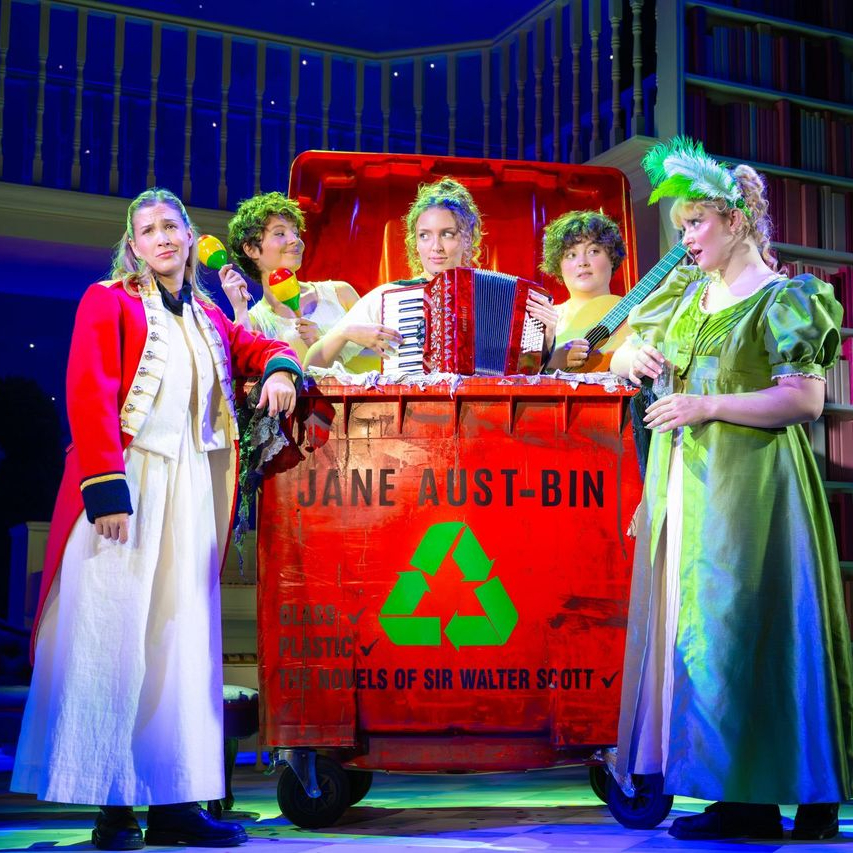
Of all Jane Austen’s messages, themes and persuasions, the importance of eating your greens, or your bum falling off, is certainly one of the more memorable takeaways. I’m not sure it made it into the original novel, but thanks to Director Isobel McArthur, it’s certainly going to stay with me.
If you want to sit in front of a stage wondering just how many levels of crazy a production can reach, then Pride & Prejudice* (*Sort Of) is the show for you. Beautifully bonkers, gloriously irreverent and utterly hilarious, this is Austen with the volume turned up to eleven.
Five female actors own every inch of the stage with all the grace of a bull in a China shop, and I mean that as the highest possible compliment. The uncouth language is gloriously filthy, outrageously funny and utterly on point and a delivered like a Northern Express train pulling into Downton Abbey. Nothing is sacred, everything is fair game, and the comedy comes thick and fast.
The acting is superb, and the vocals are outstanding. The singing is delivered with such confidence, power and comic precision that it becomes one of the production’s many unexpected delights. Watching five women transform themselves into an entire cast of characters, with costume changes that deserve a standing ovation of their own, is a sight to behold. Particular praise must go to Julia Murray, whose performance as both Mr Darcy and Mrs Bennet is nothing short of exceptional. The versatility required to bring two such wildly different characters to life, often within moments of each other, is extraordinary. She delivers Darcy with all the brooding intensity audiences hope for, while her Mrs Bennet is a masterclass in comic chaos. If Mrs Hannigan is not already on her list of character performances, then it absolutely should be.
The costumes are as colourful as Quality Street, the energy is relentless, and the seamless transformations are a credit to Costume supervisor Morag Pirrie and Wardrobe Master Rod Bicknell. The sheer pace and precision required to pull this off are extraordinary.
And then there is Mr Bennett. His presence behind the chesterfield is ironically beautiful. The only male character not played by a woman, he is rendered almost entirely irrelevant to the Bennett household: there is no actor at all, just a newspaper stuck to a chesterfield. Bravo to that chesterfield. It gives a performance of remarkable stillness, commitment and understated comic timing.
And this production has absolutely everything: humour, dancing, singing, shiny disco balls and, surprisingly, some genuinely heartfelt emotion. Amid all the glorious nonsense, lovers align, hearts are won and Darcy eventually gets his bride. Although, let’s be honest, Elizabeth would propose to him, because she is the girl boss!
If you arrive expecting a traditional Austen masterpiece, prepare for a surprise. But beneath the outrageous comedy, there are plenty of affectionate nods to the original.
And if you’ve never read the novel or watched the film, I can absolutely promise you that there were no birds sponsored by Vileda, no Pringles and certainly no Chris de Burgh in the original. At least, not in the editions I’ve read.
You may leave questioning everything you thought you knew about Jane Austen, your relationship with vegetables and whether you’ll ever look at a Quality Street tin in quite the same way again.
To quote Mrs Bennett, not only would Baby Jesus be turning in his grave, but I’ve no doubt Jane Austen herself might have had a little shuffle, too.
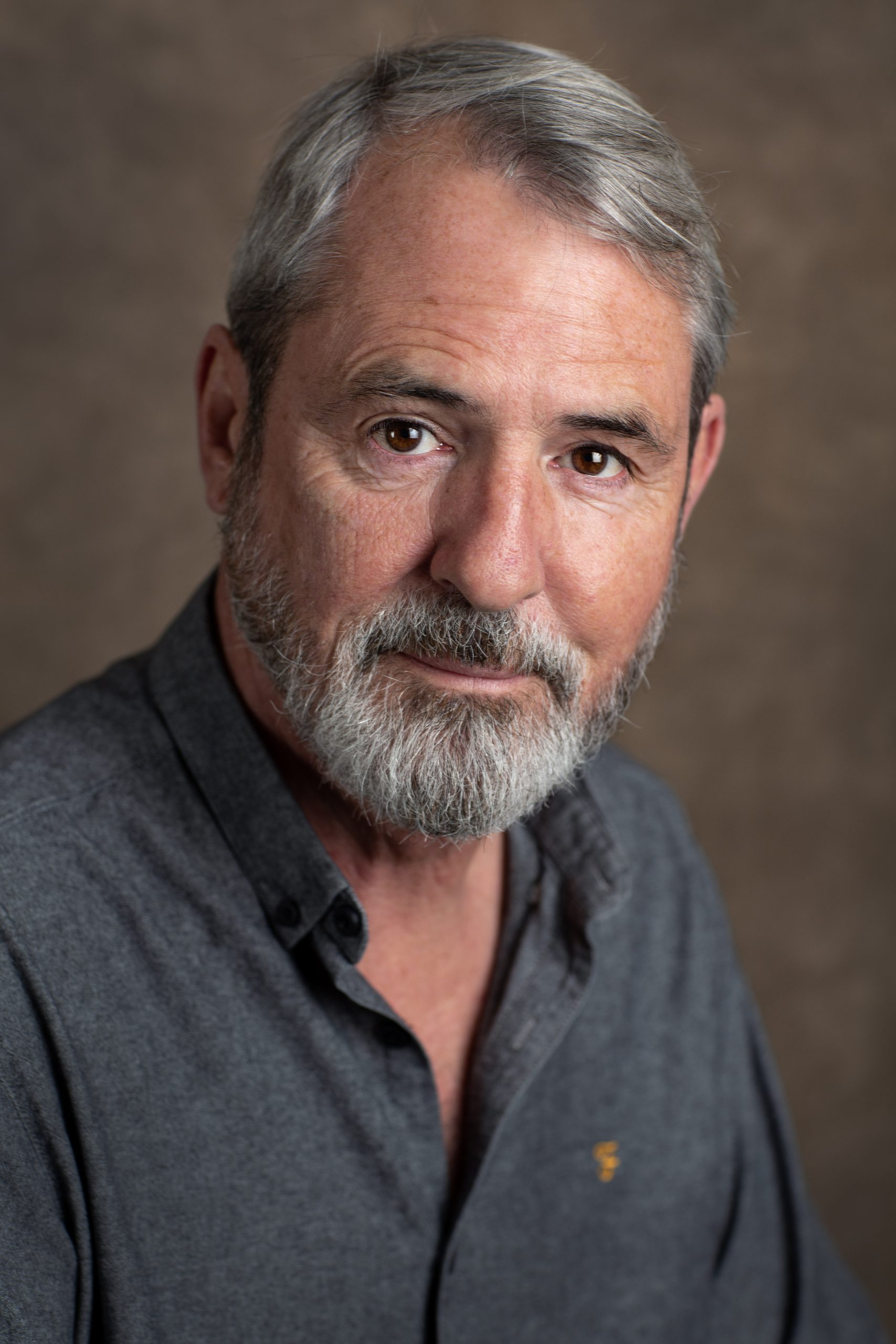
The Menier Chocolate Factory today announces that Neil Morrissey will join the previously announced Ria Jones and Sally Ann Triplett in the critically acclaimed production of Fourteen Again which ran at The Victoria Wood Theatre in Bowness-on-Windermere this spring. Jonathan O’Boyle’s production opens at the Menier on Wednesday 2 December, with previews from Saturday 21 November, and runs until Saturday 27 February 2027. Morrissey worked with Wood on the original West End run of Acorn Antiques: The Musical!.
The Victoria Wood Theatre, previously The Old Laundry Theatre, was renamed this year – the 10th anniversary of Wood’s death, by her close friends and collaborators, the husband-and-wife team, producer Charlotte Scott and designer Roger Glossop. To celebrate Wood’s life and work they commissioned Tom MacRae (Everybody’s Talking About Jamie) to work with her songbook to create a brand-new musical, the inaugural production in the newly renamed venue.
Wood originally opened the venue, was a Trustee, and performed there many times. She also directed her own show Talent – which was co-produced with the Menier; and in 2013, her television film Housewife 49 was adapted for the stage especially for the venue.
Fourteen Again begins at the local Slimming Club, where Peggy is reunited with Lou, her best friend from school who she hasn’t seen since they were teenagers. As kids, no two friends were ever funnier or more fun, but here, now, today they are shadows of their younger selves – and a story unfolds of looking back to the future, full of comedy, love and pain, with Victoria Wood’s amazing songs moving the musical fast forward.
Music and Lyrics by Victoria Wood Book and Additional Lyrics by Tom MacRae
Cast: Ria Jones, Neil Morrissey, and Sally Ann Triplett,with understudies Jayne Ashley, Matt Gillett
Director: Jonathan O’Boyle; Musical Supervisor, Arranger & Co-Orchestrator: Nigel Lilley;
Choreographer: Sammy Murray; Set Designer: Roger Glossop; Costume Designer: Caroline Hughes; Lighting Designer: Jason Taylor; Sound Designer: Sam Glossop; Video Designer: Leo Flint; Musical Director & Co-Orchestrator: Archie McMorran; Assistant Director & Choreographer: Matt Gillett; Associate Set Designer: Caroline Dalton; Associate Sound Designer: Harry Greatorex
21 November 2026 – 27 February 2027
Ria Jones returns to the Menier to play Lou – she previously appeared at the Menier in Habeas Corpus. Her other theatre credits include Sunset Boulevard (London Coliseum/Leicester Curve/ European tour), Gypsy (Royal Exchange Theatre), Guys and Dolls (Marigny Theatre, Paris), 42nd Street (Curve/Théâtre du Châtelet, Paris), Les Misérables (Palace Theatre/UK tour), Chess (Prince Edward Theatre), Cats (New London Theatre), Evita (Opera House, Manchester), Nine (Donmar), High Society (Shaftesbury Theatre/UK tour), Joseph and the Amazing Technicolor Dreamcoat (UK tour/Hammersmith Apollo), Anything Goes, The Witches of Eastwick, Acorn Antiques (UK tours), Into The Woods (Esplanade Theatre, Singapore), Romance Romance; Victor Victoria (Bridewell Theatre), Personals (New End Theatre), A Twist of Fate (Jubilee Theatre, Singapore), Honk! (Victoria Theatre, Singapore), Jerry’s Girls (St James’s Theatre/ Jermyn Street Theatre), Closer Than Ever (Landor Theatre) and A Little Night Music (Haymarket Theatre, Leicester). Her television credits include Eric and Ernie, Torchwood, The Angina Monologues and Life and Debt.
Neil Morrissey plays Duncan. His theatre credits include A Christmas Carol (Alexandra Palace); The Crown Jewels (Garrick Theatre); Acorn Antiques: The Musical! (Theatre Royal, Haymarket); Guys and Dolls (Piccadilly Theatre); Oliver!, Rain Man, A Passionate Woman (UK tours); Relative Values (Harold Pinter Theatre); Neville’s Island (Duke of York’s Theatre); Aladdin, Cinderella (Assembly Rooms, Derby). Television credits include Men Behaving Badly (as series regular Tony), Boon (as series regular Rocky), Striking Out (as series regular Vincent Pike, QC), The Good Karma Hospital (as series regular Greg McConnell), Waterloo Road (as series regular Eddie Lawson), The Long Call, The Syndicate, Penance, Line Of Duty, The Trial of Christine Keeler, Unforgotten, Striking Out, Grantchester, Me & Mrs Jones, Carrie and Barry, Murder in Mind and Paradise Heights; and for film, Up ‘n’ Under, The Bounty, Crucible of the Vampire and Clubbed.
Sally Ann Triplett returns to the Menier to play Peggy – she previously appeared at the Menier in Take Flight. Her other theatre credits include Top Hat (Chichester Festival Theatre/Royal Festival Hall), Cabaret (KitKat Club), The Witches (National Theatre), Oklahoma! (Wyndham’s Theatre), Cabaret (Lido 2, Paris), Billy Elliot (Leicester Curve), Taboo (London Palladium), Gypsy (Alexandra Palace), Piaf (Nottingham Playhouse/Leeds Playhouse), Anything Goes (National Theatre/Theatre Royal Drury Lane; WhatsOnStage Award), Guys and Dolls (Piccadilly Theatre), Chicago (Adelphi Theatre), Acorn Antiques (Theatre Royal Haymarket), Mamma Mia! (Prince of Wales Theatre), Cats (New London Theatre), Grease (Dominion Theatre), Jolson (Victoria Palace Theatre/Toronto), Follies (Shaftesbury Theatre), Chess (Prince Edward Theatre), A Damsel in Distress (Chichester Festival Theatre), My Judy Garland Life (Nottingham Playhouse; UK Theatre Award nomination), Next toNormal (Drama Centre, Singapore), Carrie (RSC/Broadway), Much Ado About Nothing (Liverpool Playhouse), Absent Friends (Watford Palace), Becoming Nancy (Alliance, Atlanta), The Last Ship (Broadway/ Chicago), Finding Neverland (Broadway), Sweeney Todd (Barrow Street, Off-Broadway), Cradle Will Rock (Classic Stage Company, Off-Broadway), and Must (Theatre at St. Clement’s, Off-Broadway). Her television credits include Whitstable Pearl, and Down to Earth.
Victoria Wood won more Television BAFTAs than anyone in BAFTA history. She won awards for her stand-up, her drama and her light entertainment programmes. As a stand-up she toured for more than twenty years, and held the record at the Royal Albert Hall for fifteen consecutive sold out shows. In 2005 she wrote Acorn Antiques: The Musical! which had a sell-out run at the Theatre Royal Haymarket starring Julie Walters and Celia Imrie. The subsequent tour in 2006 was directed by Wood. In the same year she wrote the television drama Housewife 49 based on the Mass Observation Diary of Nella Last, which won two BAFTAs and an International Emmy nomination for Wood as Best Actress. Her three-part documentary Victoria’s Empire was shown the following year. In 2011 she wrote and directed the musical That Day We Sang for the Manchester International festival, which was about the famous 1929 recording of Nymphs and Shepherds by the Manchester Children’s Choir. She played the part of Eric Morcambe’s mother in Eric and Ernie, a BBC2 film about the early days of the double act, written by Peter Bowker from an idea by Wood. She also wrote and directed a short film, The Giddy Kipper, for the Little Crackers season on Sky One. Also in 2011, she was honoured with the Women in Film and Television Lifetime Achievement Award, won the Outstanding Contribution to Comedy at the Chortle Awards, was the first woman to receive the top prize from the Writers’ Guild Awards. Also that year at the Comedy Awards, she received the Best Female Television Comic Award for her performance in The Angina Monologues. Her other acting credits include The Borrowers and Case History. In 2012 her drama Loving Miss Hatto was broadcast on BBC1 over Christmas, and she also filmed a two-part documentary about the British love of tea for the channel. In 2014, she adapted and directed That Day We Sang starring Michael Ball and Imelda Staunton for the BBC. She was awarded a CBE in 2008.
Tom MacRae’s theatre credits include Everybody’s Talking About Jamie (Book and Lyrics: Sheffield Theatres/Apollo Theatre/UK tour/Los Angeles – three wins at 2018 WhatsOnStage Awards including Best New Musical, winner of Jack Tinker Award for Most Promising Newcomer at 2017 Critics’ Circle Theatre Awards, winner of Best Musical Theatre Bookwriting at Writers’ Guild Awards 2019, five nominations at 2018 Laurence Olivier Awards including Best New Musical) and Crash of the Elysium (Punchdrunk at the MIF). His television work includes The New Librarians, The Librarians, Fungus the Bogeyman, Threesome, Doctor Who, Bonekickers, Lewis, Marple – At Bertram’s Hotel, Mayo, No Angels, Money Can Buy You Love, School’s Out, As If, U Get Me and Mile High; and for film, Everybody’s Talking About Jamie (BAFTA, BIFA, London Critics Circle nominations).
Jonathan O’Boyle directs. His theatre credits include Million Dollar Quartet (Barn Theatre/Arts Theatre Marble Arch), Barnum (Watermill Theatre/UK tour), Picture You Dead, Calendar Girls: The Musical, Hair, Rain Man, This House (UK tours), Lucie Jones: Live in Concert (London Palladium), Death Comes to Pemberley (Mill at Sonning/UK tour), The Hunchback of Notre Dame (Prince Edward Theatre), Fame (NYMT), Austenland, The Singing Revolution (Savoy Theatre), White Christmas, Top Hat (Mill at Sonning), Pippin (Theatre Royal Drury Lane), Cruel Intentions: The 90s Musical (The Other Palace/UK tour), The Last Five Years (Southwark Playhouse/Garrick Theatre/China tour – Off West End Awards for Best Director of a Musical and Best Musical Production and WhatsOnStage Award nomination for Best Off-West End Production), Proud (Turbine Theatre), The Astonishing Times of Timothy Cratchit (Hope Mill Theatre), Aspects of Love, Pippin (Hope Mill Theatre/Southwark Playhouse), The View Upstairs (Soho Theatre), Peter Pan (Park Theatre), Rasheeda Speaking, bash (Trafalgar Studios), Dear Brutus (Southwark Playhouse), An American in Paris (Dominion Theatre), Fourplay (Theatre503), The Verb ‘To Love’, Made in Britain (Old Red Lion), The Surplus, All The Ways to Say Goodbye (Young Vic), The Monster Bride (Tristan Bates Theatre) and Last Online Today and Guinea Pigs (Sheffield Crucible New Writing Project). His opera work includes Manon (ROH).
LISTINGS INFORMATION
MENIER CHOCOLATE FACTORY
MIDNIGHT AT THE NEVER GET
Until 12 September
TRU
Until 14 November
FOURTEEN AGAIN
21 November – 27 February 2027
Box Office: 020 7378 1713 (£2.50 transaction fee per booking)
QUENTIN TARANTINO’S NEW SWASHBUCKLING STAGE COMEDY
THE POPINJAY CAVALIER
TO OPEN AT THE PHOENIX THEATRE IN LONDON’S WEST END
SACHA BARON COHEN TO STAR IN THE TITLE ROLE
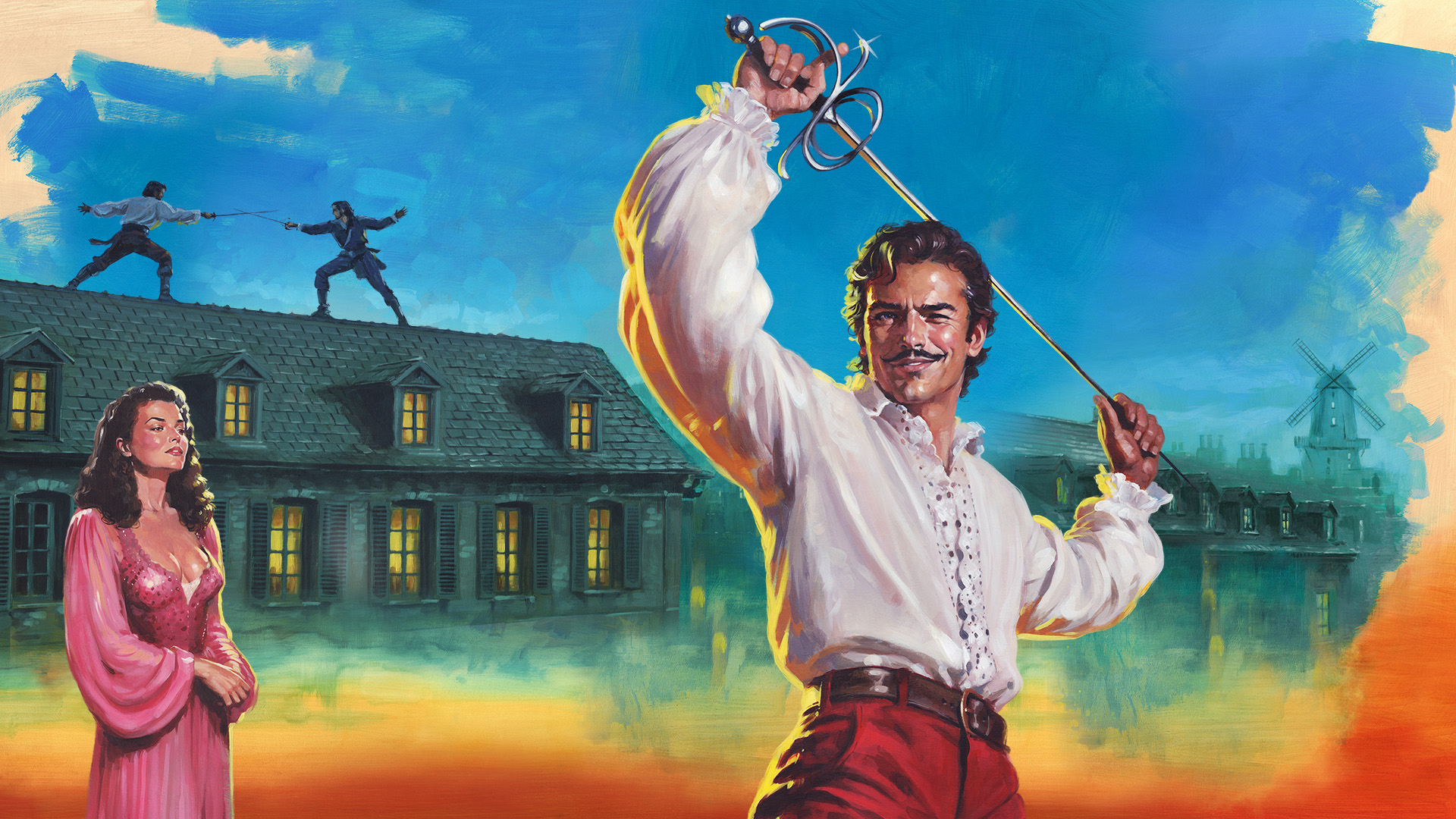
Sony Pictures Entertainment and Sonia Friedman Productions today announce that The Popinjay Cavalier, a new swashbuckling comedy written and directed by Quentin Tarantino – the first play written by Tarantino for the stage – will star Sacha Baron Cohen in the title role.
The production opens at the Phoenix Theatre in London’s West End on 18 March 2027, with previews from 23 February, and is booking until 13 June. Tickets are on sale from 9am (BST) to those who signed up for priority access, with public on sale from 12pm (BST) today. Tickets are from £25, with over 16,000 tickets under £50 across the run.
Quentin Tarantino said today, “I’m keen with anticipation to give the West End a great night out.”
Sacha Baron Cohen added, “Quentin called, I said yes before he even got to say his first ‘motherfxxxer’. When the best director in the world calls, you don’t ask questions, I am beyond delighted that we will be losing our West End virginity together, I have made him promise not to be gentle.”
Tom Rothman, Chairman and CEO of Sony Pictures Entertainment’s Motion Picture Group, and Sonia Friedman said today, “It is a joy and an honour to be developing this play with Quentin – and obviously quite an adventure. How lucky we are that one of the great storytellers of our time has chosen to make his theatrical debut.
“To see Quentin in action in a rehearsal room is extraordinary. His delight in working with actors, fencers, acrobats, musicians and our creative team is infectious, and there is such pleasure in hearing his delicious language come alive and discovering what his world can become on stage.
“And now we have Sacha Baron Cohen at the heart of it all: a fearless, brilliantly inventive actor with the wit, mischief and daring this role demands. We feel immensely fortunate to be producing this show. Audiences are in for a tremendous treat.”
Set in 1830s Europe, The Popinjay Cavalier is a rambunctious comedy of deception and disguise inspired by the grand swashbuckling epics of stage and screen.
A sweeping celebration of theatre and its heightened romance, told with Tarantino’s signature style and unmistakable wit, The Popinjay Cavalier is inspired by the classic swashbuckler genre of old Hollywood, including the writings of George Bruce, Ernst Vajda and Jesse Lasky Jr.
Also announced today is the creative team joining Tarantino – Scenic and Costume Design is by Tom Pye; with Lighting Design by Natasha Chivers; Sound Design by Ian Dickinson; the Fight Director is Philip d’Orleans; the Action Co-ordinator is Sam Lyon-Behan; Music is by Tim Phillips; Casting by Jim Carnahan, CSA; and the Associate Director is Jack Bradfield.
Full casting will be announced at a later date.
Quentin Tarantino is one of the most celebrated filmmakers of his generation. He made his directorial debut in 1992 with Reservoir Dogs, and then co-wrote, directed and starred in one of his most beloved films, Pulp Fiction, which won his first Oscar® for Best Screenplay. Following the highly acclaimed films Jackie Brown, Kill Bill Vol. 1 and Vol. 2, and Death Proof, Tarantino then released his World War II epic, Inglourious Basterds, Django Unchained (which wonhis second Oscar® for Best Screenplay), and TheHateful Eight. Tarantino’s most recent film, Once Upon a Time…in Hollywood, was nominated for five Golden Globes, ten BAFTAs, and ten Oscars®. Tarantino released his first novel, Once Upon a Time in Hollywood, in 2021 – it has been published in 31 languages and became an instant number one on The New York Times Best Seller Lists. In 2022 Tarantino published his highly acclaimed follow-up, Cinema Speculation which also debuted on The New York Times Best Seller List.
A three-time Academy Award-nominated actor and screenwriter, Sacha Baron Cohen is an iconic actor, comedian, screenwriter, producer, and director. Best known for his creation and portrayal of legendary characters Ali G, Borat Sagdiyev, Brüno Gehard, Admiral General Aladeen and Erran Morad, Baron Cohen has also acted in Adam McKay’s Talladega Nights, Tom Hooper’s Les Misérables, Tim Burton’s Sweeney Todd and Martin Scorsese’s Hugo. Baron Cohen starred in Alfonso Cuarón’s Apple TV+ series Disclaimer opposite Cate Blanchett. In 2026, he starred opposite Rosamund Pike in Netflix’s Ladies First, a No 1 film on Netflix worldwide, and appeared in Prime Video’s No 1 film Balls Up. In 2020, he wowed audiences and critics alike with his work in two timely films: Borat Subsequent Moviefilm: Delivery Of Prodigious Bribe To American Regime For Make Benefit Once Glorious Nation of Kazakhstan, for which he earned an Academy Award nomination for Best Adapted Screenplay and won two Golden Globe Awards, making Baron Cohen the first person in Golden Globes history to win two awards for the same film character after having previously won for his lead performance in the original Borat in 2007; and Aaron Sorkin’s The Trial of The Chicago 7, for which he received Academy Award, Golden Globe and SAG nominations for Best Supporting Actor for his portrayal of legendary activist Abbie Hoffman. Upcoming, Baron Cohen makes his feature directorial debut with Amazon MGM Studios’ Ali G: Who Iz I?, returning as his famed character Ali G. The film opens in cinemas worldwide on 23 October for an exclusive one-weekend run.